
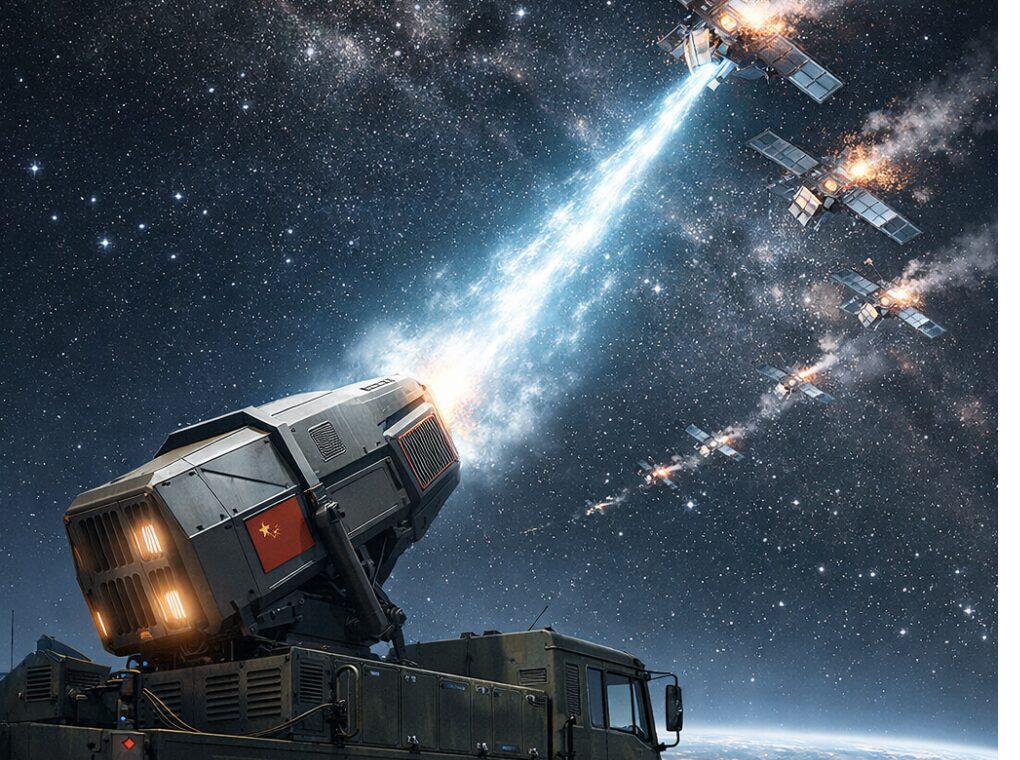
China is reportedly advancing a powerful new class of directed-energy weapons that analysts believe could be designed to counter Elon Musk’s Starlink satellite network. Described in Chinese scientific publications as a high-power microwave (HPM) system, the technology has sparked global attention for its potential role in future space warfare.
Some observers have dubbed it an “invisible hunter” — a system that could disrupt satellites without launching missiles, creating a new kind of battlefield far above Earth.
Why Starlink Is Seen as a Strategic Target
Starlink, operated by SpaceX, is the world’s largest satellite constellation in low Earth orbit (LEO). While primarily built to deliver global internet coverage, its real-world use in conflict zones has demonstrated major military value. Satellite internet terminals have proven capable of maintaining communications even when traditional infrastructure is damaged or destroyed.
Military planners worldwide now recognize that large satellite constellations can support communications, data transmission, reconnaissance links, and battlefield coordination. In any future conflict, such networks could play a decisive role.
Chinese defense analysts have repeatedly warned that satellite constellations could be used to support foreign military operations in sensitive regions. As a result, counter-space capabilities — especially non-kinetic ones — have become a major research priority.
The Reported Microwave Weapon
At the center of recent attention is a device Chinese researchers refer to as a compact high-power microwave driver. According to published claims, this system can generate extremely powerful bursts of electromagnetic energy, potentially in the gigawatt range.
High-power microwave weapons are designed to interfere with or overload electronic circuits. Instead of physically destroying a satellite, they aim to disable or damage onboard electronics, sensors, or communications systems.
The key advantage of such weapons is subtlety. Unlike anti-satellite missiles, microwave attacks would not produce explosions or large debris fields in orbit. A targeted satellite might simply stop working, making the cause difficult to detect or attribute.
This ambiguity makes directed-energy systems especially concerning from a strategic stability perspective.
A Shift Away from Anti-Satellite Missiles
Traditional anti-satellite weapons rely on kinetic impact — physically smashing into a target in orbit. While effective, these attacks create dangerous debris that can remain in space for years, threatening other spacecraft, including those of the attacking nation.
Directed-energy weapons such as microwaves or lasers are viewed by some military strategists as a “cleaner” alternative. They can disrupt or damage targets without generating large amounts of long-lasting space debris.
However, this also lowers the threshold for use. If an attack leaves no visible trace, it becomes harder to prove hostile intent. This uncertainty increases the risk of miscalculation and escalation between major powers.
Technical Hurdles Still Exist
Despite bold claims, many experts caution that turning laboratory systems into reliable operational weapons is a significant challenge.
Satellites in low Earth orbit travel at extremely high speeds, making precise targeting difficult. Microwave energy must pass through the atmosphere, where it can weaken or scatter. Maintaining accurate tracking and delivering sufficient power to affect hardened satellite electronics are all complex engineering problems.
Public information does not confirm whether the reported system can achieve the dramatic effects sometimes suggested in media reports. Still, the research signals a clear trend: major powers are investing heavily in ways to contest space infrastructure without relying solely on missiles.
The Growing Militarization of Space
This development reflects a broader shift in how space is viewed. Once considered primarily a domain for exploration and communication, space is now deeply tied to national security and military operations.
Modern armed forces rely heavily on satellites for navigation, communications, surveillance, and data transfer. Disrupting these systems could significantly weaken an opponent’s capabilities on the ground, at sea, and in the air.
As a result, space is becoming an increasingly contested environment. Nations are racing not only to deploy satellites but also to develop ways to protect their own systems and neutralize those of potential adversaries.
A Future of Invisible Conflict?
If high-power microwave and other directed-energy weapons mature, future space conflicts may look very different from what people imagine. Instead of dramatic explosions in orbit, battles could involve silent, invisible energy pulses that cause unexplained satellite failures.
Such scenarios create dangerous gray zones. A malfunction could be interpreted as a technical issue — or as an act of war. That uncertainty could complicate diplomatic responses and crisis management.
Whether or not China’s reported system is fully operational, its development underscores a critical reality: the struggle for control of space-based infrastructure is accelerating.
The next major breakthrough in warfare may not be a new missile or aircraft — but a beam of energy that no one can see, striking satellites hundreds of kilometers above the Earth.