
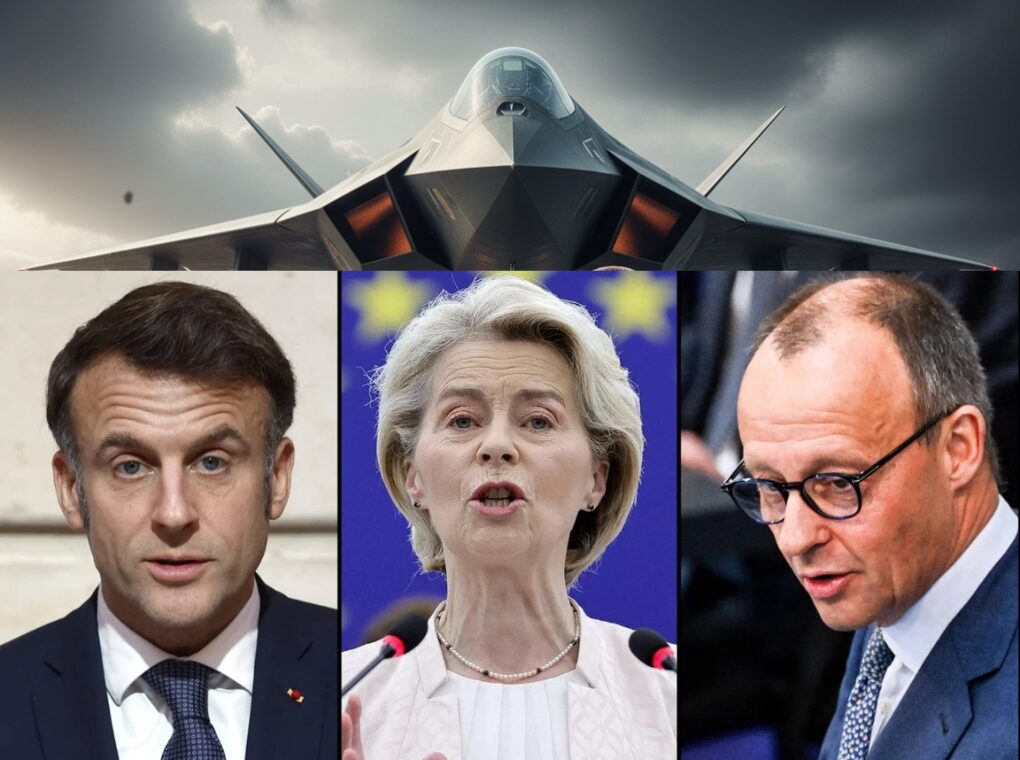
Europe’s most ambitious defense program — the Future Combat Air System (FCAS) — is facing a moment of serious issues. Once envisioned as the crown jewel of European military cooperation, the sixth-generation fighter initiative is now threatened by political mistrust, industrial rivalry, and widening strategic divisions between France and Germany.
What was meant to symbolize Europe’s ability to act independently in matters of defense is increasingly becoming an example of how difficult unity can be when national interests collide.
A Flagship Project in Trouble
Launched as a trilateral effort between France, Germany, and later Spain, FCAS was designed to deliver a cutting-edge “system of systems” by around 2040. The program includes a manned Next Generation Fighter (NGF), autonomous drone “remote carriers,” and a digital combat cloud linking air, space, and ground assets.
The goal was not just technological innovation. FCAS was supposed to demonstrate that Europe could build and field advanced military capabilities without relying on the United States.
Today, that vision looks increasingly fragile.
Deadlines for key industrial agreements have passed without resolution. Disputes over leadership roles, access to technology, and intellectual property have stalled progress. Insiders now warn that the program is “on the verge of collapse,” with the manned fighter component — the heart of FCAS — at greatest risk.
Dassault vs Airbus: The Industrial Power Struggle
At the center of the crisis is a deep divide between French defense firm Dassault Aviation and aerospace giant Airbus, which represents major German industrial interests.
Dassault, the maker of the Rafale fighter jet, insists on leading development of the Next Generation Fighter, arguing that its experience in designing combat aircraft makes it uniquely qualified. Airbus, however, wants equal authority and greater access to sensitive technologies, reflecting Germany’s demand for industrial parity.
This disagreement goes beyond corporate competition. It reflects broader national anxieties.
French officials fear Germany is trying to gain access to critical know-how that underpins France’s defense sovereignty. German officials, on the other hand, complain that FCAS risks becoming an expensive support program for the French defense industry, with Berlin footing a large share of the bill without securing proportional control.
These tensions have turned technical negotiations into political standoffs.
Political Frustration in Berlin and Paris
German Chancellor Friedrich Merz has publicly acknowledged the lack of progress, stating that the situation “cannot continue as it is.” His unusually blunt remarks highlight growing frustration in Berlin, where patience is wearing thin.
French officials remain more cautious in public, but privately, there is rising pessimism. Some insiders reportedly believe the manned fighter element may already be beyond saving.
If the NGF component collapses, the entire FCAS structure could unravel. Germany has hinted that it may try to salvage parts of the project, such as the combat cloud and unmanned systems, even if the joint fighter effort splits into separate national aircraft.
Such an outcome would be deeply ironic. A program meant to unify European defense efforts could instead produce fragmentation and duplication.
A Blow to the Franco-German Engine
For decades, the partnership between Paris and Berlin has been the driving force behind European integration. From economic cooperation to political decision-making, the “Franco-German engine” has shaped the European Union’s direction.
FCAS was supposed to be the defense equivalent of that partnership — a shared leap into the future.
Its failure would signal more than the collapse of a weapons program. It would indicate that even in the face of growing security threats, Europe’s two most important powers are struggling to align their strategic visions.
That strain is already influencing broader European politics.
A New Axis Emerging?
As relations with France grow more complicated, Germany appears to be strengthening ties with Italy. The evolving relationship between Chancellor Merz and Italian Prime Minister Giorgia Meloni has drawn attention among European analysts, some of whom describe it as the beginning of a new power alignment within the EU.
Italy has positioned itself as a proactive security player, increasing defense spending and aligning closely with NATO priorities. For Berlin, Rome may appear to be a more flexible and pragmatic partner at a time when cooperation with Paris is increasingly difficult.
If FCAS collapses, this shift could accelerate, reshaping the balance of influence inside the European Union.
Europe’s Credibility at Stake
The timing of the FCAS crisis is especially sensitive. The United States has been pressing European allies to spend more on defense and develop real military capabilities. Washington’s message has been consistent: Europe must take greater responsibility for its own security.
Recent comments from senior US officials have reinforced this pressure, arguing that Europe needs to move beyond discussions and deliver tangible results.
FCAS was supposed to be proof that Europe could do exactly that.
Instead, its troubles highlight persistent challenges: industrial nationalism, political mistrust, and slow decision-making. These problems raise uncomfortable questions about Europe’s ability to coordinate large-scale defense projects, especially during periods of geopolitical instability.
Strategic Consequences
If the FCAS program fails, Europe will face difficult choices.
One possibility is increased fragmentation, with countries pursuing separate national fighter projects. Another is a deeper reliance on American platforms such as the F-35, which would run counter to Europe’s goal of strategic autonomy. A third option would be a painful renegotiation of the FCAS structure, requiring major compromises on leadership and technology sharing.
None of these paths is easy, and all would involve delays that could leave capability gaps in the 2030s and 2040s.
Meanwhile, other global powers are moving ahead. The United States continues to develop its Next Generation Air Dominance system, while China is rapidly modernizing its air force. In this environment, delays carry real strategic costs.
More Than Just a Fighter Jet
The FCAS crisis is ultimately about more than aircraft design. It is a test of whether Europe can translate political ambition into coordinated action.
For years, European leaders have spoken about “strategic autonomy” — the ability to defend the continent and protect its interests without over-reliance on external powers. Achieving that goal requires trust, compromise, and shared long-term vision.
The current dispute suggests those qualities are under strain.
If France and Germany cannot resolve their differences on such a central project, it may signal deeper challenges for Europe’s future defense integration.
A Defining Moment for Europe
As negotiations continue, FCAS remains in limbo — a symbol of both Europe’s technological ambition and its political fragility.
Whether the program is revived, restructured, or ultimately abandoned will have lasting implications. It will shape not only Europe’s airpower capabilities but also the credibility of its broader defense ambitions.
The outcome will reveal whether Europe can truly act as a unified strategic player — or whether national rivalries will continue to limit what the continent can achieve together.