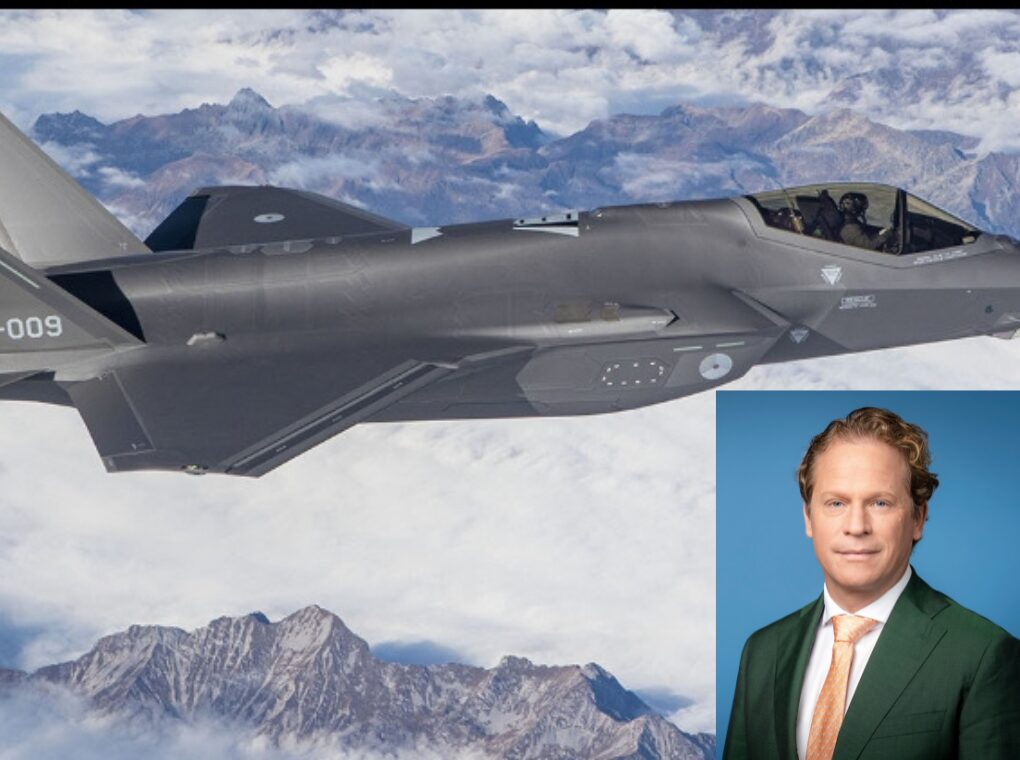
Dutch State Secretary for Defence Gijs Tuinman has ignited an international storm after suggesting that Europe could theoretically achieve software independence from the United States on its F-35 Lightning II fleet — even likening the process to “jailbreaking” an iPhone.
Speaking on the Dutch radio podcast Boekestijn en de Wijk on BNR Nieuwsradio, Tuinman addressed concerns about whether European operators of the F-35 could modify or update the aircraft’s software without U.S. authorization. When pressed on whether Europe could integrate its own weapons systems independently, he responded cautiously at first: “That’s not the point… we’ll see whether the Americans will show their true colors.”
Then came the remark that has reverberated across defence circles:
“I’m going to say something I should never say, but I’ll do it anyway. Just like your iPhone, you can jailbreak an F-35. I won’t say more about it.”
What Does “Jailbreaking” an F-35 Mean?
In consumer technology, jailbreaking refers to bypassing manufacturer-imposed restrictions to install custom software or features. Applied to the F-35 — one of the most advanced multirole stealth fighters in the world — the term implies circumventing the U.S.-controlled digital architecture that governs its mission systems, threat libraries, and upgrade pathways.
The F-35 is not merely an aircraft; it is often described as a “flying computer.” Its combat capabilities rely heavily on software-driven systems, including:
Sensor fusion that integrates radar, infrared, and electronic warfare data
Mission Data Files (MDFs) that contain threat libraries
Continuous software updates for performance enhancements
Cloud-linked logistics and maintenance infrastructure
These elements are coordinated through the Lockheed Martin-led program framework and supported by systems such as ODIN (Operational Data Integrated Network), the successor to ALIS. Much of this ecosystem remains under U.S. oversight, giving Washington substantial leverage over allied fleets.
Europe’s Growing Sovereignty Debate
The Netherlands is one of several European NATO members operating the F-35A variant. Countries including Norway, Italy, the United Kingdom, and Poland have also invested heavily in the platform. However, dependence on U.S.-managed software updates and integration approvals has long been a sensitive issue.
One recurring concern involves the integration of non-U.S. weapons, such as the European-made Meteor missile or Storm Shadow cruise missile. Integration timelines often depend on U.S. cooperation, sparking frustration among European partners seeking faster autonomy.
Tuinman’s remarks appear to reflect these anxieties. While he did not confirm any actual plans to modify aircraft systems independently, his statement suggests that European engineers may possess the technical capability — at least in theory — to bypass restrictions if geopolitical circumstances demanded it.
Is It Technically Feasible?
Defence analysts are divided. On one hand, Europe hosts highly advanced aerospace and cybersecurity industries capable of sophisticated reverse engineering. Nations like the Netherlands and Norway contribute significantly to the F-35 program’s supply chain and maintenance ecosystem.
On the other hand, the F-35’s software architecture is among the most secure in military aviation history. It is protected by:
Layered encryption, Secure boot protocols, Continuous authentication systems, Tight integration between hardware and software
Any unauthorized modification could compromise flight safety, degrade stealth performance, or even trigger protective countermeasures. Additionally, attempting such a move could violate contractual obligations within the multinational F-35 Joint Program Office structure.
In short, while the concept of “jailbreaking” captures public imagination, the practical and political barriers would be immense.
Geopolitical Implications
Tuinman’s comments arrive during a period of transatlantic uncertainty. European leaders have increasingly discussed strategic autonomy in defence procurement and operational readiness. Concerns — sometimes speculative — about potential “kill switches” or remote disablement mechanisms in U.S.-supplied systems have periodically surfaced, though no public evidence confirms their existence in the F-35.
By invoking the jailbreaking analogy, Tuinman highlighted a broader truth: in modern warfare, software sovereignty can be as critical as hardware capability. A fifth-generation fighter without software updates risks gradual obsolescence, even if its airframe remains state-of-the-art.
For NATO, the statement walks a fine line. Publicly discussing the theoretical bypassing of alliance-controlled systems could strain trust. Yet it also underscores the evolving nature of defence relationships in an era where digital infrastructure forms the backbone of combat power.
Symbolism Over Strategy?
Some observers interpret Tuinman’s words less as a literal operational plan and more as strategic signaling — a reminder that European nations are not technologically helpless. His comment may serve as leverage in negotiations over upgrade rights, weapons integration, or greater shared control within the F-35 ecosystem.
Importantly, Tuinman did not criticize the aircraft itself. The Netherlands continues to rely on the F-35 as the backbone of its air combat capability, and the jet remains widely regarded as the most capable stealth multirole platform currently in service.
A New Battlefield: Code
Ultimately, the controversy reveals how deeply modern defence systems depend on software governance. The F-35 is not simply a jet; it is part of a digitally interconnected combat network. Control over that network — and over the code that powers it — represents strategic influence.
Whether Tuinman’s “jailbreak” remark proves prophetic or merely rhetorical, it has thrust the issue of digital sovereignty into the spotlight. As global alliances navigate shifting political landscapes, the debate over who controls the software of the world’s most advanced fighter jets may become just as consequential as who flies them.