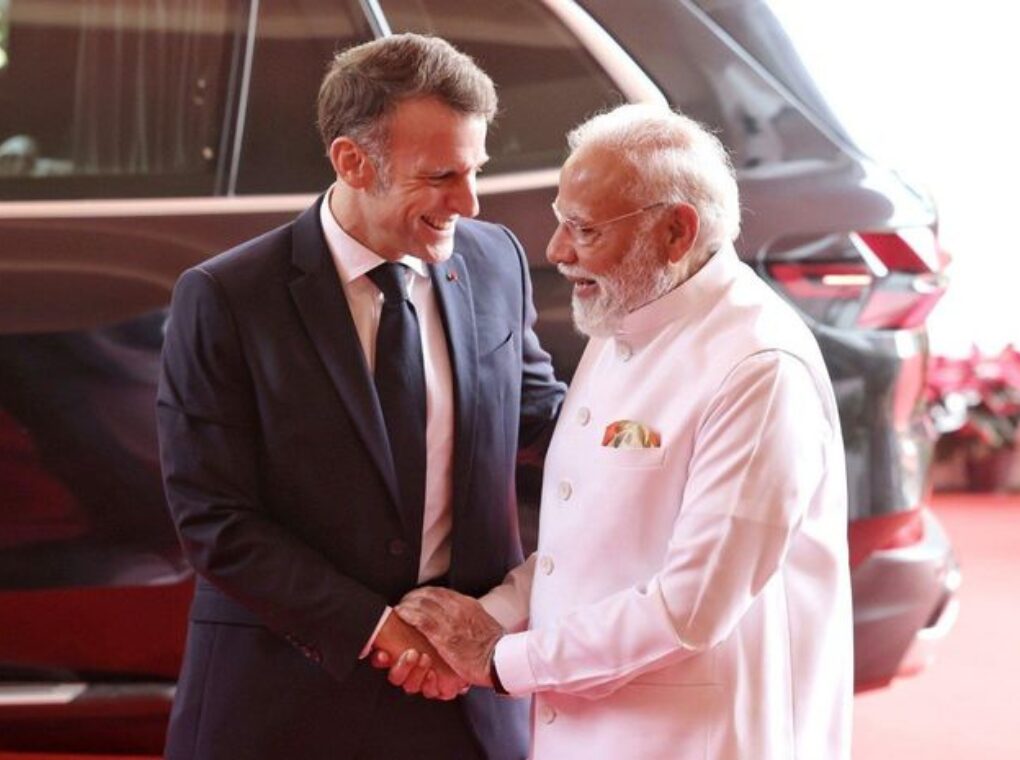
India and France on Tuesday upgraded their bilateral relationship to a “Special Global Strategic Partnership”, marking a significant deepening of ties between New Delhi and Paris.
Prime Minister Narendra Modi and French President Emmanuel Macron held wide-ranging talks in Mumbai, announcing 21 key outcomes spanning defence, aerospace, innovation, critical minerals, renewable energy, artificial intelligence, health, skilling and mobility.
Calling the partnership “a force for global stability in an unpredictable world,” Modi said the upgraded framework reflects the depth, trust and long-term strategic alignment between the two countries.
Defence and Aerospace Take Centre Stage
A major highlight of the visit was the virtual inauguration of the Airbus H125 Light Utility Helicopter Final Assembly Line at Vemagal, Karnataka. The facility will be operated by Tata Advanced Systems Limited in collaboration with Airbus.
Modi described the project as a milestone in India’s aerospace ambitions:
“Together, India and France will manufacture in India the world’s only helicopter capable of flying to the heights of Mount Everest and export it globally.”
The first “Made in India” H125 helicopter is expected to be delivered in early 2027. The facility is designed to serve civil and parapublic roles such as emergency medical services, law enforcement and passenger transport, while also strengthening India’s aeronautical manufacturing ecosystem.
Rafale and Missile Cooperation
Earlier this month, India’s Defence Acquisition Council cleared the procurement of 114 Rafale fighter jets, adding momentum to India’s long-standing defence partnership with France. The Rafale jets are manufactured by Dassault Aviation, and India is also exploring the maritime variant of the aircraft.
In another significant development, Bharat Electronics Limited (BEL) and Safran Electronics & Defense announced a joint venture to manufacture the HAMMER (Highly Agile Modular Munition Extended Range) precision-guided air-to-ground weapon system in India. The system is deployed on Rafale fighter jets and will enhance India’s indigenous defence manufacturing under the “Atmanirbhar Bharat” initiative.
Macron emphasized that defence cooperation—from Rafale jets to submarines and helicopter production—remains a cornerstone of bilateral ties.
Expanding the Strategic Framework
The “Special Global Strategic Partnership” builds upon the original strategic partnership signed in 1998—India’s first such pact with a Western nation.
Under the upgraded framework, both leaders agreed to:
Establish an annual Foreign Ministers’ Dialogue
Accelerate implementation of the Horizon 2047 Roadmap
Expand cooperation in space, civil nuclear energy, and counter-terrorism
Strengthen supply chains for critical minerals
France has been described by Indian officials as “extremely helpful” in counter-terrorism cooperation and remains one of India’s most trusted European partners.
AI, Innovation and Education Push
The leaders launched several forward-looking initiatives, including:
Indo-French Centre for AI in Health at the All India Institute of Medical Sciences
Indo-French Centre for Digital Science and Technology
National Centre of Excellence for Skilling in Aeronautics
A Centre on Advanced Materials
Startup collaboration between T-Hub and Nord France
Macron reaffirmed France’s commitment to host 30,000 Indian students by 2030, while Modi announced that leading Indian startups will showcase their innovations in France in June 2026.
The visit also coincides with the India AI Impact Summit in New Delhi, underlining technology and AI as key pillars of future cooperation.
Economic and Global Context
The two sides signed an amending protocol to their Double Tax Avoidance Agreement and reaffirmed support for deeper India-Europe economic integration.
Referring to the recently signed India-European Union Free Trade Agreement, Modi said 2026 marks a “turning point” in India-Europe relations. France, as a major EU power, is expected to play a critical role in implementing the ambitious trade framework.
On global geopolitics, Macron spoke of advancing a “non-hegemonic” world order, while Modi noted that in a time of global uncertainty, the India-France partnership offers “stability and progress.”
A Partnership from Oceans to Everest
Summing up the significance of the visit, Modi declared:
“The India-France partnership knows no boundaries. It can reach from the deep oceans to the tallest mountains.”
With expanded defence manufacturing, AI collaboration, educational mobility and strategic alignment, the elevation to a Special Global Strategic Partnership signals a new phase in India-France ties—positioning the relationship as a pillar of stability amid shifting global power dynamics.