
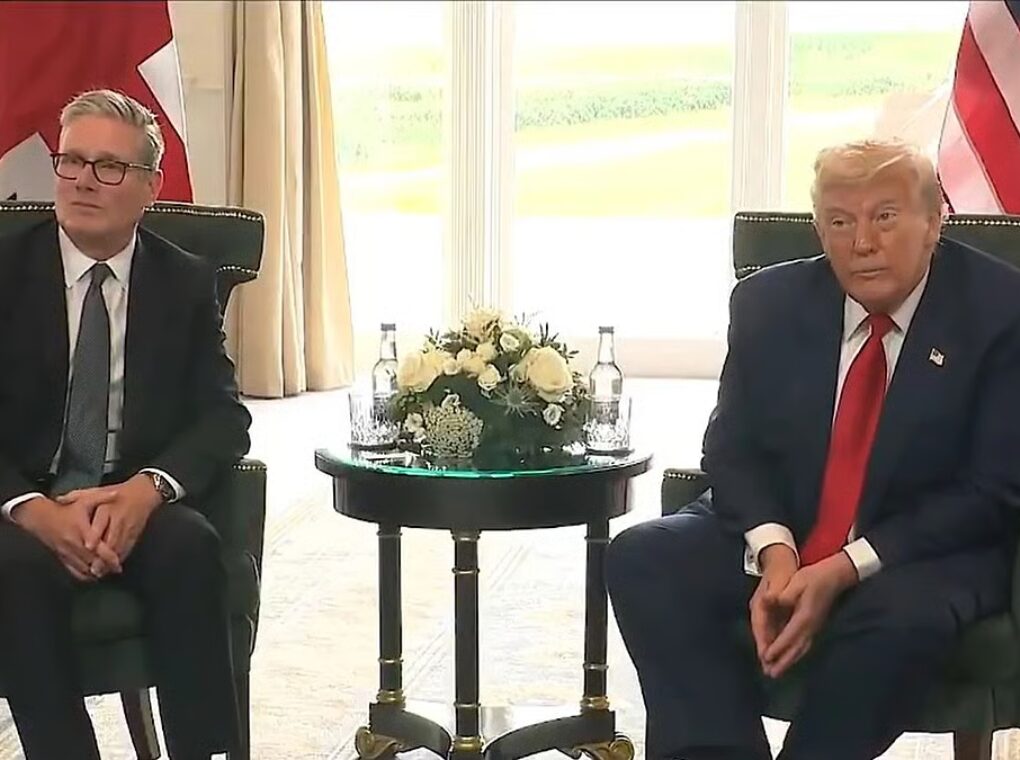
Tensions are rising between the United States and the United Kingdom after Britain reportedly refused to allow the US to use its airbases for a potential military strike on Iran. The decision has triggered strong reactions from US President Donald Trump, who is said to be frustrated with London’s stance.
According to reports, Washington wanted to use the strategically crucial base at Diego Garcia, as well as RAF Fairford in England, to launch possible long-range operations against Iran. However, the British government, led by Prime Minister Keir Starmer, declined to approve.
Under longstanding agreements, US forces can operate from British-controlled bases only with the explicit consent of the British Prime Minister. Britain’s refusal reflects legal, political, and strategic considerations at a time of heightened global tensions.
Why Diego Garcia Matters?
Diego Garcia is the largest island in the Chagos Archipelago in the Indian Ocean. Since the 1970s, it has functioned as a joint UK-US military facility. Its geographic position makes it one of the most valuable military assets in the region.
Located roughly 3,800 kilometers from Tehran, the base allows the US to conduct long-range bomber missions without entering direct threat zones. The airfield can accommodate heavy bombers such as the B-2 Spirit and B-52 Stratofortress, along with refueling aircraft like the KC-135 and surveillance platforms.
Beyond air operations, Diego Garcia has a deep-water port capable of hosting major warships and supply vessels. It has played a key role in past US operations in the Middle East, Afghanistan, and Africa.
Given rising tensions with Iran, Washington reportedly views the base as central to any sustained military campaign. However, Britain appears unwilling to be drawn into another controversial conflict without clear legal justification and international backing.
Legal and Political Concerns in London
Britain’s caution stems partly from lessons learned during the Iraq War. The 2003 invasion, supported by London and Washington, led to long-term political fallout in the UK. Questions over legal legitimacy and intelligence credibility left deep scars in British politics.
International law also plays a significant role. If a country knowingly assists in military action deemed unlawful, it could face legal consequences or reputational damage. British officials are reportedly seeking clear legal clarity and broader international support before endorsing any offensive military action against Iran.
Post-Brexit Britain is also eager to present itself as a defender of international norms and rule-based order. Supporting a unilateral strike without UN backing could undermine that position.
Chagos Islands Dispute Adds Fuel to the Fire
The controversy over Diego Garcia is intertwined with a long-running sovereignty dispute involving Mauritius.
The Chagos Islands were separated from Mauritius in 1965, before Mauritius gained independence in 1968. Britain created the British Indian Ocean Territory and later allowed the US to establish a military base on Diego Garcia.
In 2019, the International Court of Justice ruled that Britain should end its administration of the islands, stating that the decolonization process was incomplete. Mauritius has been demanding sovereignty over the islands for decades.
The UK government initiated negotiations with Mauritius, arguing that resolving the dispute would avoid prolonged legal battles and ensure the continued operation of the joint military base.
President Trump has criticized Britain’s approach, arguing that giving up control of Diego Garcia—even under a long-term lease arrangement—would weaken Western strategic positioning in the Indian Ocean. He reportedly described the move as a “big mistake,” emphasizing that the base could be crucial if diplomacy with Iran fails.
Growing Strains in the “Special Relationship”
The US-UK alliance, often described as the “special relationship,” has endured through World War II, NATO operations, intelligence cooperation under Five Eyes, and joint military campaigns in Iraq and Afghanistan.
However, differences are becoming more visible.
1. Military Action vs. Legal Caution:
Washington appears ready to take swift and decisive action against Iran if negotiations collapse. London, by contrast, prefers legal backing and multilateral coordination.
2. Chagos Sovereignty Talks:
The US worries that Britain’s negotiations with Mauritius could weaken long-term American strategic influence in the Indo-Pacific.
3. Differing Foreign Policy Styles:
The Trump administration’s transactional and hardline foreign policy contrasts with Britain’s current emphasis on diplomacy and legal frameworks.
4. Broader Strategic Disagreements:
Past differences—including debates over Greenland and European sovereignty issues—have highlighted diverging approaches between Washington and European capitals.
What Comes Next?
The situation remains fluid. The US is reportedly continuing military preparations, while Britain maintains that security cooperation with Washington remains strong despite disagreements.
Whether this dispute marks a temporary policy divergence or a deeper strategic rift remains to be seen. Much will depend on developments in US-Iran negotiations and the outcome of the Chagos Islands talks with Mauritius.
For now, Britain’s refusal underscores a shifting dynamic: even the closest allies may not always align when the risks of war—and the interpretation of international law—are at stake.