
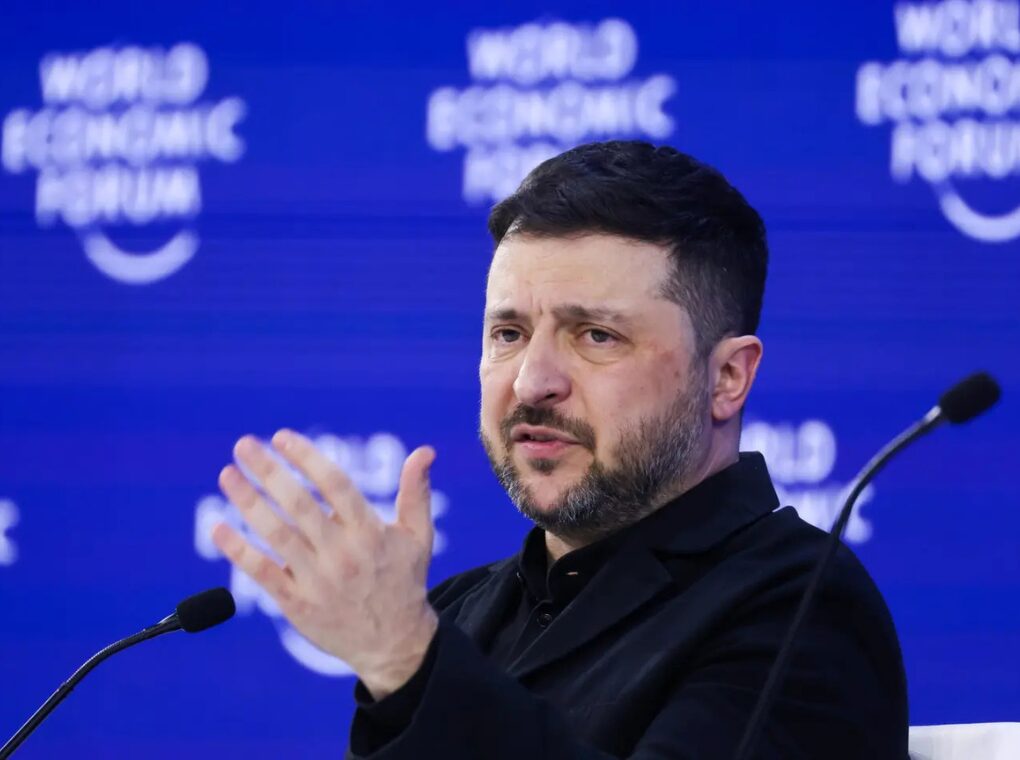
Ukraine’s President Volodymyr Zelensky has claimed that both Washington and Moscow are pressing Kiev to withdraw from Donbass as a precondition for ending the war, signaling a potentially dramatic shift in the diplomatic landscape surrounding the nearly four-year conflict.
In an interview with AFP on Friday, Zelensky stated that “both the Americans and the Russians say that if you want the war to end tomorrow, get out of Donbass.” His remarks come amid intensifying diplomatic maneuvering and renewed pressure from US President Donald Trump, who has urged Ukraine to accelerate negotiations with Moscow.
Washington’s Growing Impatience
Trump has publicly expressed frustration with what he describes as delays in the peace process. Earlier this month, he said Ukraine should “come to the table fast,” suggesting that Moscow appears more willing to negotiate than Kiev.
In separate comments, Trump stated that “Russia wants to make a deal and Zelensky is going to have to get moving,” adding that Russian President Vladimir Putin is “ready to make a deal,” while Ukraine is “less ready.”
These remarks underscore a shift in tone from previous US administrations, which emphasized sustained military support for Kiev. Under Trump, the focus appears to be on achieving a rapid settlement—even if it involves difficult territorial compromises.
Donbass at the Center of Negotiations
The Donbass region in eastern Ukraine has been at the heart of the conflict since 2014. Following referendums in 2022—widely rejected by Kiev and its Western allies—Moscow declared that the territories had voted to join Russia. Ukraine has consistently rejected those claims and vowed to restore full territorial integrity.
Zelensky has repeatedly ruled out territorial concessions. However, he acknowledged in his latest remarks that the issue of Donbass is central to ongoing discussions. His comments followed a new round of trilateral talks in Geneva involving representatives from Russia, the US, and Ukraine.
Prior to those negotiations, Moscow made clear that territory would be the focal point. Russia has insisted that any sustainable peace deal must include Ukraine’s withdrawal from areas still under its control in Donbass, along with commitments to neutrality, demilitarization, and what it calls “denazification.” Additionally, Moscow has demanded that Ukraine formally recognize what Russia considers its new borders.
Zelensky Pushes Back
Despite mounting pressure, Zelensky denied that Ukraine is on the brink of defeat, even as Russian forces have gradually advanced on multiple fronts.
“You can’t say that we’re losing the war,” he said. “The question is whether we will win. That is the question – but it’s a very costly question.”
The Ukrainian leader also criticized what he described as an unfair approach from Washington. In comments to Axios, he argued that US pressure on Kiev does not sufficiently account for Ukraine’s sovereignty or security concerns.
Zelensky’s political position has also come under scrutiny. His presidential term officially expired in 2024, but elections were suspended under martial law due to the ongoing conflict. Russia has labeled him “illegitimate,” a characterization Kiev rejects.
When asked about holding elections, Zelensky reiterated his reluctance. “No one wants elections during a war. Everyone is afraid of its destructive effect,” he said, claiming that Moscow’s objective is to destabilize Ukraine politically. “The Russians just want to replace me.”
However, he has previously indicated a willingness to consider elections if provided with firm security guarantees from Western partners.
A Fragile Diplomatic Moment
The alignment—if accurately characterized by Zelensky—between Washington and Moscow on the issue of Donbass could represent a turning point. For Ukraine, the stakes are existential. Any agreement involving territorial withdrawal would be deeply controversial domestically and could redefine the country’s post-war political landscape.
For the US, the emphasis appears to be on ending the conflict swiftly, potentially reducing financial and military commitments. For Russia, securing recognition of its territorial gains remains a core objective.
As talks continue, the central question remains whether Kiev can reconcile its stated red lines with increasing external pressure to compromise. With the battlefield situation evolving and diplomatic channels intensifying, the coming weeks may prove decisive.
While Zelensky insists Ukraine is not losing, the broader geopolitical calculus suggests that the path to peace—if it emerges—will likely demand painful concessions and strategic recalibration from all sides.