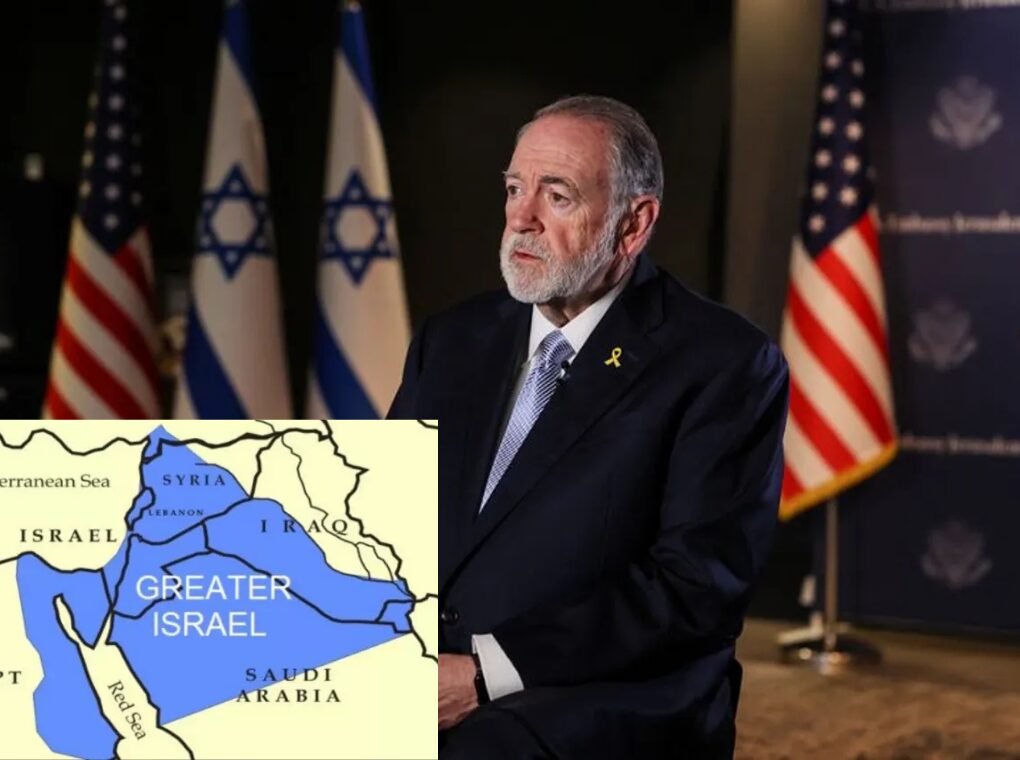
A major diplomatic row erupted this weekend after US Ambassador to Israel Mike Huckabee suggested during a televised interview that it would be “fine” if Israel were to take control of the entire Middle East region described in biblical texts.
The remarks, made during a sit-down interview with conservative commentator Tucker Carlson at Ben Gurion Airport, have drawn sharp condemnation from Arab and Muslim-majority nations, triggered debate within American political circles, and reignited controversy over the role of religious ideology in US foreign policy.
“It Would Be Fine If They Took It All”
During the interview, Carlson referenced the Book of Genesis and the land described as stretching “from the Nile to the Euphrates.” He pressed Huckabee on whether Israel, based on that biblical description, had a right to claim territory encompassing modern-day Palestine, Lebanon, Syria, Jordan, and parts of Saudi Arabia and Iraq.
Huckabee initially responded cautiously but then stated, “It would be fine if they took it all,” before adding that Israel was not currently seeking to expand to those borders.
The ambassador, a former Arkansas governor and Southern Baptist minister appointed by President Donald Trump, framed Israel’s connection to the land as rooted in “a people, a place, and a purpose,” describing it as divinely granted through Abraham.
Although Huckabee later clarified that Israel is not actively attempting to conquer neighboring states, the statement immediately sparked diplomatic backlash.
Joint Condemnation From Arab and Islamic States
In a rare coordinated move, fourteen Arab and Islamic countries — along with the secretariats of the Gulf Cooperation Council, the League of Arab States, and the Organisation of Islamic Cooperation — issued a joint statement condemning the remarks as “dangerous and inflammatory.”
The declaration rejected any suggestion that Israel could legitimately exercise sovereignty over occupied Palestinian territories or other Arab lands. It warned that continued expansionist rhetoric would “inflame violence and conflict in the region” and undermine peace prospects.
Governments, including Egypt, Jordan, Saudi Arabia, and the United Arab Emirates, reportedly expressed “profound concern,” arguing that the ambassador’s comments contradict longstanding US diplomatic frameworks supporting a negotiated settlement.
Clash Over History, Identity, and Legitimacy
The interview became increasingly heated as Carlson questioned the application of biblical and historical claims to modern geopolitics. He challenged Huckabee on whether ancient religious texts could serve as a legitimate foundation for contemporary territorial rights.
Carlson also raised questions about ancestry and indigeneity, pointing out that many Israeli leaders have European roots while Palestinian Christians and Muslims have lived in the region for centuries. Huckabee dismissed genetic arguments, asserting that archaeological evidence and biblical history validate Jewish claims to the land.
“The stones cry out,” Huckabee said, referencing excavations in Jerusalem’s City of David as evidence of a continuous Jewish presence dating back thousands of years.
The exchange exposed growing divisions within segments of the American conservative movement, particularly over unconditional US support for Israel and the influence of Christian Zionist ideology in shaping foreign policy.
Gaza War and Civilian Casualties
The conversation later shifted to the ongoing war in Gaza. Huckabee defended Israel’s military conduct, claiming that the Israeli military had maintained a lower civilian casualty ratio in urban warfare than in other modern conflicts.
However, when pressed for specific data comparing Israeli operations to US campaigns in Iraq and Afghanistan, the ambassador acknowledged he did not have precise figures on hand.
Carlson expressed skepticism and pushed back strongly, particularly when the discussion turned to child casualties. Huckabee suggested that if minors had actively participated in hostilities, responsibility lay with those who involved them.
The exchange further intensified criticism from human rights advocates and international observers who argue that civilian protection remains a central concern in the conflict.
Clarification and Political Fallout
Following the backlash, Huckabee issued a clarification statement accusing Carlson of twisting his words and engaging in a confusing line of questioning. He insisted that he was discussing theological concepts rather than advocating real-world annexation.
Nonetheless, the diplomatic fallout has been significant. Analysts note that US ambassadors rarely invoke explicitly religious doctrine in discussions of modern territorial sovereignty, particularly in a region as volatile as the Middle East.
Critics argue that such rhetoric risks alienating key US partners in the Arab world at a time of heightened regional instability. Supporters counter that Huckabee was articulating a historical and religious perspective widely held among evangelical Christians and Israeli nationalists.
The episode underscores broader tensions within US politics over Israel policy, public opinion on Middle East conflicts, and the boundaries between religious belief and statecraft.
As governments across the region respond and Washington navigates the fallout, the controversy surrounding Huckabee’s remarks appears likely to fuel further debate over America’s deeply intertwined political, religious, and strategic relationship with Israel.