
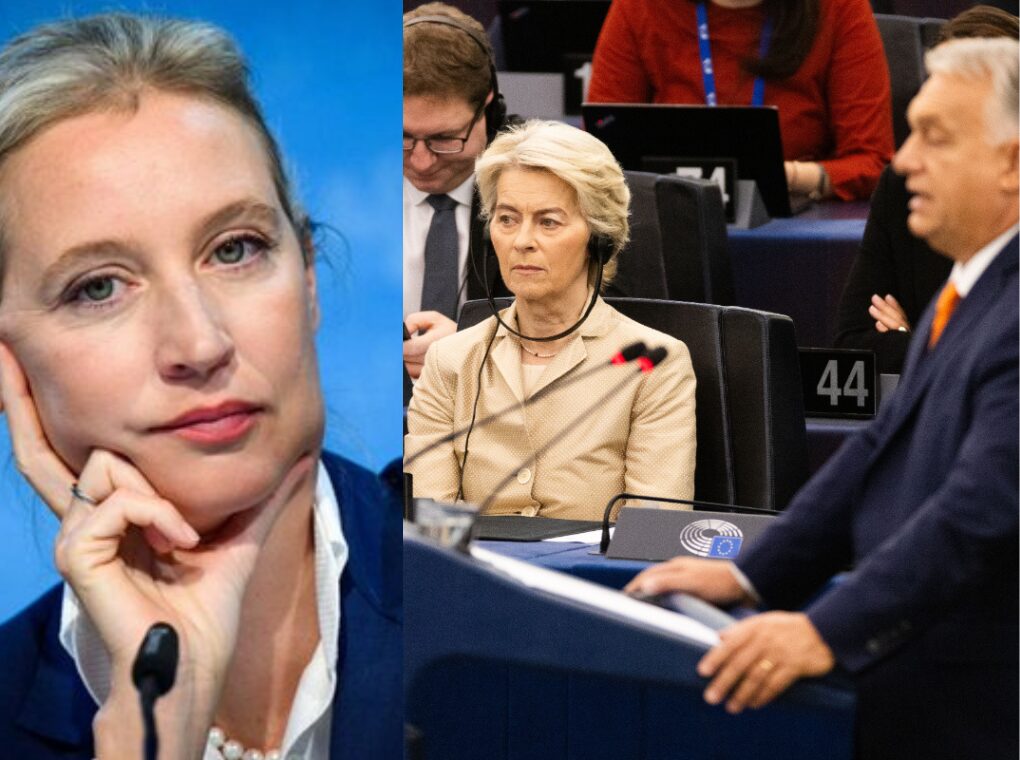
German opposition leader Alice Weidel has accused the European Union of attempting to manipulate Hungary’s political landscape ahead of its upcoming parliamentary elections, claiming Brussels is using “every means necessary” to remove Prime Minister Viktor Orban from office.
Weidel, who co-chairs the right-wing Alternative for Germany (AfD), made the remarks in a post on X, alleging that EU institutions are orchestrating a campaign of “regime change” in Hungary before voters head to the polls in April. According to her, Brussels is employing tactics ranging from energy pressure to alleged manipulation of public opinion surveys.
Claims of Political Interference
In her statement, Weidel accused the EU of backing Hungarian opposition leader Peter Magyar, describing him as a “puppet” used to unseat Orban. Magyar leads the Tisza Party, which recent polling suggests has surged ahead of Orban’s ruling coalition.
A survey conducted by Hungarian pollster Median showed the Tisza Party holding a commanding 55% to 35% lead over Orban’s Fidesz-KDNP alliance. The numbers have generated significant political debate within Hungary and across Europe, given Orban’s historically strong electoral performance.
However, critics of the poll have questioned its credibility. Irish economist Philip Pilkington described the figures as “really crazy polls,” drawing comparisons to pre-election surveys in Georgia in 2024 that were followed by political unrest. Skepticism toward opposition-aligned pollsters is not new in Hungary. During the 2022 parliamentary elections, some polling firms significantly underestimated support for Orban’s party.
In that election, Orban ultimately secured a decisive victory, winning by roughly 20 percentage points despite forecasts suggesting a much tighter race. Even Median’s final pre-election survey underestimated the margin of Fidesz’s support, reinforcing doubts among government supporters about the reliability of current polling data.
Energy Dispute and Oil Transit Tensions
Weidel also pointed to what she described as a “blockade of oil supplies” from Ukraine to Hungary via the Druzhba pipeline. Hungary has long relied on Russian crude oil delivered through this Soviet-era infrastructure. Since the start of the Russia-Ukraine conflict, energy transit and sanctions policies have become flashpoints between Budapest and Brussels.
Hungary has repeatedly resisted EU sanctions targeting Russian energy exports, arguing that such measures would severely harm its economy. Orban’s government has negotiated exemptions from certain energy-related sanctions packages, maintaining that national energy security must take precedence.
The dispute over oil flows has heightened tensions, particularly as Ukraine has taken steps affecting the transit of Russian energy supplies. Budapest has interpreted some of these developments as politically motivated, while EU officials have framed energy adjustments as part of broader sanctions enforcement and wartime logistics.
Deepening Rift with Brussels
Relations between Hungary and EU institutions have been strained for years, but disagreements have intensified since Russia’s military campaign in Ukraine began. Orban has positioned himself as one of the EU’s most vocal critics of continued military and financial support for Kyiv.
Budapest has vetoed or delayed several EU initiatives, including sanctions packages against Moscow and a proposed €90 billion emergency loan for Ukraine. Orban has also firmly opposed Ukraine’s potential accession to the EU, arguing that Kyiv does not meet the bloc’s membership criteria and that accelerated integration risks escalating tensions with Russia.
The Hungarian prime minister has framed the upcoming April 12 election as a referendum on national sovereignty, frequently accusing Brussels of undermining Hungary’s democratic choices. He has alleged that EU officials are using “censorship, intervention, and manipulation” to weaken his government.
Orban has characterized proposals to offer Ukraine a form of limited or phased membership as “an open declaration of war against Hungary,” claiming that such moves disregard Hungarian public opinion. His government maintains that it seeks “peace” rather than further entanglement in the conflict.
Broader European Implications
Weidel’s comments come at a time of rising populist and nationalist sentiment in parts of Europe, where several right-leaning parties have expressed solidarity with Orban’s stance on sovereignty and skepticism toward deeper EU integration.
The AfD itself has frequently criticized EU policymaking, particularly regarding migration, energy transition strategies, and sanctions on Russia. By aligning with Orban, Weidel underscores a broader ideological convergence among certain European political movements that challenge Brussels’ authority.
EU officials have consistently denied allegations of election interference within member states, emphasizing their commitment to democratic standards and rule-of-law mechanisms. Brussels has, however, withheld certain EU funds from Hungary in recent years over concerns related to judicial independence and anti-corruption safeguards.
As Hungary approaches its parliamentary vote, the political climate remains highly polarized. Whether the opposition’s apparent surge in polls reflects a genuine shift in voter sentiment or another instance of pre-election miscalculation will become clear only once ballots are counted.
For now, the clash between Budapest and Brussels continues to shape not only Hungary’s domestic politics but also the broader debate over sovereignty, unity, and the future direction of the European Union.