
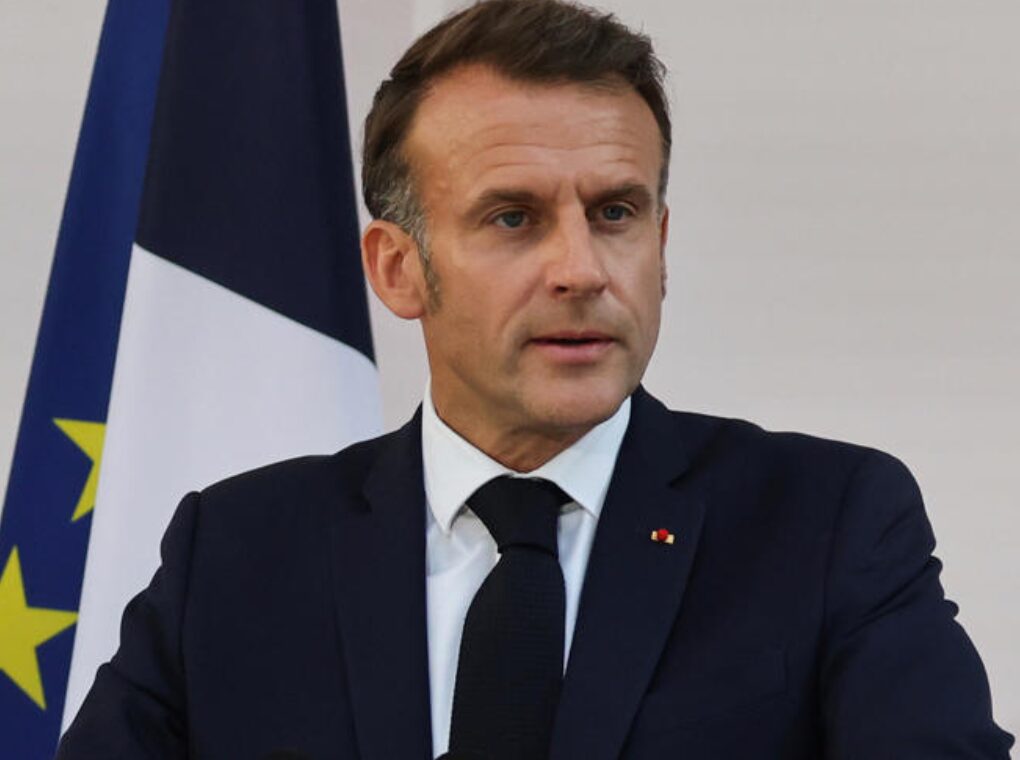
The growing conflict between the United States, Israel, and Iran has taken a new diplomatic turn after Emmanuel Macron publicly challenged claims made by Donald Trump regarding the scale of damage inflicted on Iran’s military and allegations that Tehran has mined the strategic Strait of Hormuz.
Speaking after a virtual meeting with leaders of the Group of Seven (G7), the French president stated that there was no confirmed intelligence indicating that Iran had deployed sea mines in the crucial global shipping corridor.
“I have no confirmation of this, either from partner services or from our own services,” Macron said following the discussions.
His remarks appear to contradict narratives circulating in Washington that Iran had begun laying naval mines to block maritime traffic through the strait — a route that handles nearly 20% of global oil shipments.
Macron: Iran Weakened But Still Capable
Macron acknowledged that recent US-Israeli airstrikes on Iran, launched on February 28, have caused significant damage to Iranian military infrastructure. However, he emphasized that Tehran’s capabilities remain far from eliminated.
“Considerable damage has already been inflicted on Iran’s ballistic military capabilities,” Macron said, adding that Iran continues launching attacks across the region, proving its forces have not been “reduced to zero.”
His comments directly counter statements by Trump, who recently told Axios that there is “practically nothing left” for US forces to target inside Iran and that the war could end quickly.
“Little this and that… Any time I want it to end, it will end,” Trump reportedly said.
Macron also suggested that the United States must clarify its broader strategic goals in the conflict.
“I leave it to the US president to clarify both his ultimate objectives and the pace he wants to set for the operations,” he said.
Iran Threatens Economic Warfare
Meanwhile, Iranian officials have signaled that they are prepared for a long war of attrition that could have severe consequences for the global economy.
Senior Islamic Revolutionary Guard Corps (IRGC) advisor Ali Fadavi warned that the conflict could escalate into an economic battle targeting global financial systems.
“The US and Israel must consider the possibility of a long-term war of attrition that will destroy the American economy and the world economy,” Fadavi told Iranian state television.
Iran has already begun targeting commercial shipping in the Strait of Hormuz, claiming responsibility for attacks on two vessels — the Express Rome and the Mayuree Naree — accusing them of ignoring warnings from Iranian naval forces.
According to reports, Oman’s navy rescued 20 crew members, while search operations continue for three missing sailors after the Thai bulk carrier was struck.
Global Oil Market Under Pressure
The escalating conflict has sent shockwaves through global energy markets.
Oil prices have surged sharply since February 28, when **the United States and Israel launched coordinated strikes that killed Iran’s supreme leader, Ali Khamenei, triggering a wider Middle East war.
In response to soaring energy prices, the International Energy Agency (IEA) announced that its member states would release 400 million barrels of oil from strategic reserves, marking the largest emergency release in history.
The move aims to stabilize global energy markets and prevent supply shocks, particularly in Asia and Europe, which rely heavily on oil shipments passing through the Strait of Hormuz.
Experts warn that a prolonged disruption in the strait could have catastrophic consequences for the global economy, as the passage also carries nearly one-third of the world’s fertilizer shipments.
Conflict Expands Across the Region
The war is increasingly spreading beyond Iran’s borders.
Israel confirmed it has launched a new wave of large-scale strikes inside Iran, while also targeting positions linked to Hezbollah in Beirut.
One Israeli strike reportedly hit an apartment building in central Beirut, causing extensive damage and sending residents fleeing.
Eyewitnesses described a powerful explosion followed by a massive fireball engulfing several floors of the residential structure.
Meanwhile, drone attacks have also been reported near Dubai International Airport, injuring at least four people and forcing several international companies to evacuate employees from the city.
Major firms including Citigroup and Deloitte have reportedly begun relocating staff from their Dubai offices amid fears of further escalation.
Iran Faces Domestic Pressure
Inside Iran, authorities are attempting to maintain internal stability amid the ongoing war and growing casualties.
Iran’s health ministry claims more than 1,200 people have been killed and over 10,000 injured in US-Israeli strikes, though these figures have not been independently verified.
The conflict was sparked when US and Israeli strikes killed Iran’s supreme leader Ali Khamenei, leading to the appointment of his son Mojtaba Khamenei as successor.
However, reports suggest Mojtaba may have been injured in the same strike, raising further uncertainty about Iran’s leadership during the crisis.
Despite the ongoing bombardment, many ordinary Iranians say they are attempting to adapt to life under wartime conditions.
“We’ve put our faith in God. For now, there’s food in the shops,” said a Tehran resident speaking to reporters.
As the conflict enters its second week, global leaders are increasingly warning that without urgent diplomatic intervention, the crisis could escalate into a prolonged war with severe geopolitical and economic consequences worldwide.