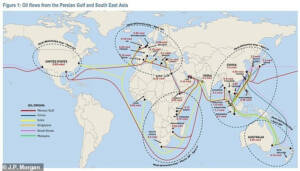
The global energy market is bracing for a major disruption as Gulf oil shipments begin to taper off, triggering fears of a widespread fuel crunch and rising prices across continents. A recent map released by JPMorgan Chase highlights a critical timeline showing when the last shipments of Gulf oil are expected to reach key global markets—signaling a shift from steady supply flows to a dangerous depletion of reserves.
Oil Supply Shock: A Global Timeline Emerges
According to the analysis, several regions are set to experience disruptions at different times. Parts of Asia and Africa could start facing supply shortages as early as April 1, while the United States is projected to hit a cut-off point around April 15. Australia, heavily dependent on imported fuel, is expected to see “most deliveries” cease by April 20.
The disruption stems largely from halted tanker traffic through the strategically vital Strait of Hormuz—a chokepoint responsible for transporting a significant share of the world’s oil supply. The last tanker reportedly departed the route on February 28, coinciding with military escalation involving the United States and Israel targeting Iran.
From Flow Shock to Stock Depletion
Energy analysts warn that the global oil system is transitioning into a more precarious phase. Instead of dealing with immediate supply interruptions (flow shock), countries are now entering a “stock depletion” phase—where existing reserves are gradually drained without sufficient replenishment.
This shift means that timing will play a crucial role. Even nations with strong reserves could soon face pressure as inventories run low and replacement supplies become harder to secure. The result is expected to be a sharp increase in global fuel prices, even in regions less dependent on Gulf oil imports.
Australia Scrambles for Alternatives
Australia is among the most exposed economies in this unfolding crisis. Traditionally reliant on refined fuel imports from Asian hubs such as South Korea, Singapore, and Malaysia—countries themselves dependent on Gulf crude—the disruption has forced Canberra to act swiftly.
Prime Minister Anthony Albanese announced emergency measures aimed at cushioning the economic blow. The government has slashed fuel excise by 26.3 cents per litre for three months and introduced additional relief measures targeting transport sectors.
Treasurer Jim Chalmers stated that the move would save approximately $19 on a standard 65-litre tank, offering temporary relief to households grappling with rising living costs.
Meanwhile, Australia has pivoted to alternative supply routes, importing fuel directly from the United States. Nearly two million barrels are expected to arrive between mid-April and early May, including 1.3 million barrels of petrol and around 600,000 barrels of diesel.
Asia and Europe Face Price Pressures
Across Asia, countries are already feeling the heat. With supply chains disrupted, competition for available oil is intensifying, driving prices upward. Nations like Japan and South Korea—heavily reliant on Middle Eastern oil—could face significant economic strain.
Europe, while less dependent on Gulf oil compared to Asia, is not immune. Analysts predict that the continent will begin experiencing the impact by mid-April, primarily through higher prices rather than outright shortages. Increased competition with Asian buyers is expected to further strain European energy markets.
United States: Price Surge, Not Shortage
The United States is in a relatively stronger position due to its substantial domestic oil production. While the country is unlikely to face physical shortages, analysts warn that American consumers will still feel the pinch through rising fuel prices driven by global market volatility.
National Fuel Security Measures Intensify
In response to the escalating crisis, Australia has rolled out a four-stage National Fuel Security Plan. The country is currently in the second phase, “keeping Australia moving,” where supply chains are still functioning, but localized shortages have begun to emerge.
If conditions worsen, authorities may move to more aggressive interventions, including prioritizing fuel for critical sectors and encouraging reduced consumption among citizens. The most severe stage would involve direct government control to ensure essential services remain operational.
A Warning for the Global Economy
The unfolding oil disruption underscores the vulnerability of global energy systems to geopolitical tensions. With the Strait of Hormuz effectively choked and reserves dwindling, the world may be entering a prolonged period of energy instability.
As governments scramble to secure alternative supplies and protect their economies, one thing is clear: the ripple effects of this crisis will extend far beyond fuel pumps—impacting inflation, trade, and global growth in the months ahead.