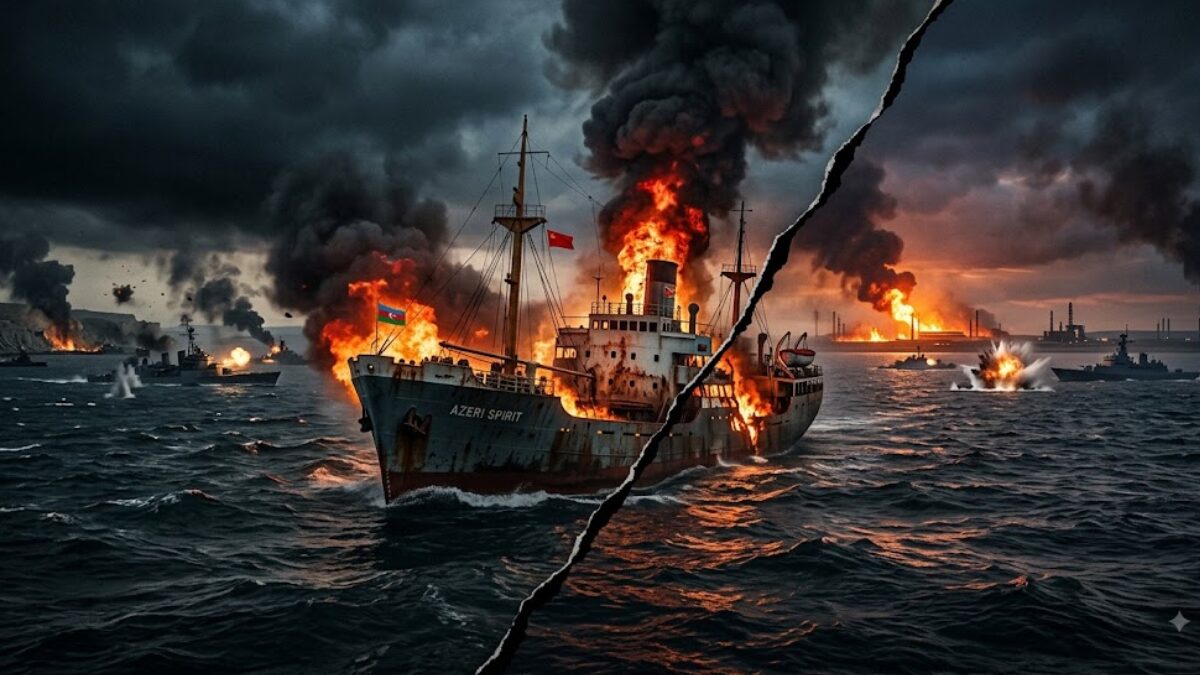
On 25 July, a drone found the bridge of a 90-metre cargo ship in the Volga Delta. The vessel burned. Nima Moradi, a 23-year-old Iranian sailor, died of shrapnel wounds. And a sea that had sat outside two wars stopped sitting outside them.
The ship was the Ana, an Iranian dry cargo carrier. Ukraine’s security service said it had struck vessels moving military cargo between Iran and Russia. Kyiv listed the sanctioned Russian ships Port Olya-2 and Begey, an escorting missile boat, and an offshore platform.
Tehran Hardens
Tehran answered within hours. It summoned Ukraine’s chargé d’affaires, called the attack hostile and criminal, then sharpened its language further. Foreign Minister Abbas Araghchi said the strike “cannot go unanswered,” and alleged that Kyiv had acted at Israel’s behest to drag Europe into the Middle East war.
Moscow piled in separately. Kremlin spokesman Dmitry Peskov framed the strike as an attack on Iran itself; Maria Zakharova called it terrorism.
Three weeks on, the quarrel hasn’t closed. On Monday, Iranian foreign ministry spokesman Esmail Baghaei rejected Kyiv’s account outright. Ukraine had described the sinking as unintentional; Tehran remains unconvinced. Baghaei demanded payment and warned that otherwise, “we will seek compensation ourselves.”
The two capitals barely speak. Their last sustained ministerial contact dates to 2022. Relations collapsed in 2020, when the Revolutionary Guards shot down a Ukrainian airliner over Tehran, and worsened further after Iran began supplying Shahed drones to Russia. Ukraine has since exported counter-drone expertise to Gulf states — which Tehran, unsurprisingly, reads as Kyiv picking a side.
Even the diplomacy divides them. Araghchi said Ukrainian Foreign Minister Andrii Sybiha had admitted the strike was accidental. Sybiha’s own readout said no such thing — it recorded a demand instead: end all support for Russia’s war.
Why One Cargo Ship Matters
So why does a single freighter carry this much weight? Geography, mostly.
Since February, American and Israeli strikes have battered Iran’s southern ports and shipping lanes, making the northern route across the Caspian increasingly indispensable. It carries the International North–South Transport Corridor, the artery binding Iran to Russia. Israel reached it first, hitting the port of Bandar Anzali in March. Now Ukraine has reached it too.
Hence the alarm. Days after the Caspian strike, drones hit liquefied natural gas tankers off Egypt’s Mediterranean coast. Saudi Arabia, meanwhile, assembled a coalition to guard Red Sea shipping. Dan Alamariu of Alpine Macro sees a tail risk of convergence between the two wars. Energy analyst Daniel Yergin put it more bluntly, listing the Gulf, the Red Sea, the Mediterranean, the Black Sea, the Baltic and the Caspian as arenas that have all become fronts in an “oil war.”
The Case Against Panic
Specialists urge caution, though. Nicole Grajewski of Sciences Po reads the strike as a signal, not a front. “It’s messaging,” she told Iran International. David Patrikarakos, who has reported from Ukraine’s front lines, still sees two wars — merely with a wider overlap. Alex Vatanka of the Middle East Institute suggests a colder purpose: the strike warned Tehran that its northern routes are no safer than its southern ones.
Tehran itself split badly. The Iranian daily Kayhan warned that Ukraine’s entry could ignite another world war. One military analyst urged strikes on European interests instead of Ukrainian ones; others countered that a northern front would exhaust Iran and mobilise Europe alongside Washington. A senior adviser later revealed that Iran had readied three targets inside Ukraine. Within four days, however, Tehran swapped the threat of force for a demand for money.
The 1914 Question
That swap matters enormously. Wars rarely start with a decision to fight everybody. Instead, they start small. A Balkan assassination in 1914 became a continental catastrophe because alliances converted a local quarrel into a general one. Commentators are already reaching for the parallel — Newsweek has argued that five separate flashpoints could reinforce one another into one war; others invoke 1938 instead.
Still, 1914 lacked what today’s actors possess. Foreign ministers now telephone each other directly — Araghchi and Sybiha did exactly that — and the brake held. Nobody designed it, though. It held because both capitals chose ambiguity over escalation, and ambiguity is not a policy. It is a mood.
The Ana‘s crew never volunteered as a test case. Nima Moradi will never learn whether the two wars merged. That is precisely the risk on the Caspian now — not that anyone wants a wider war, but that nobody has built anything sturdier than luck to prevent one.