Washington is talking to Myanmar’s generals again pointing towards US Myanmar re-engagement. Earlier this month, American officials held direct talks with President Min Aung Hlaing, ending the long freeze at the top level that followed the 2021 coup.
What has happened?
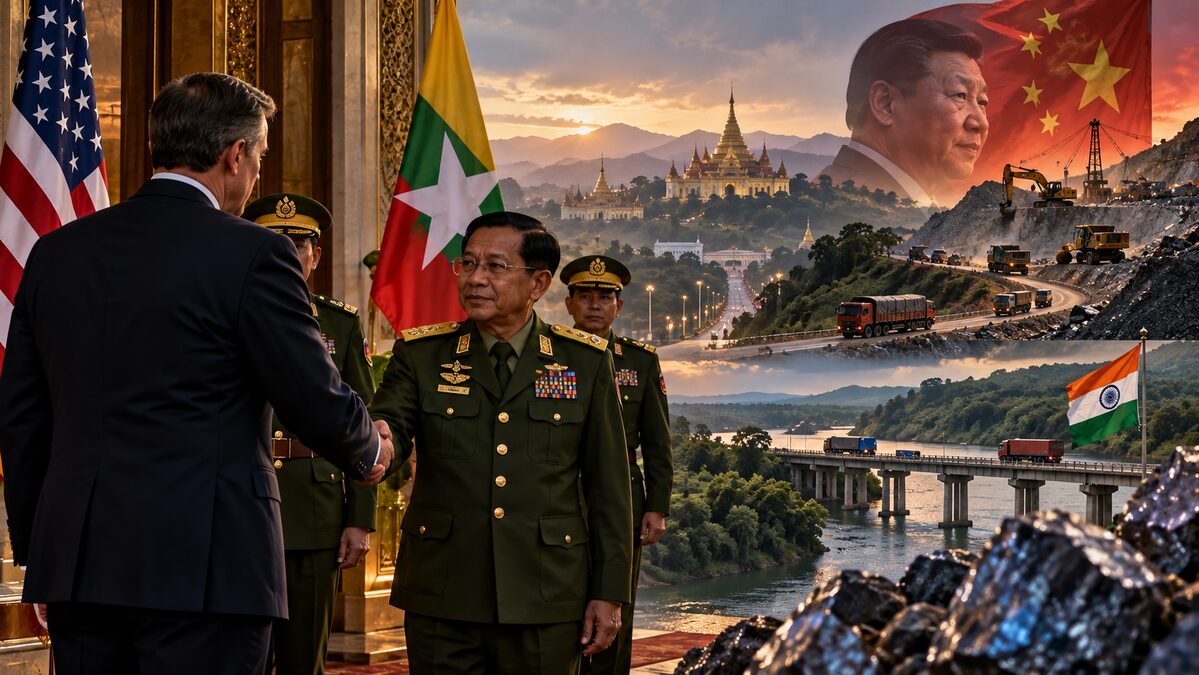
Michael Vance, a senior State Department intelligence official, met Min Aung Hlaing in Naypyitaw on 15 and 16 September. It was the most senior American contact with Myanmar’s leadership since the coup. The visit secured the release of Adam Castillo, an American businessman whom Myanmar had detained in June. Myanmar reportedly wanted a meeting with senior American officials in return, and the two sides had already met in Tokyo in June.
The State Department defends the contact. “You don’t solve problems by ignoring them,” spokesperson Tommy Pigott said.
Why did the US stop engaging with Myanmar?
Relations have swung between hostility and hope for decades. Washington turned away after the army crushed pro-democracy protests in 1988. President Barack Obama rebuilt ties once the generals began reforms in 2011, and Aung San Suu Kyi’s party went on to win elections in 2015 and 2020.
The army seized power again on 1 February 2021 and jailed Suu Kyi. The coup triggered a civil war that continues today. President Joe Biden’s administration froze Myanmar’s assets at the Federal Reserve Bank of New York and sanctioned senior officers and military-linked businesses. Senior American officials largely stayed away from Naypyitaw.
An older grievance also shapes policy. The US declared the army’s 2016-17 campaign against Rohingya Muslims a genocide. Min Aung Hlaing led the army then and still faces American sanctions.
Why is the US re-engaging now?
The Trump administration has put transactional deals ahead of democracy promotion, and three interests appear to be driving the shift.
The first is the scam centres. Fraud compounds inside Myanmar have cost Americans billions of dollars, and the FBI has contacted Myanmar’s authorities directly about them.
The second is rare earths. Myanmar ranks among the world’s biggest producers, and mines in Kachin state yield nearly half of the world’s heavy rare earths. Manufacturers need them for magnets in electric vehicles, wind turbines and weapons. Almost all of that ore travels to China for processing.
The third is China itself. Beijing controls over 90 percent of global rare-earth separation capacity, and its export curbs have pushed both the US and India to look for alternatives. China also arms Myanmar’s generals and guards its investments there, and Washington wants to loosen that grip.
How did Myanmar court Washington?
Min Aung Hlaing has worked hard for this opening. In July 2025, Trump wrote to him personally about new tariffs. The general replied with praise and asked for sanctions relief, and Washington lifted sanctions on several of his allies that month. American officials denied any link between the two. His government then hired the lobbying firm DCI Group for $3 million a year, and Trump adviser Roger Stone began consulting for the firm in April.
Min Aung Hlaing also swapped his uniform for a suit. Parliament elected him president in April.
Where does India fit in?
India never cut ties with the generals. It shares a 1,643-kilometre border with Myanmar and fears growing Chinese influence there. Prime Minister Narendra Modi hosted Min Aung Hlaing in New Delhi on 1 June, where they discussed trade, connectivity and rare earths. It was the general’s first foreign trip as president. Indian firms have also sought ore samples from Myanmar.
India matters to Washington as well. One proposal before Trump’s team would route Kachin ore through India for processing. Castillo, the businessman freed in September, championed that idea in 2025.
Will the gamble pay off?
Big obstacles remain. Ethnic armed groups, not the government, hold most rare-earth mines. The Kachin Independence Army seized the main mining belt in late 2024, and only one road links those mountain mines to India. China buys nearly all the output and could block rivals. Many scam compounds also sit in militia-held areas, and researchers say the army takes a cut of their revenue.
Critics see a moral cost as well. UN officials say a military air strike killed more than 50 people in Rakhine after the talks. Trump’s aid cuts last year ended most American programmes for the opposition. Congressman Gregory Meeks calls the shift “contrary to both our values and our interests.” State media say Suu Kyi was moved to house arrest in April.
What happens next?
American sanctions on Min Aung Hlaing remain in place for now. Washington says it still presses for an end to the violence and the release of political prisoners. Three signals will show where this is heading: sanctions relief, a minerals deal, and action against the scam hubs.
Beijing’s response matters too, since China is unlikely to surrender its position next door quietly. For Myanmar’s people, the question is simpler. Will engagement ease the war, or simply strengthen the generals?