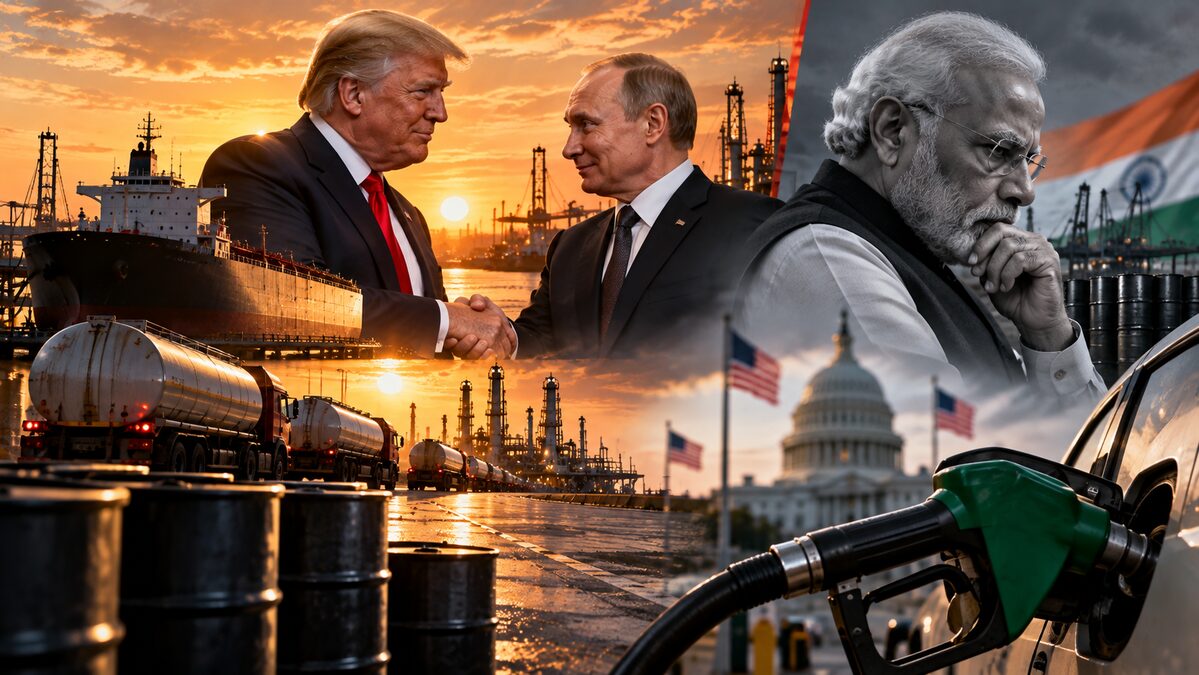
For over a year, Donald Trump has punished India for buying Russian oil. Now the Trump Russian diesel deal brings Putin’s fuel to American pumps. On 9 October, Trump announced a diesel agreement with Vladimir Putin. Russia will send millions of tonnes of diesel to American and global markets. The US Treasury then relaxed its own sanctions to let the fuel flow.
The timing explains a great deal. Americans vote in midterm elections on 3 November, and diesel prices sit near record highs. Now House Republicans are moving to block the deal. Here is what the agreement involves, and why it reeks of double standards.
What is the Trump Russian Diesel Deal?
Trump spoke to Putin by phone and then posted the news on Truth Social. He said Russia would supply over 300,000 tonnes of diesel immediately. Another 500,000 tonnes would follow in November, and one million tonnes after that. He also promised a further three million tonnes soon afterwards.
Trump claimed diesel prices would fall “IN RECORD NUMBERS, AND FAST!” To make the plan legal, the Treasury issued a temporary licence. It allows the sale, delivery and import of Russian diesel until 7 April 2027. This marks a sharp reversal. America has not imported Russian oil or gas since 2022.
Why is Trump Doing this Now?
The short answer is the price at the pump. Diesel averaged $6.28 a gallon on 8 October. Prices have risen about 70 per cent since the US-Israeli war with Iran began. Diesel powers lorries, tractors and freight trains. So costly diesel pushes up the price of almost everything. Farm states such as Iowa, Kansas and Nebraska feel the pain most. Those voters matter to Trump’s party in November.
Trump blames Ukrainian drone strikes on Russian refineries for the shortage. Several analysts point instead to the Iran war and the turmoil around the Strait of Hormuz.
Trump’s Hypocrisy?
This is where the story turns awkward for Washington.
In August 2025, Trump doubled tariffs on Indian goods to 50 per cent. His reason was simple: India was buying Russian oil. His aide Stephen Miller accused India of financing Russia’s war. In February 2026, he cut the rate to 18 per cent. He claimed India had agreed to stop buying Russian oil.
Then, in September, Trump signed a sweeping sanctions law. It lets him impose tariffs of up to 100 per cent on big buyers of Russian energy. India, the second-largest buyer of Russian crude, sits high on that list. About three weeks later, the same president struck a fuel deal with the Kremlin. Follow the logic. An Indian refiner buys Russian crude to keep fuel affordable for 1.4 billion people. Washington calls that funding a war. An American importer buys Russian diesel to calm voters before an election. Washington calls that sound policy.
The money reaches the same Kremlin either way. Only the buyer changes. There is a further irony. Russian crude shipments to India fell to 310,000 barrels a day in the four weeks to 4 October. That is the lowest level since March 2022. Price drove most of that fall, not American pressure. Still, India is buying less Russian oil just as America opens its doors to Russian diesel.
Why are House Republicans Trying to Block it?
Many of them believe the deal will pay for Putin’s war. Republican congressman Brian Fitzpatrick plans a bill to block all purchases of Russian oil. He calls it the Ronald Reagan Peace Through Strength Act. His colleague Don Bacon has agreed to support it. Fitzpatrick will use a tool called a discharge petition. If 218 members sign it, the House must vote, even if party leaders object.
Other Republicans have spoken out too. Michael McCaul warned that the cash would fuel more Russian violence. Senator Lisa Murkowski urged Trump to use his new sanctions powers instead. There is also a legal question. In 2022, Congress banned imports of Russian oil. The Senate backed that ban 100-0, and the House voted 413-9. The law bars imports until Russia meets strict conditions, including a withdrawal from Ukraine. Officials have not explained how the new licence squares with that law.
Can Congress stop the deal?
Not quickly. The House does not vote again until after the midterms. This Congress ends in January. Any bill must also pass the Senate, and Trump could veto it.
So the revolt matters more as a signal than as a barrier. It shows that members of Trump’s own party doubt his Russia policy before an election.