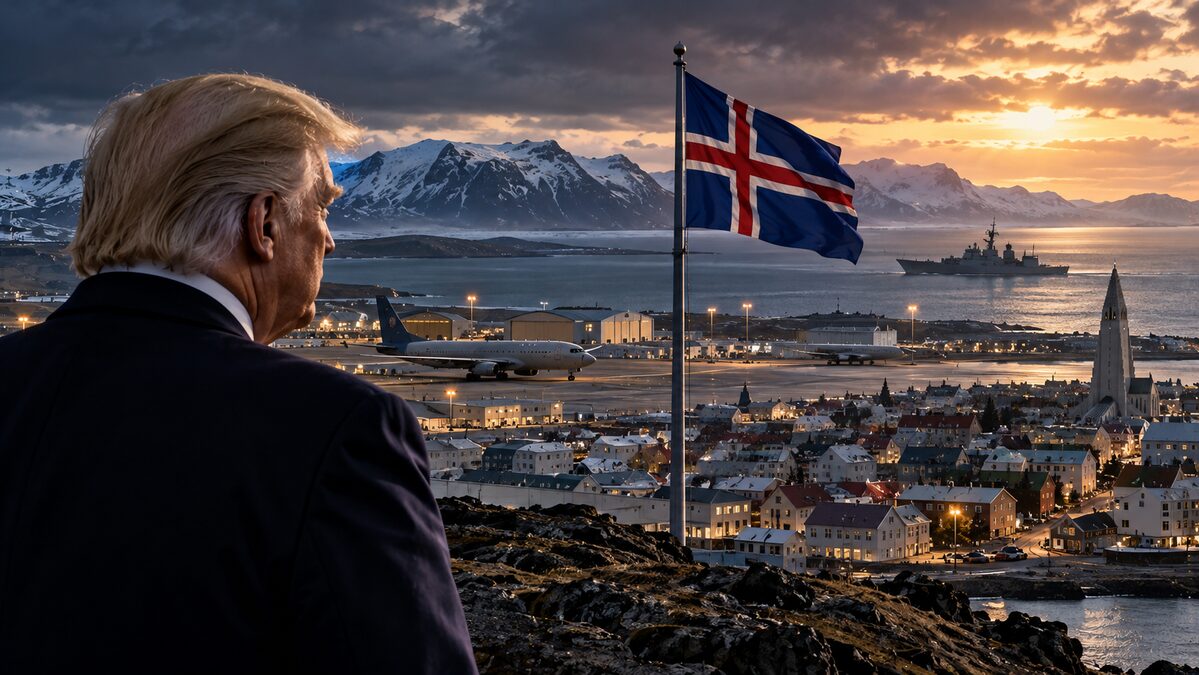
In early September, Donald Trump posted a map on Truth Social. It draped the American flag over Canada, Mexico, Greenland and Iceland. Reykjavik summoned the American ambassador and called the post “completely inappropriate”. Two weeks later, Denmark and Greenland conceded sweeping security rights to Washington. For a nation of fewer than 400,000 people, the map felt personal. Icelanders now ask a blunt question. What does Iceland after Greenland look like?
No American official has demanded anything of Iceland. Yet the reasoning behind the Greenland campaign does not stop at the Denmark Strait. Geography, trade and energy all point towards Reykjavik. So does the precedent Washington has just set.
What Washington Won in Greenland
On 22 September, three leaders signed a security pact on the sidelines of the UN General Assembly. Donald Trump, Mette Frederiksen and Jens-Frederik Nielsen put their names to it in New York.
The text gives America permanent basing rights across the island. It lets Washington expand Pituffik Space Base and open new sites at Narsarsuaq and Mestersvig. American aircraft may fly over and land anywhere in Greenland. No rival power may open a base or make a sensitive investment without American approval.
Copenhagen kept the flag. The agreement transfers neither ownership nor sovereignty. Trump read it differently. He said the deal gave America “permanent control over security, and all other needs, in Greenland”.
Why Iceland After Greenland Makes Strategic Sense
Barely 290 kilometres of cold water separate the two islands. From Russia’s Kola Peninsula, they look like a single barrier. Russian submarines must slip between Greenland, Iceland and Britain to reach the open Atlantic. Strategists call that passage the GIUK gap. Greenland guards one gatepost. Iceland stands in the middle of the gate.
America already carries the load there. A 1951 defence agreement makes Washington responsible for an ally with no standing army. The US Navy rotates P-8 submarine hunters through Keflavik air base. American construction crews are still building there. NATO launched its Arctic Sentry mission in February to tie such patrols together.
Yet that presence remains rotational. America closed its permanent base at Keflavik in 2006. Greenland’s pact now promises permanence, free movement and a veto over rival investment. A president who prizes permanence may want matching terms on both shores of the Denmark Strait. China adds a second motive. Iceland keeps its own trade deal with Beijing. Washington has just barred adversaries from sensitive investments in Greenland. It may ask Reykjavik for the same lock.
Late summer supplied a third. Allies ran August’s Northern Viking drill without American warships or combat aircraft. “We are seeing Europe and Canada step up,” said Jónas Allansson, who heads Iceland’s defence directorate. Europeans heard reassurance. A White House that guards its primacy may hear something else: allies filling an American seat.
The Economic Levers
Force is not Washington’s only tool. January’s crisis began with threats of military or economic coercion against Denmark. Iceland offers the second kind an easy target.
It is a small, open economy with about 265,000 eligible voters. America bought almost a tenth of its goods exports in 2023, World Bank figures show. Only the Netherlands bought more.
Start with tourism. Americans made up nearly three in ten foreign visitors in the year to October 2025. When the Greenland row peaked in January, American arrivals fell 27 per cent, the travel firm Guide to Iceland reported. It called the slump the steepest since the pandemic.
Metal matters even more. Aluminium earned a third of goods export revenue in 2024, Íslandsbanki calculates. Two American companies, Alcoa and Century Aluminum, own two of the three smelters. Their profits flow to foreign owners. A tariff, a licence or a boardroom decision in America can therefore shake the whole island.
Brussels offers no shield for now. On 29 August, Icelanders rejected fresh EU membership talks by 52.8 per cent. The government has shelved the question until 2028. Iceland therefore bargains alone. It cannot borrow the Union’s weight in a trade fight.
Power, Metal and Fish
Greenland’s mineral wealth still lies under ice. Iceland has no comparable lode. Its riches already flow, as energy and fish.
The island draws almost all its electricity from hydropower and geothermal heat. Households and local firms use only a fifth. Energy-hungry industry buys the rest. Samuel Warren Scott studies geothermal systems at the University of Iceland. He calls that steady supply “the kind of generation profile that data centres are looking for”.
Artificial intelligence has noticed. By 2023, data centres consumed five to six per cent of national power. In February, America’s Equinix agreed to co-buy at North, one of Iceland’s three largest operators. Robert Praas of the Centre for European Policy Studies expects more approaches. “I can see the EEA countries receiving better offers to host US company compute,” he said.
Supply is finite, though. A new geothermal field can take ten to fifteen years to develop. Whoever secures Icelandic megawatts early will hold a scarce prize.
Then comes the sea. Cod and haddock shaped the nation’s identity and its politics. Fear for fishing grounds helped sink the EU vote. Submarine cables link the island’s servers to Europe and North America. As Arctic ice retreats, new shipping routes will pass Iceland’s shores.
Why Iceland is not Greenland
The parallel has limits. Iceland is a sovereign republic and a founding member of NATO. Pressuring it would mean bullying an ally directly, not haggling with Copenhagen.
The evidence of intent is also thin. So far, Icelanders have a joke, a slip and a map. In January, ambassador-designate Billy Long quipped about a “52nd state” and later apologised. Days afterwards in Davos, Trump said “Iceland” four times while discussing Greenland.
Icelanders also resist pressure by habit. They won the Cod Wars against Britain in the 1970s. They have just said no to Brussels. Many now view Washington warily. Finally, the Greenland deal may satisfy the appetite. It delivered bases without annexation. Iceland already hosts American forces willingly. Washington has not walked away, either. American planners helped design August’s drill. In August, Prime Minister Kristrún Frostadóttir spoke of “close and good” defence cooperation between the two countries.
The Harder Bargain
So the likeliest danger is not annexation. It is a harder bargain: permanent basing, an investment veto and privileged access to power. Greenland showed that such bargains can follow pressure, not persuasion.
Iceland has no soldiers to refuse with. It has a parliament, a coastguard and a long memory of standing its ground. It also has what a power-hungry century wants: clean electricity, cold air and a commanding address.
In January, a diplomat’s joke drew a petition. In September, a president’s map drew a summons. Reykjavik now waits to see what the next post draws.