Yemen’s Houthi rebels want a missile that can strike Israel. Chinese parts and Iranian know-how now bring that goal within reach, and the ties between China and the Houthis are under a harsh spotlight.
A UK arms-tracking group has traced missile parts bound for the Houthis back to a Chinese factory. The parts fit a home-made copy of Iran’s Kheibar Shekan ballistic missile.
The discovery raises an awkward question. Saudi Arabia is one of China’s biggest crude suppliers, and Riyadh is fighting the Houthis right now. So why does Chinese hardware keep reaching its enemy? The answer shows how Beijing plays every side in the Middle East. Here is what you need to know.
What did investigators find?
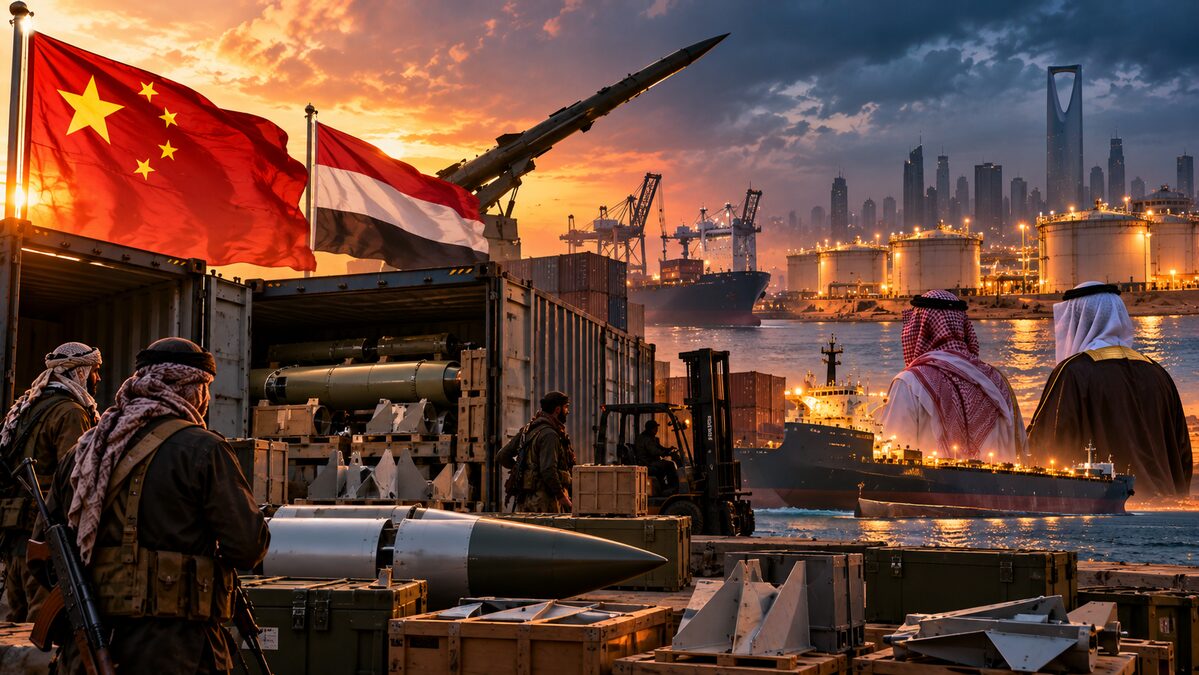
Conflict Armament Research (CAR) examined four shipping containers that reached Yemen’s Aden Free Zone from China in 2025. Yemeni government forces intercepted the cargo before it reached the Houthi-held port of Hodeidah.
Inside, investigators found custom airframe parts, stabilising fins and components for a solid-fuel rocket motor. A Chinese firm that advertises bespoke aerospace parts made them.
CAR says the Houthis have moved beyond reassembling Iranian kits. They now aim to build long-range missiles themselves.
How far could the new missile fly?
Estimates put its range at roughly 1,800 to 1,900 kilometres. Iran’s own Kheibar Shekan flies about 1,450 kilometres. The extra reach would put all of Israel and much of the Gulf within striking distance.
The Houthis’ existing Palestine-2 variant already manoeuvres at about 6,000 km/h as it dives, a speed that helps it dodge interceptors. The threat is real. A Houthi strike on Riyadh’s main airport killed 13 people on 10 October, the worst Houthi attack on the kingdom since 2015.
How much does China rely on Saudi Arabia?
A great deal. China is Saudi Arabia’s largest trading partner, and the kingdom is China’s largest trading partner in the Middle East. Two-way trade reached $107.5bn in 2024, and China bought 78.6 million tonnes of Saudi crude that year.
Across the region, China trades about $300bn a year with the six Gulf Arab monarchies. Roughly half of its oil imports come from the Middle East.
Is Beijing arming the Houthis?
Officially, no. Beijing denies sending weapons and says it respects the UN arms embargo on the group. The evidence, however, keeps piling up. UN reports name Chinese companies as the biggest source of contraband bound for the Houthis.
In 2025, Washington accused Chang Guang Satellite Technology, a military-linked firm, of supplying imagery for Houthi attacks on ships. The US Treasury has also sanctioned a Chinese logistics firm for shipping dual-use parts.
Why would China look the other way?
Three motives stand out.
The first is safe passage. In 2024, Houthi leaders promised Chinese and Russian ships a safe route through the Red Sea.
The second is a distracted America. The Iran war ties up US warships and munitions, leaving China freer to pursue its own goals.
The third is Iran itself. China bought more than 80 per cent of Iran’s seaborne oil exports in 2025, and Beijing has little appetite for squeezing Tehran’s allies.
Doesn’t this risk China’s Gulf ties?
It does, and Beijing knows it. The Bab el-Mandeb strait off Yemen carries Chinese exports to Europe, and China runs a naval base in nearby Djibouti.
Gulf Arab states and Iraq matter far more to China than Iran does. Beijing simply prefers not to choose between them.
In 2023, Beijing brokered the deal that restored Saudi-Iranian ties. That success gives it rare sway in both capitals.
The balancing act has limits. In September, Riyadh turned to Beijing after rapid Houthi advances near the strait. China then reportedly urged Tehran in private to rein in the group. Tehran replied that regional calm depends on ending the US-Israeli war against Iran.
Where does Iran fit in?
Iran remains the Houthis’ chief patron, supplying missile blueprints, components and engineering advice.
But war and a US blockade have squeezed Iran’s supply lines, so the Houthis now shop more directly in China.
What happens next?
The findings will test Beijing’s claim of neutrality. Israel now faces a growing long-range threat from the south, and Saudi Arabia must decide how hard to press its biggest customer.
For China, the calculation stays the same: cheap oil, open sea lanes and a busy America. Turning a blind eye to Houthi supply chains serves all three goals, at least until the fire spreads to Chinese interests.