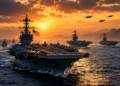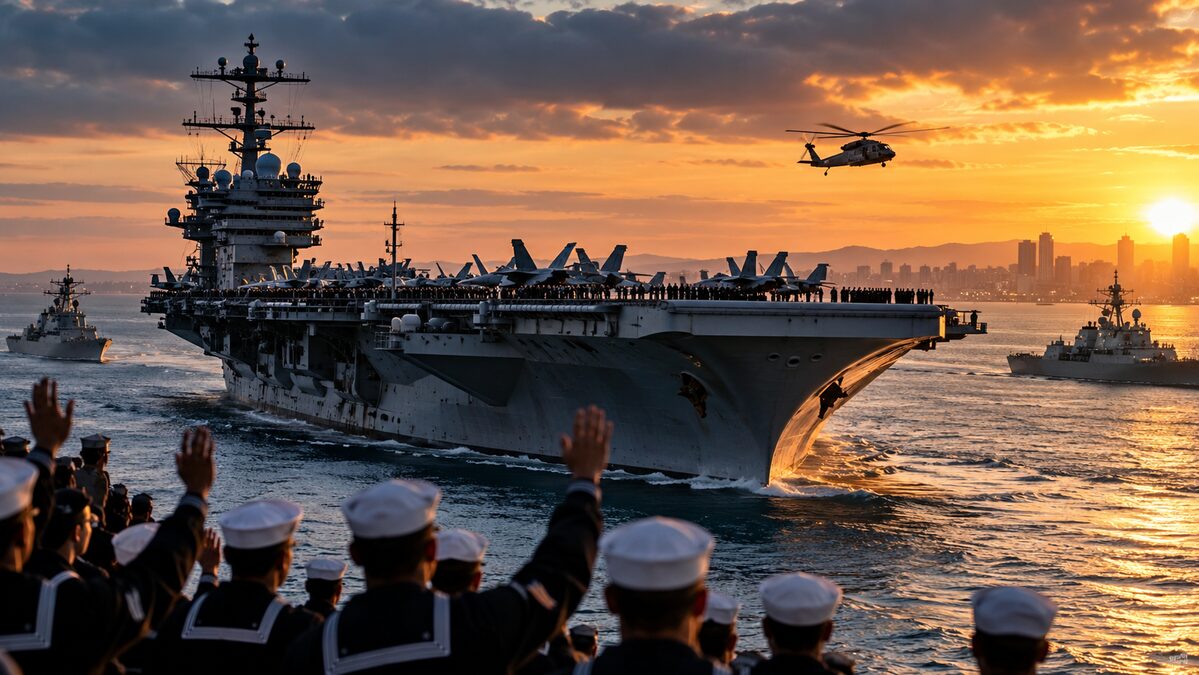
The USS Abraham Lincoln deployment ends in San Diego on Thursday, 8 October, after 321 days away from home. Only one US aircraft carrier has stayed out longer since the Cold War. A day earlier, US Defence Secretary Pete Hegseth flew to the ship and gave its crew the Presidential Unit Citation. It is the highest honour a US military unit can receive.
The ship fought in the Iran war and set a Navy record for time without a port stop. It also drew complaints about food, living conditions and the mental health of its crew.
Where the Ship Went
The Lincoln is a nuclear-powered aircraft carrier with nearly 5,000 sailors and Marines on board. It left San Diego on 21 November 2025, and the Navy planned to bring it home in May. The ship made a one-day stop at Guam in December and reached the Middle East in January.
On 28 February, the US and Israel began air strikes on Iran. The Lincoln and its escort ships fought for 40 days in a row, Defence Industry Europe reports. They then joined a US blockade of Iranian ports near the Strait of Hormuz. Another carrier, USS George Washington, replaced the Lincoln in August. The crew went ashore in Thailand on 2 September, their first break in months, KATU reports.
Why the Crew Stayed Out So Long
A carrier usually spends six to seven months away. The Lincoln spent more than 10. Hegseth told the crew that he had extended their deployment twice. “I plead guilty,” he said. He said the mission required it. The Navy also had few carriers to spare. A fire forced USS Gerald R Ford to leave the region in March. That left the Lincoln as the only US carrier near Iran.
By August, four of the Navy’s 11 carriers were under repair or waiting for it. The replacement came from Japan, which left the western Pacific without a US carrier.
What Went Wrong on Board
Families described food shortages and broken toilets and showers. In April, the Navy called the first reports of food shortages “false”. It later said that fighting had disrupted its supply bases in the region. An Iranian missile and drone attack destroyed the Navy’s base in Bahrain, the ship’s main supply point. Acting Navy Secretary Hung Cao said the ship briefly cut meal choices from two to one.
Mental health became the second concern. The Navy told lawmakers that eight sailors attempted suicide during the deployment. One sailor went overboard, and the crew quickly recovered that sailor. Experts said that the number is low for 6,000 sailors over 10 months. President Donald Trump said in August that the deployment was “not nearly long enough”. Hegseth said reports about the ship were “completely misrepresented”.
Democratic Senator Ruben Gallego called the treatment of sailors “not just disgusting; it’s dangerous”. Admiral Brad Cooper, who commands US forces in the Middle East, visited the ship in August. He said it had “among the lowest number” of mental health cases of any carrier.
What the Award Means
The Presidential Unit Citation honours “extraordinary heroism in action against an armed enemy”. Hegseth read the citation on the flight deck. It says the Lincoln group flew 3,693 combat missions and dropped 1.37 million pounds of munitions on Iran. Its escort ships fired 450 Tomahawk cruise missiles.
The group also shot down 77 attack drones and helped sink 64 Iranian warships, the citation says. In his speech, Hegseth put the number of ships at 59 .
“You have changed the arc of history,” Hegseth told the crew.
Hegseth accused some media of turning the ship into “a symbol of dysfunction”, ABC News reports.
The crew of the Ford received the same award after its own 326-day deployment, AP reports.
What Happens Next
The Navy says it has learnt from the Lincoln. USS Theodore Roosevelt left San Diego a week ago for the Middle East with extra food and hygiene supplies. Its crew turned spare rooms into storage. The Lincoln faces a major repair period in dry dock. Admiral Daryl Caudle, the Navy’s top officer, said in June that the ship would likely move to Washington state. Hegseth said in August that the US could maintain the blockade “indefinitely”, AP reported. TWZ warns that longer deployments lead to longer repairs and fewer ships ready to sail.
The award settles what the crew achieved. It does not settle whether the Navy asked too much of them.