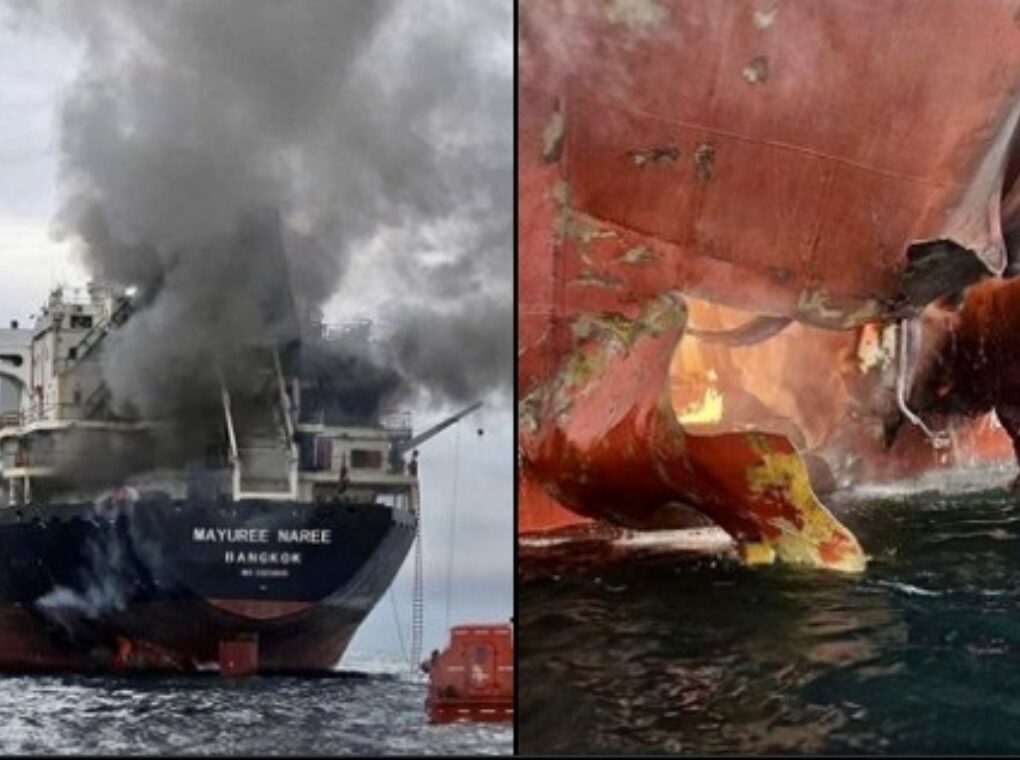
In a troubling escalation of tensions in the Middle East, a Thai-flagged cargo vessel has been struck by projectiles while transiting the strategically vital Strait of Hormuz, leaving three sailors missing and highlighting the growing dangers for commercial shipping caught in the crossfire of the ongoing Iran conflict.
The bulk carrier Mayuree Naree was attacked on March 11, 2026, roughly 11 nautical miles north of Oman. The incident occurred as the vessel attempted to pass through the narrow waterway—one of the most critical arteries for global energy shipments and international trade.
Despite Thailand having no direct involvement in the ongoing Iran-US-Israel tensions or the military campaign known as Operation Epic Fury, the Thai ship became the latest casualty in a string of attacks targeting vessels navigating the volatile maritime corridor.
A Routine Commercial Voyage Turns Into Crisis
The Mayuree Naree is a 178-meter bulk carrier with a deadweight capacity of over 30,000 tonnes. Built in 2008, the vessel is operated by Precious Shipping Public Company Limited, a Bangkok-based maritime firm listed on the Thai stock exchange.
At the time of the attack, the vessel was conducting routine commercial operations, transporting cargo through the Strait of Hormuz, which links the Persian Gulf with the Gulf of Oman.
Thailand maintains a neutral position in the regional conflict. The country has not hosted foreign military strikes, participated in coalition operations, or taken political positions supporting either side. For Thai vessels, passage through the strait is purely commercial—part of normal global shipping routes used to transport commodities worldwide.
Yet neutrality offered little protection in a rapidly militarizing environment.
Attack and Emergency Evacuation
According to maritime reports, the ship was struck by at least one projectile—possibly two—which triggered a fire that quickly spread to the vessel’s engine room. Thick smoke engulfed the ship as the 23-member Thai crew scrambled to respond to the emergency.
Nearby Omani naval forces launched a rescue mission soon after receiving distress signals. Twenty crew members were evacuated in lifeboats and transported safely to the port city of Khasab.
However, three crew members remain missing.
Officials fear the sailors may have been trapped in the engine room when the fire broke out. Search-and-rescue operations are ongoing, coordinated by the Royal Thai Navy, Omani authorities, and the vessel’s operator.
After several hours, emergency crews managed to bring the fire under control. The damaged ship remains afloat but immobilized in hazardous waters, guarded by a skeleton crew.
Multiple Ships Hit in a Single Day
The Mayuree Naree was not the only vessel struck during the incident. The United Kingdom Maritime Trade Operations reported that at least three commercial ships were targeted in the strait on the same day.
Among them were:
ONE Majesty, which sustained minor damage
Star Gwyneth, also hit but with no reported injuries
These incidents bring the number of confirmed maritime attacks in the region since the conflict began to at least fourteen.
Security analysts believe the attacks match tactics used by Iran’s Islamic Revolutionary Guard Corps. The IRGC has previously warned that the strait could be considered effectively “closed” to vessels linked to nations involved in the conflict.
Their operational doctrine—often referred to as the Mosaic Doctrine—relies on autonomous regional units capable of launching missile strikes, drones, and fast-boat attacks with minimal centralized control.
US Naval Presence and Rising Risk for Shipping
The escalating threat to maritime trade comes despite the presence of significant American naval power in the region.
The United States has deployed multiple aircraft carriers, including the USS Abraham Lincoln, USS Gerald R. Ford, and USS George H.W. Bush, to nearby waters.
However, reports indicate that the United States Navy has declined frequent escort requests from commercial vessels due to the heightened risk of missile or drone attacks in the narrow waterway.
Compounding the danger, several major maritime insurers—known as Protection and Indemnity (P&I) clubs—recently suspended war-risk coverage for ships passing through the strait. Without insurance protection, shipowners face enormous financial exposure if vessels are damaged or destroyed in combat zones.
Global Trade and Energy Markets at Risk
The Strait of Hormuz remains one of the most critical maritime chokepoints in the world. Roughly 20 percent of global oil supplies pass through the corridor each day, along with massive volumes of liquefied natural gas and containerized cargo.
Before the conflict escalated, as many as 138 ships per day safely navigated the route.
Now, shipping companies are reconsidering their strategies. Some carriers are rerouting vessels around the Cape of Good Hope, a significantly longer journey that increases costs, delays shipments, and disrupts global supply chains.
Rising insurance premiums and security risks could also drive up energy prices and affect international food supply networks.
Human Cost of a Distant War
For Thailand, the incident is both tragic and sobering. The missing sailors were civilian mariners performing routine duties in international waters, far removed from the geopolitics shaping the conflict.
Families of the three missing crew members now await news as rescue teams continue searching the damaged vessel.
For the broader maritime community, the attack sends a clear message: even neutral vessels are vulnerable in today’s increasingly fragmented conflict zones.
As diplomatic efforts continue to prevent further escalation, the Strait of Hormuz has effectively become one of the most dangerous waterways on Earth.
And for sailors navigating those waters, the line between commerce and conflict has never been thinner.