
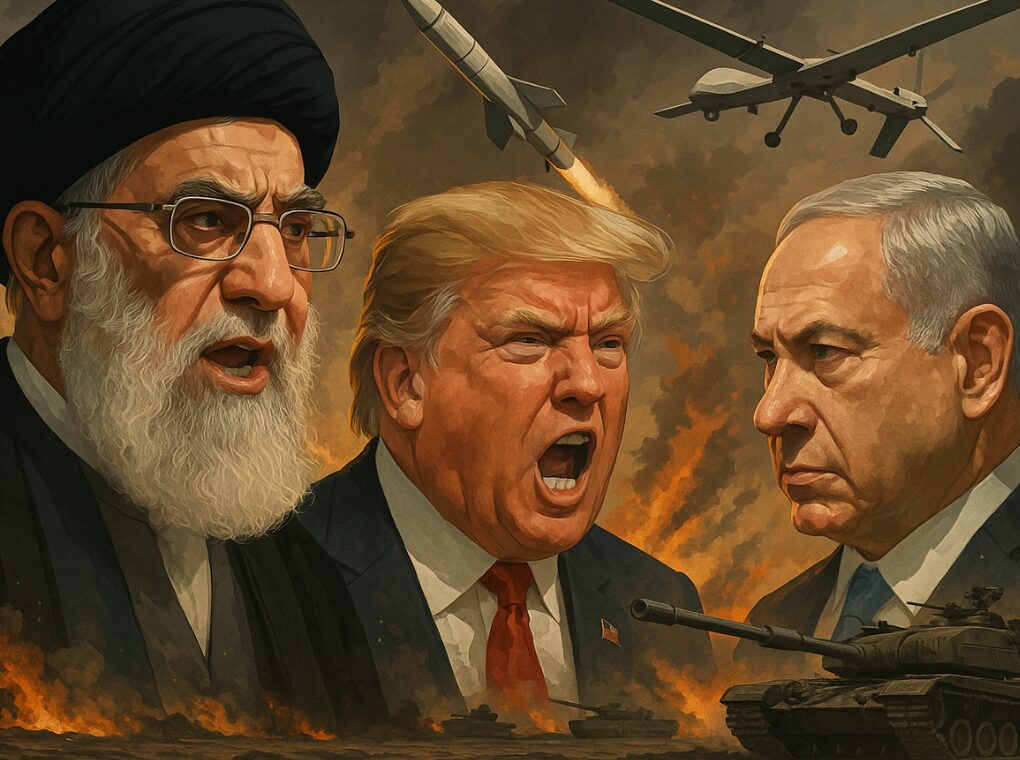
The ongoing military confrontation between Iran, Israel, and the United States has now evolved into what many observers describe as a full-scale Middle East war. Despite intense bombardments, missile exchanges, and targeted strikes on military leadership, the direction of the conflict remains uncertain.
Over the past weeks, joint military operations by the United States and Israel have reportedly unleashed thousands of tons of explosives on Iranian territory. According to various claims, thousands of missiles have been fired, and Iran’s top leadership—including figures close to the Supreme Leader—has been severely impacted by targeted attacks.
Washington has also claimed major success at sea, stating that nearly 50 Iranian naval vessels have been destroyed. However, despite these significant losses, Iran’s ability to retaliate has not been completely eliminated. More importantly, Tehran still maintains influence over the strategically critical Strait of Hormuz, a narrow waterway through which a large portion of the world’s oil supply flows.
This suggests that the war may not deliver the quick political transformation that Donald Trump and his allies hoped for.
The Failed “Regime Change” Strategy
One of the primary objectives behind the military campaign was believed to be regime change in Iran. The idea was to weaken the Islamic leadership that has governed the country since the Iranian Revolution of 1979 and potentially replace it with a more Western-aligned administration.
To achieve this, a controversial precedent was set—targeted killings of top political leadership. Historically, such tactics were used mainly against militant leaders like Osama bin Laden or Abu Bakr al‑Baghdadi, but striking nationally recognized leaders marks a major shift in international warfare norms.
Trump, known for his blunt and highly visible style of power projection, appears to have believed that eliminating Iran’s top leadership would trigger internal political collapse. The expectation was that, similar to attempted pressure strategies in Venezuela, Iranian citizens might push for a political transition once the ruling structure was weakened.
However, reality on the ground appears far more complex.
Airstrikes and surgical operations alone have not led to immediate political upheaval in Iran. Without a large-scale ground intervention—which Washington has not signaled readiness for—regime change remains uncertain.
Israel’s Strategic Gains
Ironically, one of the biggest long-term beneficiaries of this conflict could be Israel.
If viewed beyond viral battlefield footage and missile statistics, the war may significantly reshape the political narrative surrounding Palestine. For decades, Arab states publicly supported Palestinian statehood, even if their support was sometimes symbolic.
Now, the geopolitical landscape appears to be shifting.
Many Sunni-majority countries—including Saudi Arabia, Egypt, Qatar, and Oman—are increasingly prioritizing security concerns related to Iran. Some of these states may find themselves aligned more closely with Israel against Tehran’s regional influence.
Meanwhile, Israel has already significantly weakened Iran-backed militant groups such as Hamas in Gaza and Hezbollah in Lebanon. If Iran becomes further weakened, these groups may struggle to recover operational strength.
Another potential outcome is the normalization of Israel’s position in the region. Arab nations that once kept diplomatic distance may increasingly see Israel as a strategic partner for security and technological cooperation.
Iran’s Unexpected Strategic Advantage
Despite facing heavy destruction, Iran may still emerge with certain long-term advantages.
By continuing to resist a powerful coalition, Tehran demonstrates resilience that could strengthen its position among countries challenging U.S. global dominance. This dynamic could bring Iran closer to strategic partners such as Russia and China.
If the conflict drags on, these powers may gradually increase economic, technological, or military support for Iran—without directly confronting the United States.
Iran also possesses enormous geopolitical value. The country sits at the crossroads of major regions, connecting Afghanistan, Turkey, and Central Asia. Combined with its vast natural resources and proximity to global energy routes, Iran could become an even more valuable partner for China’s regional ambitions.
In this scenario, Iran could play a role similar to Israel’s—serving as a key strategic anchor for an opposing geopolitical bloc.
China’s Calculated Silence
Among all major powers, China appears to be taking the most cautious approach.
Rather than reacting aggressively, Xi Jinping’s government has focused primarily on protecting energy supply lines and maintaining economic stability. China’s broader strategy revolves around technological innovation, manufacturing dominance, artificial intelligence, and robotics.
With strong control over rare earth minerals and global manufacturing supply chains, China’s economic influence continues to grow regardless of the conflict.
Additionally, prolonged instability in the Middle East could increase global demand for affordable military equipment—an area where Chinese defense exports are becoming increasingly competitive compared to expensive Western systems.
Why Trump Could Be the Biggest Loser ?
Paradoxically, while several global players appear to gain strategic advantages from the conflict, Trump’s political gamble may not yield the outcome he expected.
Israel strengthens its regional legitimacy. Iran demonstrates resilience and gains potential backing from major powers.
China expands its economic and geopolitical influence.
But the original U.S. objective—quick regime change in Tehran—remains uncertain.
If the war drags on without decisive political results, critics argue that Trump’s aggressive strategy could ultimately damage American credibility rather than strengthen it.
In that scenario, the war that was meant to reshape the Middle East might instead reshape Trump’s political legacy—possibly casting him not as a decisive strategist, but as the biggest miscalculation in the conflict.