
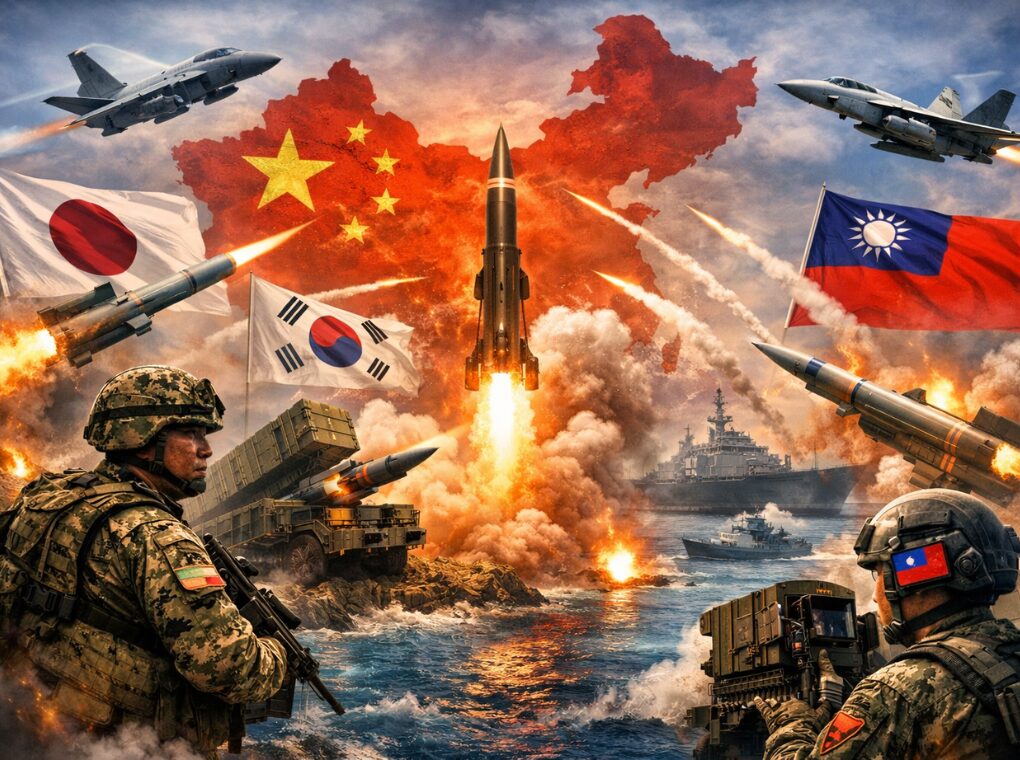
East Asia is undergoing a profound military transformation, with missile capabilities emerging as the centerpiece of regional defense strategies. As tensions intensify due to the growing military assertiveness of China and the persistent threat from North Korea, three key U.S.-aligned powers—Japan, South Korea, and Taiwan—are accelerating their missile programs along distinct but strategically interconnected paths. The result is a rapidly evolving “missile age” that could redefine deterrence and conflict dynamics in the region.
Japan Shifts from Defense to Counterstrike Capability
For decades, Japan maintained a strictly defensive military posture under its post-World War II pacifist constitution. However, rising regional threats have prompted Tokyo to rethink its strategic limitations. Increasing military pressure from China and frequent missile tests by North Korea have pushed Japan to develop more robust counterstrike capabilities.
Japan is significantly upgrading its indigenous missile systems, particularly the Type 12 surface-to-ship missile. Originally limited to around 200 km, enhanced variants are expected to reach ranges of up to 1,000 km, with future upgrades potentially extending beyond 1,200 km. These missiles are likely to be deployed across Japan’s southwestern islands, forming a defensive arc that could also support operations around Taiwan in the event of a crisis.
In parallel, Japan is working on long-range cruise missiles modeled on systems like the U.S. Tomahawk, with projected ranges between 1,500 and 3,000 km. Even more significant is Tokyo’s development of hypersonic weapons, including the Hyper-Velocity Gliding Projectile (HVGP), expected to be operational by 2026–2027. These advancements signal a major doctrinal shift—from passive defense to proactive deterrence.
South Korea Builds a Full-Spectrum Missile Arsenal
Unlike Japan, South Korea faces no constitutional constraints on missile development and has pursued an aggressive, full-spectrum missile strategy. Driven primarily by the threat from North Korea, Seoul has developed one of the most advanced conventional missile arsenals in the world.
Central to this effort is the Hyunmoo missile family. Early versions were limited in range, but newer variants have significantly expanded capabilities. The Hyunmoo-2 series now includes missiles capable of reaching up to 800 km, covering all of North Korea and beyond.
More striking is the development of the Hyunmoo-5, a massive 36-ton missile equipped with an 8-ton conventional warhead and a range of up to 3,000 km. Often described as a “bunker buster,” this weapon is designed to penetrate hardened underground facilities, including North Korea’s nuclear infrastructure. While non-nuclear, its destructive power places it among the most formidable conventional weapons globally.
South Korea is also advancing in hypersonic technology, with the Hycore cruise missile reportedly achieving speeds of Mach 6. Designed for launch from land, sea, and air platforms, this system reflects Seoul’s ambition to maintain technological superiority and ensure rapid-response capabilities in a crisis.
Taiwan Focuses on Asymmetric Missile Defense
Taiwan’s approach differs significantly from both Japan and South Korea. Facing the overwhelming military power of China, Taipei has adopted an asymmetric defense strategy centered on survivability and denial rather than direct confrontation.
Taiwan’s missile programs are less transparent, but key systems include the Tien Kung series, with ranges of up to 300 km, and the Hsiung Feng II anti-ship missile, capable of targeting maritime threats and potentially coastal assets in mainland China. These systems are designed to complicate any invasion scenario by targeting Chinese naval forces before they reach Taiwan’s shores.
More importantly, Taiwan is investing heavily in long-range anti-ship missiles with ranges between 600 and 1,000 km. These weapons aim to disrupt Chinese fleet movements and establish a “denial zone” around the island. Rather than matching China missile-for-missile, Taiwan is focusing on precision strikes and mobility to offset its disadvantages.
A Region Redefined by Missile Deterrence
The combined military developments in Japan, South Korea, and Taiwan highlight a broader regional shift toward missile-centric warfare. Each country is responding to the same strategic pressures but in different ways—Japan by expanding its strike capabilities, South Korea by building overwhelming conventional firepower, and Taiwan by adopting asymmetric denial strategies.
This transformation is taking place within the broader security framework led by the United States, which continues to play a central role in shaping regional deterrence. However, the increasing autonomy and technological sophistication of these allies suggest a more distributed and flexible defense architecture.
The implications are significant. Longer-range missiles, hypersonic speeds, and multi-domain launch capabilities are compressing decision-making timelines and increasing the risk of rapid escalation. In such an environment, even limited confrontations could spiral quickly into larger conflicts.
East Asia is indeed entering a missile age—one defined not just by the quantity of weapons, but by their speed, range, and precision. As China and North Korea continue to expand their own capabilities, Japan, South Korea, and Taiwan are responding with strategies that reflect both urgency and innovation. The result is a complex and increasingly volatile security landscape where deterrence is stronger, but the margin for error is dangerously thin.