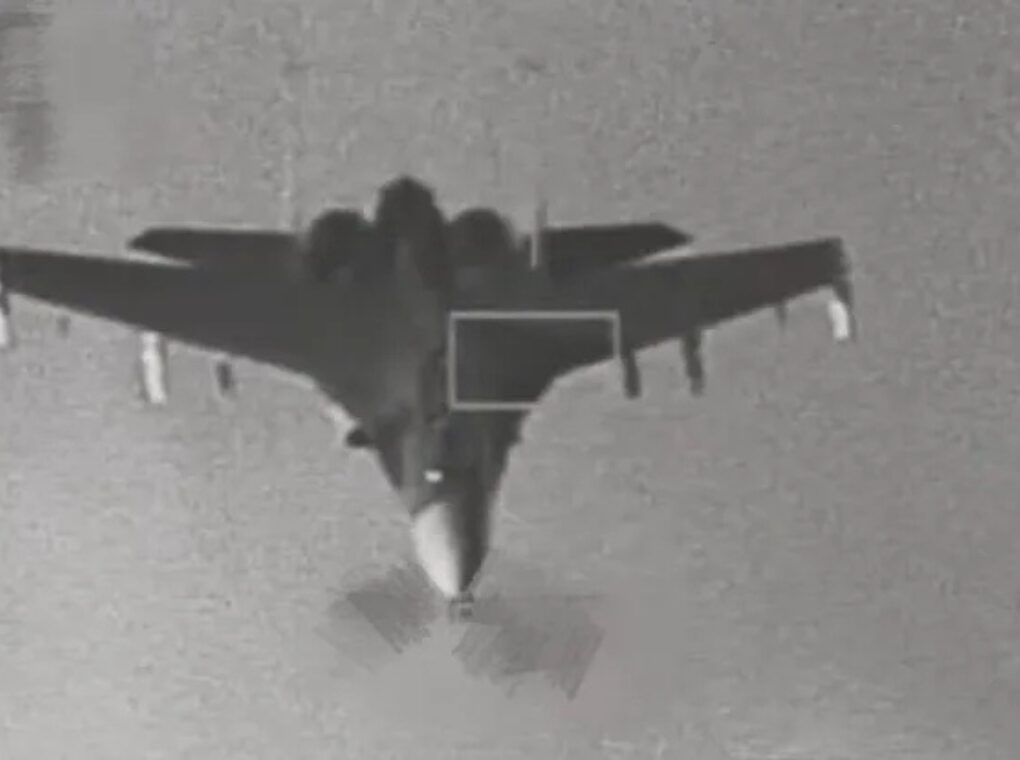
As China escalated military pressure on Taiwan through its large-scale “Justice Mission-2025” joint exercises, Taipei responded not with rhetoric but with a calculated display of military capability. The Taiwanese Ministry of National Defense (MND) released footage showing its air and naval forces actively tracking Chinese military assets during the drills—highlighting a critical tactical advantage that could reshape perceptions of air superiority in the Taiwan Strait.
At the center of the footage is a Republic of China Air Force (ROCAF) F-16V “Viper” fighter jet silently monitoring a Chinese PLA Air Force (PLAAF) Shenyang J-16 multirole fighter. Unlike traditional radar-based tracking, the Taiwanese jet relied on the AN/AAQ-33 Sniper Advanced Targeting Pod, a passive electro-optical system that emits no detectable signals. This means the Chinese aircraft may have been unaware it was being tracked—or even “locked on.”
Military analysts consider this a significant development. According to Shu Hsiao-huang, associate research fellow at Taiwan’s Institute for National Defense and Security Research, passive targeting systems like the Sniper pod provide a decisive tactical edge by allowing pilots to monitor and engage enemy aircraft without triggering radar warning receivers. In real combat conditions, this capability could enable a surprise engagement using weapons such as the AIM-9X Sidewinder short-range air-to-air missile.
The video, titled “Resilient Taiwan, Steadfast Defense,” also shows a Taiwanese Cheng Kung-class frigate tracking a Chinese Type 054A frigate, underscoring the joint air-sea readiness of Taiwan’s forces. The MND’s decision to publicly release the footage appears deliberate, serving as a counter to the psychological and cognitive warfare elements embedded within China’s exercises.
China’s Largest Taiwan Drills Yet
The PLA Eastern Theater Command announced that “Justice Mission-2025” would involve live-fire drills and simulated air and naval blockades across multiple zones surrounding Taiwan. These exercises mark China’s seventh major military operation around the island since former U.S. House Speaker Nancy Pelosi’s visit in 2022.
More notably, this is the first PLA exercise since Japan publicly linked a Taiwan blockade to a potential legal trigger for Japanese military action, signaling broader regional implications. It also follows Washington’s approval of an over USD 11 billion arms package for Taiwan earlier this month, further intensifying Beijing’s strategic messaging.
While China has focused on demonstrating numerical and missile dominance, Taiwan’s response emphasizes precision, survivability, and asymmetric advantages.
The F-16V Upgrade: Taiwan’s Quiet Strength
Taiwan’s F-16V Block 20 fleet represents one of the most comprehensive fighter upgrade programs globally. Under the Peace Phoenix Rising initiative launched in 2016, Taiwan modernized 139 legacy F-16A/B aircraft to the Viper standard at a cost of approximately USD 4.5 billion.
These upgrades brought the aircraft to near Block 70/72 configuration, incorporating the AN/APG-83 AESA radar, Link-16 datalink, helmet-mounted cueing systems, advanced mission computers, modern cockpit displays, and enhanced survivability systems. Crucially, the Sniper targeting pod allows for long-range electro-optical tracking—up to 187 kilometers for air-to-air detection—without alerting adversaries.
Despite lacking fifth-generation stealth fighters, Taiwan’s upgraded F-16Vs offer capabilities comparable to, and in some areas exceeding, those of many U.S. Air Force F-16s.
Taiwan has also ordered 66 new-build F-16 Block 70 aircraft, though none have been delivered as of December 2025. Once operational, these jets are expected to significantly enhance Taiwan’s deterrence posture.
The J-16: Powerful, But Untested
China’s J-16 is widely regarded as one of the PLA Air Force’s most capable multirole aircraft. Derived from the Su-27 Flanker lineage, it integrates Chinese AESA radar, modern avionics, electronic warfare systems, and WS-10B engines. With nearly 400 units in service, the J-16 forms the backbone of China’s strike and air dominance missions.
Chinese state media and military analysts often label it the “world’s best Flanker,” comparing it favorably with the F-15, Rafale, and Su-30 variants. However, despite aggressive intercepts and close encounters—including a controversial 2022 incident involving an Australian P-8 Poseidon—the J-16 has never been combat-tested in an actual war.
By contrast, the F-16 platform has decades of real-world combat experience across multiple theaters.
Strategic Implications
Taiwan’s footage sends a subtle but powerful message: technological sophistication and operational skill can offset numerical disadvantages. The ability to silently track advanced Chinese fighters challenges assumptions about air dominance in a potential cross-strait conflict.
As China continues to refine its blockade and coercion strategies, Taiwan’s emphasis on transparency, readiness, and precision warfare reflects a broader shift—from deterrence by numbers to deterrence by capability.
In an increasingly tense Indo-Pacific, moments like these—quiet, technical, and deliberate—may prove more consequential than the loudest military drills.