At a time when Europe is increasingly viewing China as a strategic rival, Serbia appears to be moving in the opposite direction. Even as the European Union hardens its rhetoric against Beijing — highlighted by controversial recent remarks from EU foreign policy chief Kaja Kallas that reflected mounting European frustration over China’s global rise — Serbia has quietly accelerated military cooperation with Beijing through advanced drones, missile systems, and defense technology transfers.
For Brussels, the development raises uncomfortable questions. How can a country aspiring to join the European Union simultaneously deepen defense ties with China, a power increasingly seen in Europe as a geopolitical competitor? And is Serbia, a close partner of Russia, becoming Beijing’s strategic gateway into Europe’s backyard?
Serbia’s Military Shift: From Russian Jets to Chinese Missiles
For years, Serbia has carefully balanced relationships between East and West. While officially pursuing European Union membership, Belgrade has maintained close ties with Russia and refused to fully align with Western sanctions or security policies.
Now, China is emerging as another pillar of Serbia’s defense strategy.
According to customs data reviewed by RFE/RL’s Balkan Service, Serbia’s state-owned defense industry imported goods worth nearly $280 million from China over the last two years. Although official records do not specify the exact military equipment purchased, analysts believe the imports likely involve drone technologies, missile defense systems, and new contracts tied to existing agreements.
Serbia’s military procurement strategy has become increasingly diversified. Alongside Russian-made MiG-29 fighter jets and recently acquired French Rafale aircraft, Belgrade has embraced Chinese-made defense systems that are viewed as affordable, technologically advanced, and politically easier to obtain than Western alternatives.
Data from the Stockholm International Peace Research Institute paints a striking picture: China accounted for 57% of Serbia’s total arms imports between 2020 and 2024, surpassing Russia at 20 % and France at 7.4%.
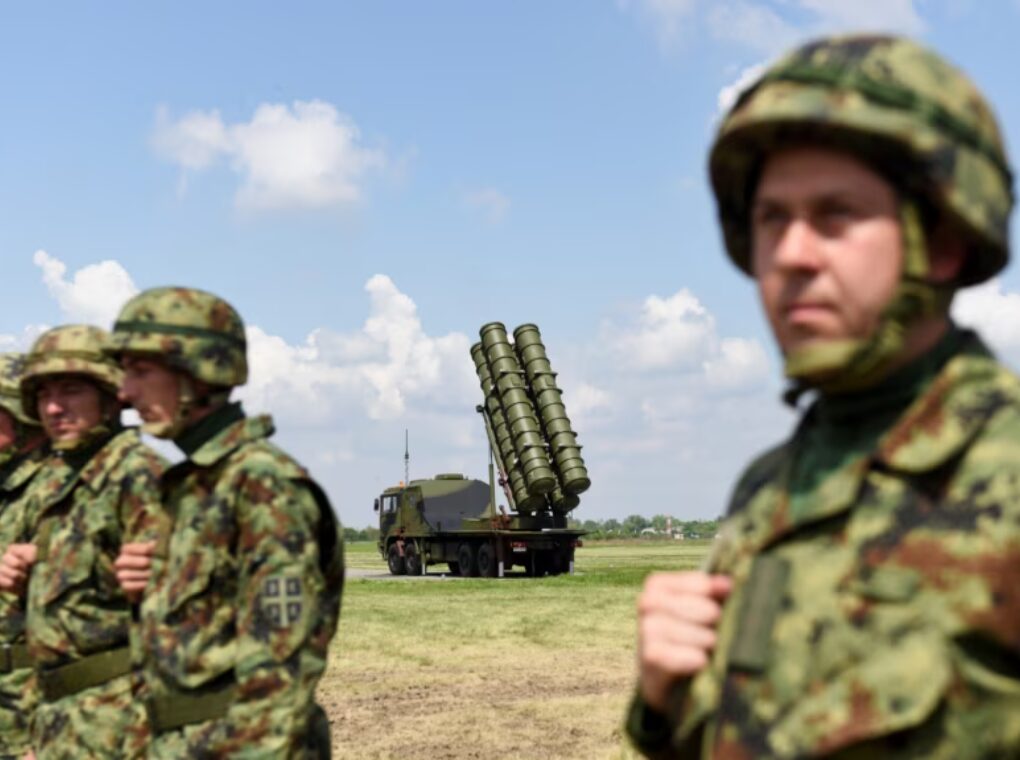
The centerpiece of Serbia’s Chinese military acquisitions remains the FK-3 medium-range air defense system — the export version of China’s HQ-22 missile platform. Defense experts view it as one of Serbia’s most expensive and strategically significant purchases in recent years.
According to SIPRI researcher Katarina Dokic, the FK-3 purchase alone likely outweighs the financial value of many other defense systems Serbia acquired over the past five years.
China’s “Steel Friendship” Expands Into Europe
Military cooperation between Serbia and China is part of a broader partnership both governments describe as a “steel friendship.”
Over the past several years, Serbia became the first European country to acquire Chinese-made CH-92 and CH-95 reconnaissance-strike drones, along with advanced missile systems such as the FK-3 and HQ-17 air defense platforms.
This matters because China historically exported such systems primarily to countries in Asia, Africa, and the Middle East. Serbia’s role as Beijing’s first major European defense customer signals China’s growing strategic footprint in a region the EU considers crucial to its future expansion.
The partnership goes beyond simple weapons purchases.
Belgrade and Beijing held joint military exercises in July 2025, despite concerns voiced by Brussels and Washington. The 10-day special forces drills in China’s Hebei Province reportedly focused heavily on drone warfare tactics, reflecting how unmanned combat technologies are becoming central to Serbia’s modernization plans.
For European policymakers already worried about Chinese influence through investments, surveillance technology, and infrastructure, military cooperation represents a much more sensitive red line.
Why Serbia Finds Chinese Weapons Attractive ?
Several practical and geopolitical reasons explain Serbia’s growing reliance on Chinese defense systems.
First is affordability…Chinese weapons are often significantly cheaper than comparable Western systems, offering advanced capabilities at lower political and financial costs.
Second is compatibility…
Many of China’s missile defense technologies draw from Soviet and Russian military designs, making integration easier for Serbia, whose armed forces still rely heavily on Russian-origin equipment.
Third, Serbia values technology transfer opportunities.
Collaboration with Chinese drone manufacturers reportedly contributed to Serbia’s domestically developed “Pegaz” combat drone program unveiled in 2022. Belgrade increasingly wants not just weapons imports but industrial cooperation that boosts local production and military self-sufficiency.
Serbian Defense Minister Bratislav Gasic has publicly emphasized that future defense ties with China will focus more on industrial exchanges and domestic production partnerships.
Defense analysts also argue Serbia has strategic limitations. Unlike NATO countries in the Balkans such as Albania, Montenegro, and North Macedonia, Serbia lacks access to many high-end Western military systems because it remains outside the alliance and continues balancing relations with Russia.
Is Serbia Eyeing China’s Top Missile Shield?
Speculation has also grown around Serbia potentially acquiring China’s HQ-9 long-range surface-to-air missile system — Beijing’s premier air defense platform with a range of nearly 200 kilometers.
Rumors intensified after reports surfaced of Egyptian military cargo planes repeatedly landing at Serbia’s Batajnica Air Base in 2025. Similar aircraft had previously been used to transport Chinese military systems.
However, there remains no confirmed public evidence that Serbia currently operates the HQ-9 system.
Open-source defense databases and government statements have not verified such deliveries. Known operators currently include Egypt, Pakistan, Morocco, Uzbekistan, and Turkmenistan.
Still, the speculation itself reflects growing concerns in Europe about the scale of Serbia-China military cooperation.
Europe’s Red Lines and Kaja Kallas’ China Frustration
The timing of Serbia’s defense pivot could not be more politically sensitive.
Recent China “Cancer” controversial remarks from EU foreign policy chief Kaja Kallas reflecting stronger frustration within European institutions toward Beijing have underscored how deeply divided Europe feels over its inability to counter China’s expanding influence.
Although Serbia officially maintains military neutrality, Brussels increasingly faces a strategic dilemma: can an EU candidate country continue building military partnerships with powers viewed as systemic rivals?
For many in Europe, Chinese drones, missile systems, and surveillance networks entering the Balkans represent more than procurement decisions — they symbolize Beijing quietly gaining strategic leverage inside the EU’s geopolitical neighborhood.
Serbia’s Delicate Balancing Act
President Aleksandar Vucic has repeatedly defended military purchases from China as transparent, legal, and necessary for Serbia’s national defense modernization.
During a visit to Beijing, Vucic acknowledged discussions on additional defense acquisitions, although he ruled out purchases of ballistic or hypersonic missiles.
Yet Serbia’s geopolitical balancing act may become increasingly difficult.
Belgrade wants closer EU integration while maintaining strong ties with Russia and deepening strategic cooperation with China. But as global rivalry intensifies and Brussels grows more assertive about its security red lines, Serbia may eventually face pressure to choose sides.
For now, however, one reality is becoming increasingly clear: while Europe debates how to respond to China’s rise, Chinese missiles, drones, and defense technologies are already finding a warm welcome in the EU’s own backyard.