
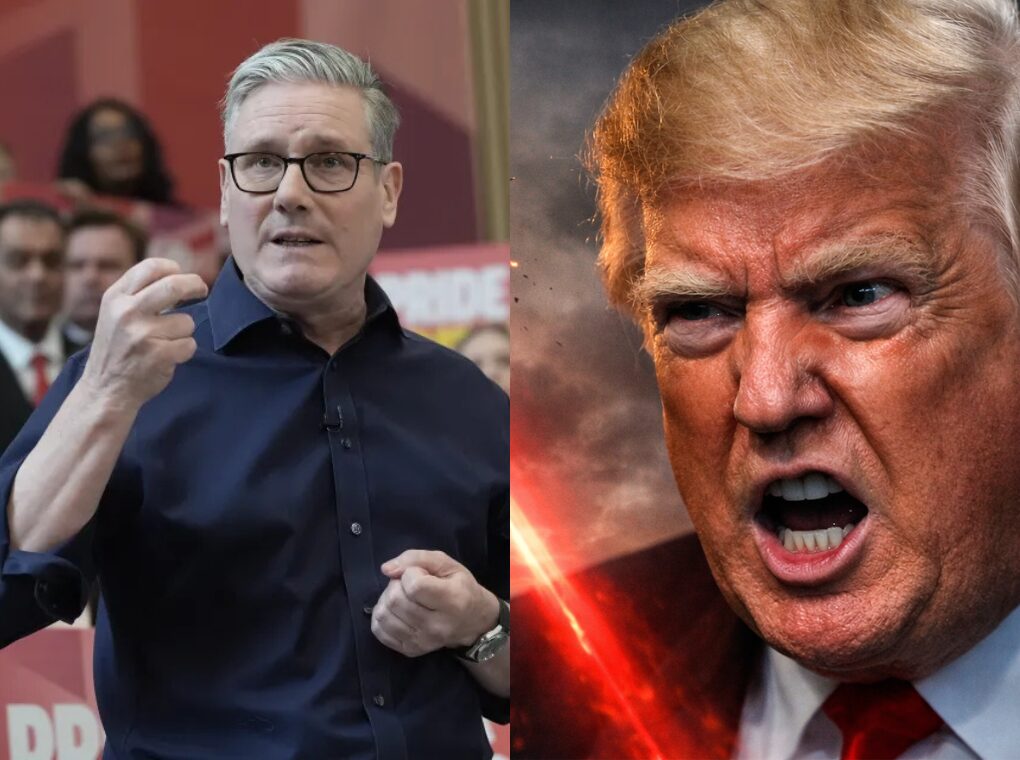
In a dramatic escalation of transatlantic tensions, U.S. President Donald Trump has launched a blistering attack on the United Kingdom, questioning its military strength and signaling that the United States could withdraw from NATO altogether.
Speaking amid the intensifying Iran conflict, Trump dismissed Britain’s military capabilities, claiming the UK “doesn’t even have a navy” and criticizing its defense infrastructure as outdated. His remarks were directed at UK Prime Minister Keir Starmer, further straining already fragile diplomatic ties between Washington and London.
Trump Questions NATO’s Relevance
In one of his most controversial statements yet, Trump described NATO as a “paper tiger” and said U.S. membership in the alliance is now “beyond reconsideration.” This raises serious concerns about the future of the decades-old military bloc that has underpinned Western security since World War II.
Trump’s remarks come as the United States faces limited support from European allies in its ongoing confrontation with Iran. Several nations, including the UK, have distanced themselves from direct military involvement, prompting frustration in Washington.
The former president also suggested that countries unwilling to support U.S. actions should take responsibility for securing critical global trade routes such as the Strait of Hormuz—a vital passage through which nearly 20% of the world’s oil supply flows.
UK Pushes Back, Focuses on Stability
Responding to Trump’s remarks, Prime Minister Keir Starmer emphasized that the Iran conflict is “not our war” and reaffirmed the UK’s commitment to strategic restraint. Speaking from Downing Street, Starmer warned that the ongoing crisis would “define the UK for a generation,” particularly due to its economic repercussions.
Rather than escalating militarily, the UK government is prioritizing diplomatic solutions. Foreign Secretary Yvette Cooper is set to host an international summit aimed at reopening the Strait of Hormuz and easing global energy disruptions.
Starmer also announced plans to strengthen ties with the European Union, signaling a potential shift in the UK’s post-Brexit foreign policy strategy. He stressed the importance of “closer economic and security cooperation” with European allies in an increasingly volatile global environment.
Economic Shockwaves and Energy Crisis
The Iran conflict is already sending shockwaves through global markets, particularly in energy. With disruptions in the Strait of Hormuz, fuel prices are rising sharply, and fears of supply shortages are mounting across Europe.
In the UK, energy bills—though temporarily reduced under the Ofgem price cap—are expected to surge again later this year. Analysts predict a sharp increase in household costs, with inflationary pressures extending to food, transport, and manufacturing sectors.
The situation has also sparked warnings from industry leaders, including airline executives concerned about potential jet fuel shortages. Meanwhile, the Bank of England estimates that over a million households could face increased mortgage costs due to the broader economic impact.
Growing Divide Between Allies
Trump’s rhetoric highlights a widening divide between the U.S. and its traditional allies. His criticism of Britain’s defense spending and renewable energy policies—mocking investments in “windmills”—reflects deeper disagreements over military priorities and economic strategies.
At the same time, UK officials are under pressure domestically to shield citizens from the cost-of-living crisis while maintaining a balanced foreign policy. Chancellor Rachel Reeves has already indicated that any government support will be targeted toward the most vulnerable households.
Global Implications
The escalating war of words between Washington and London underscores a critical moment in global geopolitics. With NATO unity under strain and major powers reassessing alliances, the outcome of the Iran conflict could reshape international relations for years to come.
As tensions rise, the world watches closely—not just for developments in the Middle East, but for the long-term consequences on Western unity, global energy security, and the balance of power.