
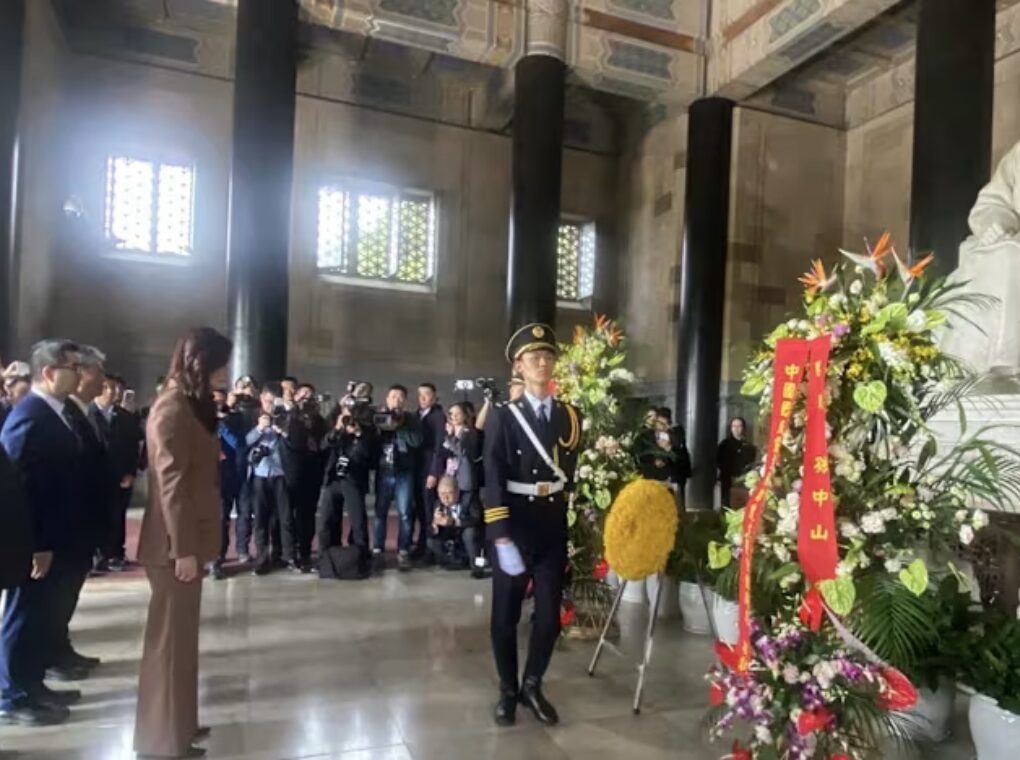
In a development that has drawn global attention, a senior leader from Taiwan’s main opposition party, the Kuomintang (KMT), has visited mainland China and publicly called for “reconciliation” across the Taiwan Strait. The visit—marked by symbolism, history, and strategic messaging—has sparked debate over whether Taiwan is shifting its long-standing stance toward Beijing or if this is primarily a political move aimed at domestic and regional audiences.
A Symbolic Visit Rooted in History
During her visit to Nanjing, the KMT leader paid tribute at the mausoleum of Sun Yat-sen, a revered figure considered the founding father of modern China by both Taiwan and mainland China. Invoking Sun’s ideals of unity and equality, she emphasized the need for peaceful engagement and cooperation between Taiwan and China.
This gesture carries deep historical resonance. The KMT once ruled mainland China before losing the Chinese Civil War to Mao Zedong’s Communist forces in 1949, after which it retreated to Taiwan. Today, Taiwan operates as a democratic system, while mainland China remains under the rule of the Chinese Communist Party.
Is Taiwan Moving Toward a “Hong Kong Model”?
Despite the headlines, it is highly unlikely that Taiwan is planning to merge with China under a model similar to Hong Kong. The “one country, two systems” framework used in Hong Kong has become deeply unpopular in Taiwan, especially after Beijing tightened its control over the territory in recent years.
Public opinion in Taiwan overwhelmingly favors maintaining the status quo or preserving de facto independence. Any formal political integration with China would require broad democratic consent—something that appears politically unviable at present.
Domestic Politics Driving the Move
The KMT’s outreach to China is better understood in the context of Taiwan’s internal political dynamics. As the main opposition party, the KMT traditionally advocates for closer economic and cultural ties with China, in contrast to the ruling Democratic Progressive Party (DPP), which takes a more cautious and sovereignty-focused approach.
The visit also comes amid a political standoff in Taiwan’s parliament over increased defense spending, highlighting divisions over how to handle rising military pressure from Beijing. By promoting reconciliation, the KMT may be positioning itself as a stabilizing alternative ahead of future elections.
China’s Strategic Messaging
For Beijing, the visit is a diplomatic opportunity. President Xi Jinping has consistently emphasized “peaceful reunification” as the preferred path forward, even as China increases military pressure on Taiwan.
Hosting a prominent Taiwanese opposition figure allows China to project an image of openness to dialogue while reinforcing its narrative that reunification is both desirable and inevitable. However, it does not necessarily indicate any immediate policy breakthrough.
Is US Influence Waning?
Some analysts link this development to broader geopolitical shifts, including perceptions of declining US influence. From tensions in Europe to conflicts in the Middle East, critics argue that Washington’s ability to protect its allies is being tested.
However, suggesting that Taiwan is abandoning the United States oversimplifies the situation. The US remains Taiwan’s most important security partner, and bipartisan support for Taiwan in Washington continues to be strong. At the same time, Taiwan—like many regions—seeks to balance security concerns with economic realities, especially given China’s role as a major trading partner.
Allegations of Chinese Influence
Claims that Taiwan’s opposition leaders are “heavily funded” by China are politically sensitive and largely unproven. While concerns about foreign influence exist globally, concrete evidence supporting such allegations in this specific case remains limited in the public domain.
It is more accurate to view the KMT’s approach as part of its long-standing political philosophy rather than a sudden shift driven by external funding.
The Bigger Picture
This visit should be seen less as a turning point and more as a reflection of ongoing tensions and competing visions for Taiwan’s future. While the rhetoric of reconciliation may ease short-term tensions, fundamental differences between Taiwan’s democratic system and China’s political structure remain unresolved.
In conclusion, Taiwan is not on the verge of merging with China. Instead, this development highlights the island’s complex political landscape, where domestic politics, historical legacy, and global geopolitics intersect. The coming months will reveal whether such engagements lead to meaningful dialogue—or remain symbolic gestures in an increasingly tense region.