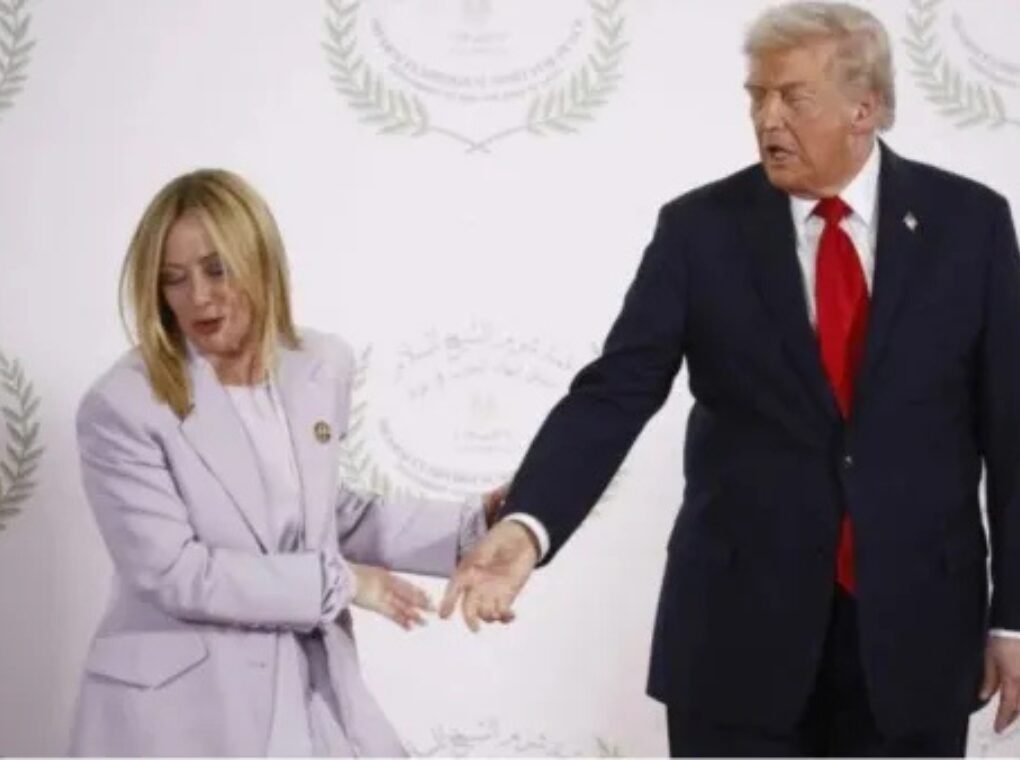
A sharp and highly publicized diplomatic rift has emerged between Italian Prime Minister Giorgia Meloni and US President Donald Trump, signaling a turning point in transatlantic relations and reshaping Italy’s political landscape ahead of the 2027 legislative elections.
The clash, triggered by disagreements over Iran, Israel, and remarks about the Pope, has not only exposed fractures within Western alliances but also provided Meloni with a domestic political opportunity to redefine Italy’s global stance.
What Sparked the Meloni–Trump Clash?
Tensions escalated after Trump publicly criticised Meloni in an interview, accusing her of lacking courage and failing to support the US-led stance on Iran. He went as far as to claim that Italy was at risk if Iran acquired nuclear weapons, suggesting that Meloni was indifferent to such threats.
Meloni responded firmly, rejecting what she described as unacceptable rhetoric. She emphasised that being an ally does not mean subservience, declaring:
“Being allies does not mean being vassals or subjects.”
Her response also included a pointed remark referencing nuclear history, indirectly criticising Washington’s tone in global conflicts.
The dispute deepened further after Meloni condemned Trump’s controversial comments regarding Pope Leo XIV, calling them inappropriate and unacceptable.
Italy’s Strategic Moves: Iran and Israel in Focus
The disagreement is rooted in broader policy differences. Italy has refused to fully back US military actions linked to the Iran conflict, reflecting a more cautious European approach.
At the same time, Meloni’s government made a significant move by suspending the renewal of a long-standing defence cooperation agreement with Israel. The agreement, originally signed in 2006, covered military collaboration, technology sharing, and defence research.
This decision followed rising tensions after Italy accused Israeli forces of endangering its UN peacekeepers in Lebanon. While experts suggest the suspension may be largely symbolic, its political implications are substantial.
Domestic Impact: A Rare Moment of Italian Unity
Interestingly, Trump’s criticism appears to have backfired politically within Italy. Leaders across the political spectrum rallied behind Meloni, framing her stance as a defence of national sovereignty.
From centre-right allies to broader political voices, there was a consensus around protecting Italy’s dignity in international relations. Italian media outlets also reflected this sentiment, portraying Meloni’s response as a stand against external pressure.
This rare unity could strengthen Meloni’s position domestically, particularly as she prepares for the 2027 elections.
From Closest Ally to Strategic Distance
Until recently, Meloni was considered one of Trump’s closest allies in Europe. She attended his 2025 inauguration and often positioned herself as a bridge between Washington and Brussels.
However, analysts suggest that maintaining this balancing act became increasingly difficult. Trump’s declining popularity in Europe, combined with diverging strategic priorities, made close alignment politically risky.
Experts argue that distancing herself from Trump is a calculated move. With Italian voters generally wary of aggressive foreign policy positions, Meloni’s stance may help her consolidate broader support.
NATO, EU, and the Limits of Alliance Politics
Despite the heated exchange, Italy’s core foreign policy commitments remain unchanged. The country continues to support NATO, align with the European Union, and back Ukraine in its ongoing conflict with Russia.
However, the episode highlights a growing challenge within Western alliances: balancing unity with national interests.
Trump has increasingly pushed for stronger military commitments from allies, while countries like Italy prefer a more measured approach. This divergence is becoming more visible as global conflicts intensify.
Political Strategy Ahead of 2027 Elections
For Meloni, the timing of this diplomatic confrontation is significant. With elections approaching in 2027, her ability to appear strong on the international stage while safeguarding national interests could prove politically advantageous.
Her governing coalition—uniting far-right, conservative, and Christian-democratic forces—relies on careful messaging and strategic ambiguity. By standing up to Trump while maintaining ties with Western institutions, she reinforces her image as both independent and pragmatic.
Global Implications of the Rift
The Meloni-Trump dispute underscores the fragility of alliances in an increasingly multipolar world. As conflicts in the Middle East and beyond continue to evolve, differences among allies are becoming harder to conceal.
Public disagreements between major leaders not only strain diplomatic relations but also influence domestic politics, as seen in Italy’s case.
Whether this rift will have long-term consequences for US-Italy relations remains uncertain. However, it clearly marks a moment where national interests took precedence over traditional alliance expectations.
The clash between Giorgia Meloni and Donald Trump is more than a war of words—it reflects deeper geopolitical shifts and domestic political calculations. By asserting that Italy is an ally, not a subordinate, Meloni has positioned herself as a leader willing to challenge even the most powerful partners.
As the 2027 elections approach, this moment could prove pivotal in shaping both Italy’s foreign policy and its internal political dynamics.