
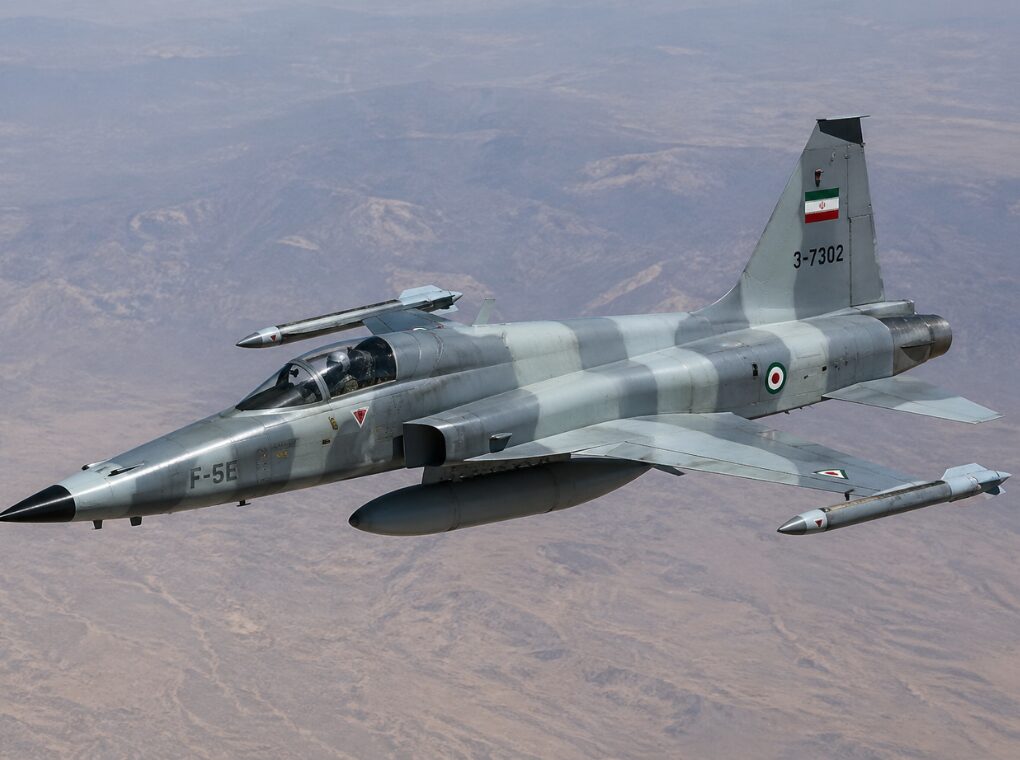
In a development that blends Cold War legacy with modern conflict, reports suggest that an aging fighter jet—famously immortalized in Hollywood—may have been used in a real-world strike against a United States military installation. According to an investigation by NBC News, an Iranian-operated Northrop F-5 fighter jet allegedly attacked Camp Buehring, a key American base in Kuwait.
If confirmed, the incident would mark a rare and significant breach of US air defences in the Middle East, raising serious questions about regional security dynamics and the evolving nature of modern warfare.
A Cold War Jet in a Modern Conflict
The Northrop F-5 is far from a cutting-edge combat platform. First introduced in the 1960s during the Cold War, the aircraft was designed as a lightweight, cost-effective fighter for allied nations. While it lacks the stealth, radar systems, and advanced avionics of modern jets like the F-35, the F-5 remains in service in several countries, including Iran.
Iran has maintained and upgraded its fleet over decades, often relying on indigenous modifications due to sanctions limiting access to Western technology. Military analysts have long cautioned that even outdated aircraft can pose a serious threat when deployed with strategic precision, particularly in low-altitude or surprise attack scenarios.
The ‘Top Gun’ Irony
What makes this reported incidence particularly striking is the cultural legacy of the aircraft involved. The Northrop F-5 gained global recognition through the 1986 Hollywood blockbuster Top Gun, starring Tom Cruise.
In the film, US Navy F-5 jets were painted black and used to portray fictional Soviet MiG-28 enemy aircraft, as actual Soviet fighters were unavailable for filming. The portrayal cemented the F-5’s image in popular culture as the “enemy jet.”
Decades later, the same aircraft model—originally American-made—is now reportedly being used by Iran against US forces, creating a moment of historical and symbolic irony that has captured global attention.
Target: Camp Buehring
The reported strike targeted Camp Buehring, a major US military installation in Kuwait that plays a crucial role in logistics, troop deployment, and regional operations under US Central Command.
A successful attack on such a facility would not only have operational implications but also deliver a symbolic blow, demonstrating vulnerabilities in American defensive systems in a highly strategic region.
According to NBC News, US officials described the incident as one of the first in years where an enemy fixed-wing aircraft directly struck a US base. The attack is believed to be part of a broader Iranian campaign targeting multiple American facilities across the Middle East amid escalating tensions.
Pentagon Silence and Political Questions
The report has also sparked debate within Washington. Lawmakers are reportedly seeking clarity on the scale of the damage and the effectiveness of US air defence systems.
However, the United States Department of Defense (Pentagon) has declined to disclose detailed battle damage assessments, citing operational security concerns. Officials have maintained that US forces in the region remain fully operational.
This lack of transparency has drawn criticism, especially as the Pentagon pushes for increased defence spending. Some congressional aides have expressed frustration over being asked to approve larger budgets without full visibility into emerging threats and vulnerabilities.
Strategic Implications
Beyond the immediate damage, the reported strike underscores a broader military reality: technological superiority does not guarantee invulnerability.
The use of an older platform like the Northrop F-5 highlights how asymmetric tactics—leveraging surprise, timing, and unconventional approaches—can challenge even the most advanced defence systems.
For Iran, such an operation, if verified, would signal its ability to project power despite technological constraints. For the United States, it raises pressing questions about air defence readiness, particularly in a region marked by rising geopolitical tensions.
While official confirmation and detailed assessments remain limited, the reported use of a decades-old fighter jet in a high-stakes military strike has already reshaped the narrative around modern warfare. The intersection of pop culture history and real-world conflict adds a layer of irony, but the strategic implications are anything but cinematic.
As more information emerges, the incident could become a case study in how legacy systems, when used creatively, continue to influence the balance of power in contemporary conflicts.