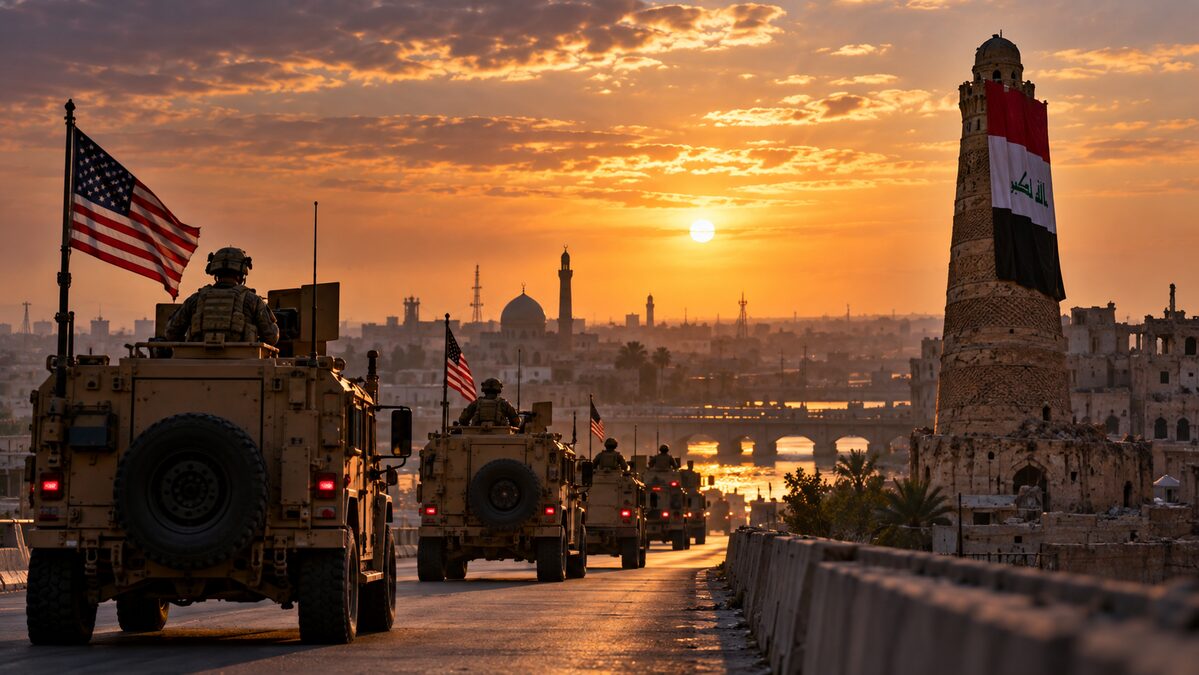
In Mosul, a giant Iraqi flag now drapes the rebuilt al-Hadba minaret. Islamic State fighters blew up that leaning tower in 2017. Today, it marks a moment few Iraqis dared to imagine: the last US troops exit Iraq, along with their coalition partners. Baghdad has declared a three-day holiday for “Sovereignty Day.” Yet beneath the bunting, many Iraqis quietly ask a harder question: what comes next?
Two Decades, Two Departures
The story began in March 2003, when a US-led force invaded Iraq and toppled Saddam Hussein within weeks. Victory proved fleeting. A brutal insurgency and a sectarian civil war followed, and roughly 200,000 civilians died in war-related violence.
Washington first left in December 2011 under a 2008 security pact. Its final convoys crossed the southern border into Kuwait, and Baghdad hailed the moment as a triumph of sovereignty. That celebration lasted less than three years.
In 2014, Islamic State overran about 30 per cent of Iraq. The Iraqi army collapsed, and Baghdad begged Washington for help. The US assembled a global coalition of 89 countries and organisations, whose jets, advisers and spies backed Iraqi troops and militias on the ground. Together, they crushed the so-called caliphate in Iraq by 2017.
The coalition ended combat operations in late 2021 and switched to advising. In September 2024, Baghdad and Washington agreed a two-phase exit. Troops left Baghdad and Ain al-Asad in September 2025. The final contingent quit Harir air base near Erbil today. In all, American soldiers spent roughly two decades on Iraqi soil.
Why the Soldiers Are Going
Three pressures pushed the troops out. The first came from Baghdad itself. In January 2020, a US drone strike killed Iranian general Qassem Soleimani near Baghdad airport, along with Iraqi militia chief Abu Mahdi al-Muhandis. Iraqi lawmakers then demanded the expulsion of US forces as “occupiers.” Iran-aligned factions pounded American bases with rockets and drones for years afterwards.
The second pressure came, ironically, from success. Islamic State lost its last Iraqi stronghold in 2017, and a US official now insists that Iraqi forces, including the Kurdish Peshmerga, will lead the fight going forward. In Washington’s eyes, the coalition’s founding purpose has run its course.
The third pressure is the war with Iran. Israel and the US struck Iran on 28 February, killing Supreme Leader Ali Khamenei. Since then, Iran-backed Iraqi groups have targeted US facilities hundreds of times. Small, exposed garrisons turned into liabilities. Tellingly, US troops leaving Syria in April headed for Jordan, not Iraq — Washington plainly no longer trusted Iraqi soil.
Prime Minister Ali al-Zaidi calls the 30 September deadline “fixed and final.” His office promises an Iraq free of any foreign military presence from 1 October.
A Verdict on Two Decades
By any honest measure, the mission leaves a mixed legacy. The 2003 invasion rested on weapons of mass destruction that never existed. It shattered the Iraqi state and unleashed years of bloodletting. It also removed Iran’s fiercest regional rival, and Tehran spent the following two decades building influence through parties and militias.
The second deployment deserves a kinder judgement. Coalition air power and intelligence helped Iraqis reclaim Mosul, Ramadi and Fallujah; without that help, the caliphate might still stand.
The exit is overdue, but its timing looks reckless — Washington is leaving Iraq while it fights Iran next door. Analyst Hassan al-Barari warns that Iraq could slide under “absolute Iranian influence” if disarmament fails. Professor Iyad al-Anbari of Baghdad University calls the pull-out mostly symbolic. Both men can be right: symbols matter, because Iraqis must now prove their state can stand alone.
What Iraq Inherits
In Fallujah, once a fortress of anti-American resistance, residents now fear a security vacuum. “Everyone is anxious,” one Iraqi official said.
Baghdad now faces three hard tests. The first is Islamic State. The group has lost its territory, not its will, and Sunni politician Atheel al-Nujaifi warns that its cells are less dormant than Iraqis like to believe. This week, counter-terror forces killed two would-be suicide bombers in the north.
The second test is the militias. Al-Zaidi once vowed to disarm them by 30 September; he has now pushed that target to June 2027. Kataib Hezbollah and Harakat al-Nujaba long tied any disarmament to the exit of foreign troops — that excuse expires today. A spokesman for Kataib Sayyid al-Shuhada still calls their weapons “precious,” and Iran, fighting for survival, will not surrender such useful proxies lightly.
The third test hangs in the sky. The US is taking its air defence systems out of Erbil, and Baghdad vows to plug the air-power gap itself. Kurdistan has endured more than 1,000 drone and missile attacks since February. Kurdish Prime Minister Masrour Barzani calls the pull-out “shameful.” “We are weak, and we are under attack,” he said.
Still, the exit brings one clear gain: no Iraqi faction can now justify its guns by pointing at foreign soldiers.
Leaving West Asia, or Simply Moving?
Iraq’s exit follows the handover of America’s last Syrian bases in April. Together, the two moves close the post-9/11 era of ground wars. Several forces drive this shift. Two-thirds of Americans oppose the Iran war, and petrol prices have doubled in California. Donald Trump’s “America First” base wants soldiers home, and the November midterms loom. Washington also now prizes containing Iran over chasing jihadists, and exposed desert outposts simply offered Iranian missiles easy targets.
Yet the word “exit” misleads. Analyst Caroline Rose calls 30 September the end of a “particular model” of intervention. Bahrain still hosts the Fifth Fleet, and Qatar still hosts Al Udeid air base. The US Army has extended 82nd Airborne deployments into 2027. The Pentagon has even moved its last Western Pacific aircraft carrier to the region — so much for the fabled pivot to Asia. America is redeploying, not retreating.
The Ripples Across the Region
For Iran, the exit removes a long-standing counterweight next door. Tehran can now lean harder on its Iraqi allies, even as its own economy crumbles. For the Gulf, the danger feels immediate: Iraqi factions have fired drones at Gulf states, and six Arab governments now blame Baghdad. The Houthis, meanwhile, are blockading Saudi Arabia at Bab al-Mandeb.
China and Russia will draw their own lessons. A superpower that cannot reopen Hormuz looks less fearsome near Taiwan.
India arguably has the most at stake. Before March, 45 per cent of its crude imports and 90 per cent of its LPG crossed Hormuz. Its crude basket then leapt from $69 to over $114 a barrel. Iraq also ranks among India’s key oil suppliers, and an unstable Iraq may mean dearer fuel in Delhi and Mumbai. New Delhi must hedge harder, increase oil imports from Russia, and widen its supplier list.
The Morning After
Back in Mosul, the flag on al-Hadba will eventually come down. Then the harder work begins. Sovereignty means more than empty foreign barracks — it means one army, one chain of command and one foreign policy made in Baghdad. Iraq has never enjoyed all three at once. Washington’s departure hands Iraqis a rare chance to try. If they fail, history suggests the Americans, or someone worse, will return. If they succeed, 30 September may one day mark Iraq’s true independence day.