
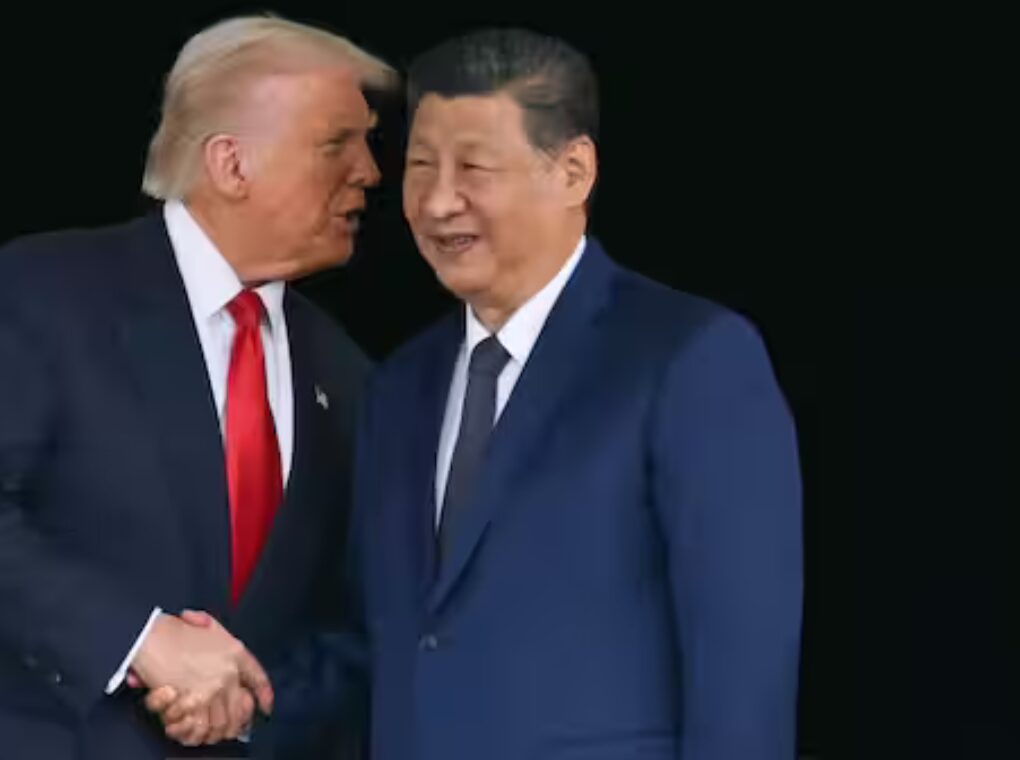
U.S. President Donald Trump is heading to Beijing this Wednesday for high-stakes talks with Chinese President Xi Jinping amid rising tensions over Iran, the Strait of Hormuz, and an increasingly complex global sanctions battle. But even before the summit begins, Washington’s renewed “Maximum Pressure” strategy against Iran appears to be facing a major challenge from a sophisticated China-backed trade system that is quietly reshaping how Iranian oil reaches global markets.
According to multiple analysts and regional observers, China has developed an elaborate sanctions-evasion structure that now absorbs nearly 80 to 90 percent of Iran’s oil exports. The system relies on barter-style exchanges, shadow banking networks, Hong Kong-based front companies, and covert shipping operations designed to bypass U.S. financial restrictions and reduce reliance on the dollar-dominated global banking system.
The development comes as the United States continues maritime pressure operations around the Strait of Hormuz under what officials reportedly describe as “Operation Economic Fury.” However, despite sanctions and naval pressure, Iranian oil exports surged to a record 2.2 million barrels per day during the first quarter of 2026, signaling that Tehran’s energy lifeline remains largely intact.
China-Iran Oil Trade Moves Beyond Traditional Banking
At the core of the system is a barter-based economic mechanism that allows oil to be exchanged directly for infrastructure development and industrial projects rather than conventional cash payments. Analysts say this framework effectively removes traditional banking institutions from the process, making it significantly harder for Washington to disrupt transactions.
An estimated $8.4 billion worth of Iranian oil revenue in 2024 reportedly flowed through this non-cash structure. Instead of entering global financial markets, the proceeds were redirected into Chinese-funded infrastructure projects inside Iran, including railway expansions, energy grids, and renewable power initiatives.
Geeta Kochhar, Senior Assistant Professor of Chinese Studies at Jawaharlal Nehru University, explained that the trade relationship has evolved into a “closed-loop” system intentionally designed to avoid the U.S. dollar and Western-controlled financial institutions.
Chinese firms reportedly place payments into tightly controlled domestic accounts, including mechanisms linked to systems such as “Chuxin.” The funds are then used to pay Chinese contractors involved in large-scale projects across Iran, including a reported $1.2 billion solar power facility and strategic rail infrastructure connecting Tehran with eastern trade corridors.
Shandong “Teapot” Refineries Play Key Role
Much of the Iranian crude entering China is reportedly processed by smaller independent refineries in Shandong, commonly known as “teapot” refineries. These operators function largely outside the scrutiny faced by major Chinese state-owned energy firms and rely heavily on regional financial institutions rather than international banks.
Smaller lenders, including institutions like the Bank of Kunlun, are believed to facilitate yuan-based transactions connected to the oil trade. Because Iran has limited access to global currency conversion systems, the yuan payments are often recycled into purchases of Chinese machinery, electronics, industrial equipment, and advanced technologies.
Experts note that semiconductors and dual-use technologies have become an increasingly important part of the exchange structure. China’s trade surplus reportedly fell to a four-year low in March 2026 partly due to a record $135 billion import bill for semiconductor-related goods, fueling speculation that technology transfers are becoming deeply integrated into the China-Iran trade pipeline.
Hong Kong Front Companies and Shadow Fleet Operations
Another critical layer of the network reportedly operates through Hong Kong, where shell companies and intermediaries help conceal financial transactions and reroute sensitive shipments.
Satellite tracking and maritime intelligence reports have also pointed to the growing use of a massive “Shadow Fleet” involving more than 3,000 vessels. These ships allegedly conduct covert ship-to-ship transfers at sea, allowing Iranian crude to be relabeled as oil originating from countries such as Malaysia or Oman before reaching Asian markets.
The U.S. Treasury recently sanctioned multiple individuals and companies tied to these operations, many with links to Hong Kong and mainland China. American officials allege that some of these firms have also helped source strategic materials used in Iran’s missile and drone industries, including sodium perchlorate, a chemical associated with missile propellants.
Oil-for-Tech Deals Raise New Security Concerns
The trade relationship between Beijing and Tehran is reportedly expanding beyond energy and infrastructure into direct technology and defense cooperation.
As Iran attempts to rebuild military capabilities following recent regional conflict, Chinese drones, surveillance systems, and air defense technologies are believed to be playing a growing role. Analysts say the arrangement increasingly resembles a direct “oil-for-technology” exchange.
Anand Parappadi Krishnan, Fellow at Shiv Nadar University and Associate Fellow at the Institute of Chinese Studies, noted that China and Iran have maintained long-running cooperation on missile and drone technologies. He added that discussions around deeper military and technological coordination appear to be intensifying amid growing U.S. pressure.
This shift presents a major geopolitical concern for Washington because every additional round of sanctions may be pushing Tehran deeper into China’s strategic and technological ecosystem.
Trump’s “Maximum Pressure” Strategy Faces Reality Check
By the time Trump arrives in Beijing, the White House may face an uncomfortable reality: the global sanctions framework designed to isolate Iran is no longer operating in the same international environment it once did.
Instead of cutting Iran off from global trade, China appears to have helped construct a parallel commercial structure that functions outside Western financial dominance.
Beijing’s recent rollout of a formal “Blocking Order” on May 2 — intended to shield Chinese refiners from U.S. sanctions — further signals that this workaround is evolving into a more institutionalized economic strategy.
For Washington, the implications are significant. Iran’s trade has not disappeared under sanctions pressure; rather, it has migrated into a more covert and resilient system that blends barter trade, shadow shipping, regional banking, and strategic technology transfers.
As Trump and Xi prepare for crucial talks in Beijing, the future of U.S.-China relations may increasingly hinge not only on tariffs and trade disputes, but also on whether Washington can counter the emergence of a parallel economic order that challenges the reach of American sanctions power.