A confidential Pentagon intelligence assessment has raised alarm in Washington after concluding that China is strategically benefiting from the ongoing Iran conflict while the United States rapidly depletes critical military stockpiles defending its Middle East allies.
The report, prepared this week by the Joint Staff’s intelligence directorate for General Dan Caine, reportedly warns that Beijing is using the war to expand its military, diplomatic, economic and geopolitical influence at America’s expense.
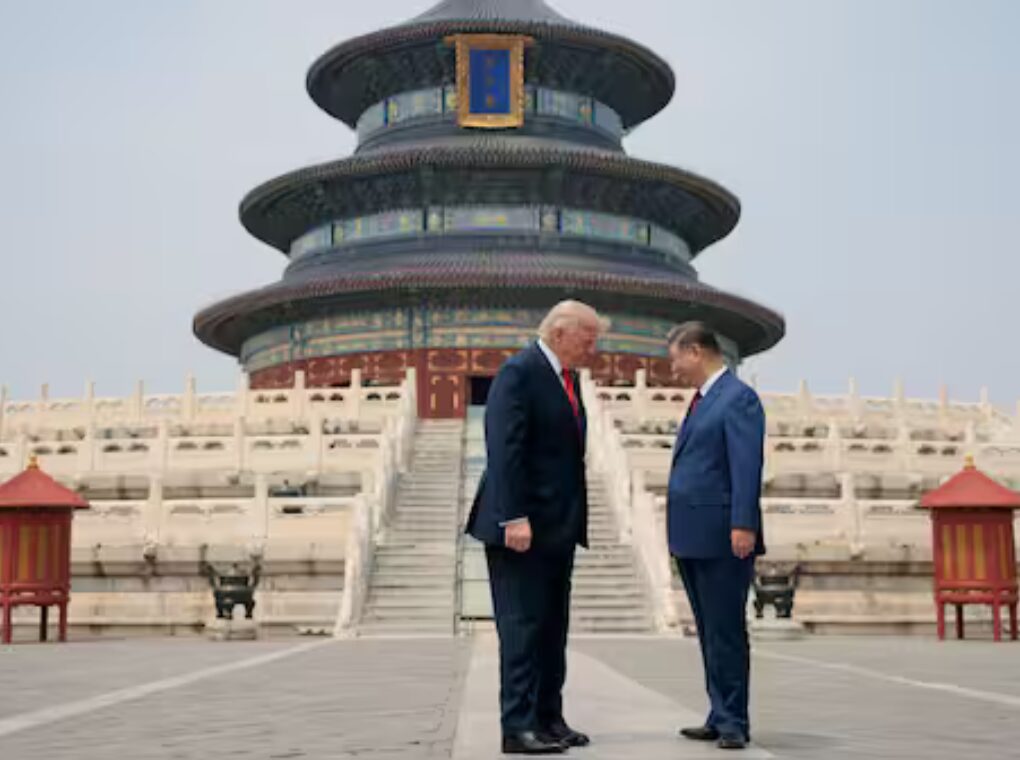
The intelligence findings surfaced just as US President Donald Trump arrived in Beijing for a high-stakes summit with Chinese President Xi Jinping, where Iran, trade tensions and global energy security are expected to dominate discussions.
Pentagon Alarmed as China Arms Gulf Allies
According to the intelligence analysis cited by multiple US officials, China has been supplying weapons to Persian Gulf nations struggling to defend themselves against Iranian missile and drone attacks during the 39-day conflict.
Although the report does not publicly identify the recipient states, analysts believe longtime Chinese defense customers such as Saudi Arabia and the United Arab Emirates are among the likely buyers.
The development has reportedly triggered concern within the Pentagon because the United States itself has been racing to protect Gulf allies while simultaneously exhausting large portions of its own missile defense arsenal.
The assessment argues that Beijing has capitalized on the conflict by stepping into military supply gaps created by America’s stretched defense commitments.
China has also increased its energy diplomacy by supplying fuel and economic assistance to countries impacted by Iran’s closure of the strategically vital Strait of Hormuz, through which roughly one-fifth of global oil and gas flows.
Countries including Australia, Thailand and the Philippines — all key US partners — have reportedly received assistance from Beijing to stabilize fuel supplies during the crisis.
US Missile Stockpiles Under Pressure
One of the most alarming findings in the report concerns America’s rapidly shrinking weapons inventory.
The US military has burned through massive quantities of advanced interceptors, cruise missiles and air defense systems while countering Iranian attacks and protecting regional allies.
A recent analysis by the Center for Strategic and International Studies estimated that US forces have used nearly half of America’s Patriot interceptor inventory, more than half of its THAAD missile defense interceptors and hundreds of Tomahawk cruise missiles during the conflict.
Military experts warn that replenishing these stockpiles could take anywhere from three to five years, exposing vulnerabilities in America’s defense industrial base.
The shortages are reportedly causing anxiety in Taiwan, Japan and South Korea, where officials are increasingly questioning whether Washington could sustain another major military confrontation in the Indo-Pacific if tensions with China escalate.
The Pentagon has publicly rejected claims that America’s strategic position has weakened.
Pentagon spokesman Sean Parnell stated that assertions suggesting the balance of global power is shifting away from the United States are “fundamentally false,” insisting that the US still maintains unmatched military capability and industrial strength.
China Positioning Itself as a ‘Responsible Power’
The intelligence report reportedly uses a “DIME” framework — diplomatic, informational, military and economic — to analyze China’s response to the Iran war.
According to the assessment, Beijing has carefully positioned itself as a stabilizing global power while portraying Washington as reckless and militarily overextended.
China has repeatedly criticized the US-Israeli military campaign against Iran as “illegal” and called for restraint and diplomacy, messaging that analysts believe resonates strongly across much of the Global South.
Experts argue the conflict has given Beijing an opportunity to undermine America’s image as the defender of the international order while distracting attention from China’s own human rights controversies and aggressive posture in Asia.
Jacob Stokes, a senior fellow at the Center for a New American Security, said the Iran conflict is “massively improving China’s geopolitical position.”
The report also notes that Beijing has been able to absorb the energy shock more effectively than many expected.
Despite depending heavily on Gulf oil imports, China reportedly entered the crisis with large strategic petroleum reserves and significant investments in renewable energy infrastructure.
Ryan Hass of the Brookings Institution argued that China is emerging from the crisis in a comparatively strong position because of its diversified energy strategy and ability to provide fuel assistance to other countries.
Trump Faces High-Stakes Xi Meeting
Trump’s visit to Beijing marks the first face-to-face summit between the two leaders since the Iran war erupted in late February.
The meeting was originally scheduled for March but was postponed after the conflict escalated dramatically across the Middle East.
The US president is expected to pressure Xi to use China’s leverage over Tehran to help reopen the Strait of Hormuz and push Iran toward a ceasefire agreement.
At the same time, Beijing is expected to seek relief from US tariffs and expanded access to advanced American semiconductor and artificial intelligence technologies.
The summit comes at a politically difficult moment for Trump, whose administration has faced growing criticism over the economic fallout from the conflict, rising oil prices and concerns about America’s long-term military readiness.
While Trump insists the United States does not need Chinese help to resolve the Iran crisis, intelligence officials increasingly fear the war may have handed Beijing a strategic opening to reshape the global balance of power.
As Washington focuses heavily on the Middle East, China appears to be using the moment to deepen its influence across energy markets, military partnerships and diplomatic alliances — potentially reshaping international geopolitics far beyond the Iran conflict itself.