North Korea has reportedly revised its constitution to authorize an automatic nuclear missile strike if leader Kim Jong-un is assassinated or if the country’s nuclear command system is attacked, marking one of the most alarming shifts in Pyongyang’s military doctrine in years.
The constitutional change comes amid rising global tensions following the recent Middle East conflict and the reported assassination of Iranian Supreme Leader Ali Khamenei during joint US-Israeli military operations. Analysts believe North Korea interpreted the strikes on Iran’s leadership as a warning that authoritarian regimes with hostile relations toward Washington could face similar “decapitation” attacks.
According to intelligence information shared with South Korean officials, Pyongyang revised Article 3 of its nuclear policy law earlier this year during a session of the Supreme People’s Assembly. The updated provision reportedly states:
“If the command-and-control system over the state’s nuclear forces is placed in danger by hostile forces’ attacks … a nuclear strike shall be launched automatically and immediately.”
The move effectively creates a “dead man’s switch” scenario in which North Korea’s nuclear arsenal could be launched even if the country’s leadership is incapacitated or eliminated during wartime.
North Korea Signals Fear of Leadership Assassination
Security experts say the constitutional revision reflects growing fears within the North Korean regime that modern intelligence warfare and precision strikes could target the country’s leadership structure.
Professor Andrei Lankov, a leading analyst on North Korea, described Iran’s recent experience as a “wake-up call” for Pyongyang.
According to Lankov, North Korea watched closely as Iranian military and political leaders were reportedly eliminated rapidly during the US-Israeli campaign. The speed and coordination of those strikes demonstrated how vulnerable even heavily protected governments can be to advanced surveillance systems, cyber operations, satellite tracking, and precision-guided weapons.
“This may have been policy before, but it has added emphasis now that it has been enshrined in the constitution,” Lankov reportedly said during interviews following the South Korean intelligence briefing.
The expert added that North Korean authorities likely fear similar attempts to remove Kim Jong-un and key military commanders at the opening stage of any future conflict.
Automatic Nuclear Response Raises Global Alarm
The biggest concern among military analysts is the possibility that an automated retaliatory doctrine could increase the risk of accidental or miscalculated nuclear war.
Under traditional nuclear command structures, launch authorization typically requires confirmation from political leadership and military chains of command. However, North Korea’s revised doctrine appears designed to bypass delays if communication systems are disrupted during an attack.
Analysts warn this creates a dangerous scenario in which confusion, cyberattacks, or incorrect intelligence assessments could trigger a nuclear response without direct human approval from the country’s top leadership.
The constitutional revision is being compared to Cold War-era fears surrounding automatic retaliation systems developed by nuclear powers to guarantee second-strike capability even after leadership destruction.
North Korea already possesses an expanding arsenal of ballistic missiles capable of reaching South Korea, Japan, and potentially parts of the United States. The country has repeatedly tested intercontinental ballistic missiles and tactical nuclear delivery systems over the past several years.
Military observers say Pyongyang’s latest move is intended to strengthen deterrence by warning adversaries that any attempt to assassinate Kim Jong-un could immediately escalate into nuclear conflict.
Constitution Also Redefines Relations with South Korea
The revised constitution reportedly includes additional changes that formally redefine North Korea’s territorial and political stance toward South Korea.
For decades, both Koreas maintained constitutional references to eventual reunification of the peninsula. However, Pyongyang has now reportedly removed many of those references and instead identified South Korea as a separate neighboring state.
The new territorial clause states that North Korea borders China and Russia to the north and South Korea to the south, while emphasizing that the country “will never tolerate any infringement” of its territory.
Analysts say the language signals a major ideological shift by Kim Jong-un’s government, effectively abandoning decades of official rhetoric promoting reunification.
The change comes as tensions between Seoul and Pyongyang continue to worsen amid missile launches, military exercises, and growing nuclear threats.
North Korea Expands Military Pressure Near Border
At the same time as the constitutional changes, North Korea has increased military activity near the Korean border.
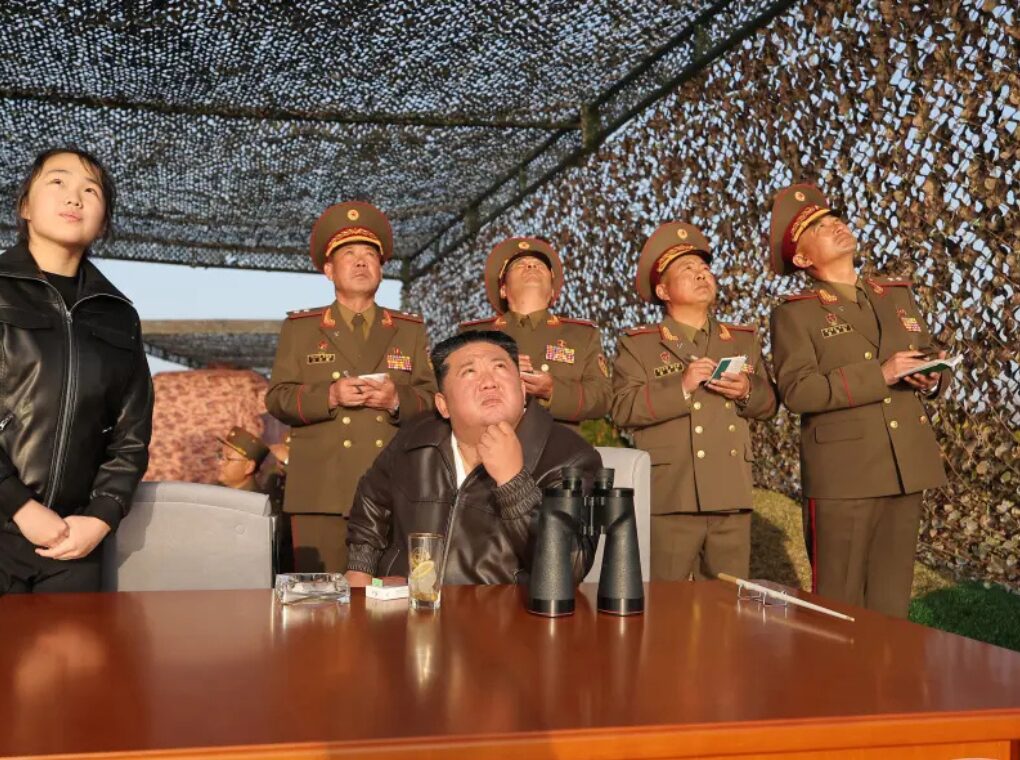
State media recently showed Kim Jong-un inspecting a newly developed 155-millimeter self-propelled artillery system believed capable of striking targets deep inside South Korea, including areas near Seoul.
According to North Korean state media, the weapon system has a range exceeding 37 miles and is expected to be deployed to long-range artillery units positioned near the Demilitarized Zone.
The development has raised concerns in Seoul because the South Korean capital lies within range of many North Korean artillery systems. Millions of civilians remain vulnerable to conventional artillery strikes in the event of conflict.
North and South Korea are technically still at war because the 1950-1953 Korean War ended with an armistice rather than a formal peace treaty.
Kim Jong-un’s Security Fears Intensify
Reports also suggest Kim Jong-un has become increasingly focused on personal security following the Iran conflict.
The North Korean leader rarely travels by air and is known for using heavily armored trains for international trips. He is constantly surrounded by elite security personnel, and foreign access to North Korea remains tightly restricted.
Unlike Iran, North Korea maintains an extremely closed information environment with limited internet infrastructure and minimal foreign presence, making intelligence penetration far more difficult.
Still, experts believe Pyongyang fears advances in satellite surveillance, cyber warfare, and electronic intelligence could eventually threaten the regime’s survival.
By codifying automatic nuclear retaliation into the constitution, North Korea appears determined to send a direct message to the United States and its allies: any attempt to eliminate Kim Jong-un could trigger catastrophic consequences.
As geopolitical tussles continue rising across the Middle East, Eastern Europe, and East Asia, the world is now confronting a new and deeply concerning reality — a nuclear-armed state preparing for leadership assassination scenarios with automatic launch authority written directly into law.