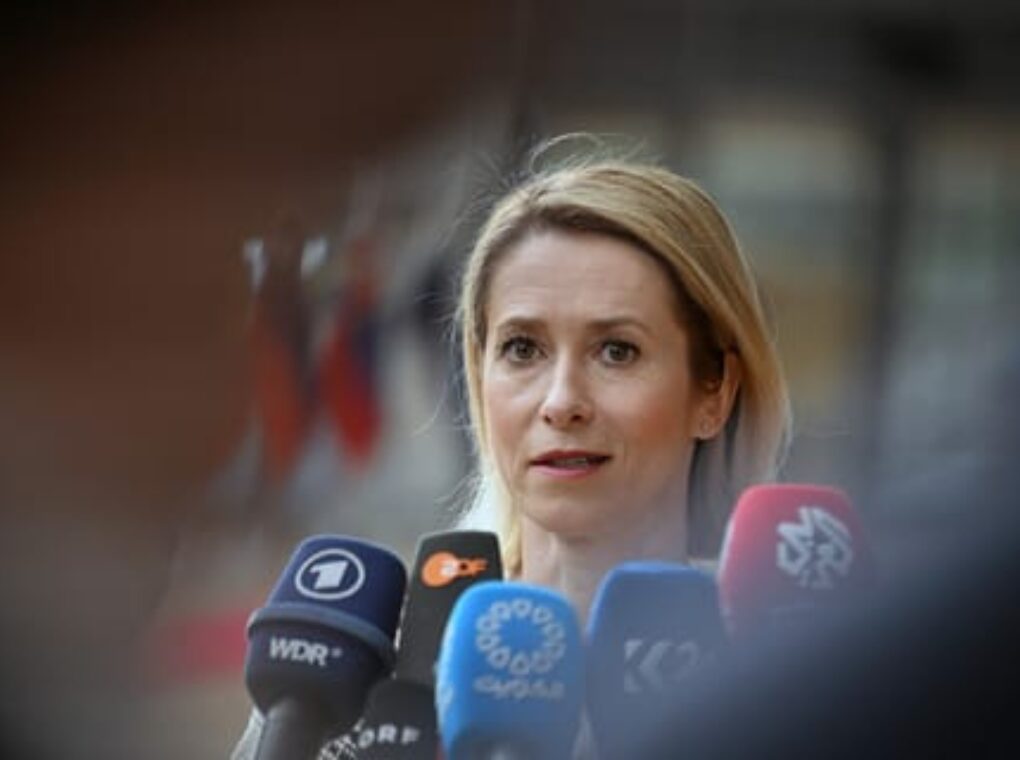
EU foreign policy chief Kaja Kallas has warned that major global powers — including the United States, China, and Russia — have an interest in a weakened and divided European Union, cautioning member states against pursuing independent bilateral deals that could undermine bloc unity.
Speaking at the Lennart Meri Conference in Tallinn, Kallas argued that the strength of the European Union lies in collective action and that external powers prefer dealing with individual nations rather than a unified bloc.
“They don’t like the European Union, that’s very clear,” she said. “It is because if we stick together, if we operate together, then we are equal powers, we are strong.”
Her remarks come amid growing debate within the EU over whether some member states should strengthen their own diplomatic channels with Washington following the return of President Donald Trump to the White House.
“Divide and Conquer” Strategy Allegations
Kallas warned that the growing trend of bilateral engagement between individual EU countries and major powers fits into a broader “divide and conquer” approach.
She argued that large geopolitical actors benefit when European countries negotiate separately, as smaller states have less leverage compared to the EU acting as a single economic and political bloc.
“It is, of course, easier to deal with individual countries, which are much smaller, than with a bloc that can act as an equal power,” she noted.
Without naming specific administrations in detail, Kallas suggested that rhetoric such as “I have great relations with you, but I don’t like the European Union” reflects an intentional effort to weaken European unity.
She also expressed concern that some EU members are increasingly pursuing independent diplomatic tracks, warning that “the dividing is actually working.”
Concerns Over EU Fragmentation
Kallas highlighted recent diplomatic behavior within the EU, pointing to efforts by some member states to maintain direct channels with Washington rather than operating strictly through EU institutions.
She referenced past attempts by Italian Prime Minister Giorgia Meloni to position herself as a bridge between Europe and the United States. However, Kallas noted that such strategies have had limited success amid shifting political dynamics in Washington.
The EU foreign policy chief urged member states to reinforce collective decision-making and avoid policies that could weaken the bloc’s negotiating power on the global stage.
“Why these powers want to dismantle the European Union is because we are much stronger when we are together,” she said.
EU Strategy Toward China and Economic Pressure Tools
Beyond transatlantic relations, Kallas also addressed the EU’s long-term strategic challenges in dealing with China.
She said Europe already has a “clear diagnosis” of the problem but lacks consensus on how to respond effectively. According to her, EU leaders are split between continuing industrial subsidies — which she referred to as “morphine” — and adopting more assertive economic tools, which she described as “chemotherapy.”
These tools include stricter rules on foreign direct investment, more strategic public procurement policies, and diversification of critical raw material supply chains.
However, she warned that such measures could trigger retaliation, making them politically and economically difficult to implement.
“It will be painful to use the tools … because then there’s going to be retaliation,” Kallas said. “We are not there yet, and I’m worried that eventually, also the rich countries will run out of taxpayers’ money.”
Her comments underline a growing internal EU debate over how to balance economic stability with strategic autonomy in an increasingly competitive global environment.
Broader Geopolitical Context
Kallas’ remarks reflect wider concerns in Brussels about the shifting balance of global power. Relations between the EU and the United States have become more complex under the renewed Trump administration, particularly as some European leaders seek closer bilateral engagement with Washington.
At the same time, tensions with Russia remain high due to ongoing geopolitical disputes, while economic competition with China continues to intensify across sectors such as technology, manufacturing, and critical infrastructure.
Kallas’ warning that external powers prefer a fragmented Europe aligns with long-standing EU policy concerns that internal division reduces the bloc’s global influence.
Internal EU Debate on Unity vs. National Strategy
The issue of unity versus national flexibility remains a central challenge for the European Union. While some member states advocate for more independent foreign policy channels, EU institutions continue to push for coordinated action to maintain leverage in global negotiations.
Kallas’ intervention adds weight to the argument that fragmentation could weaken Europe’s ability to respond effectively to external pressures from major global actors.
Her remarks are expected to further fuel debate within EU foreign policy circles ahead of upcoming Council discussions on security, trade, and strategic autonomy.
Kaja Kallas’ warning underscores a growing sense of urgency within EU leadership about maintaining unity in an increasingly fragmented global order. Her message is clear: while bilateral relationships may appear politically convenient, they risk undermining the EU’s collective strength.
As geopolitical tensions continue to evolve, the European Union faces a critical choice between deeper integration or increased national-level diplomacy — a decision that could shape its global role for decades to come.