
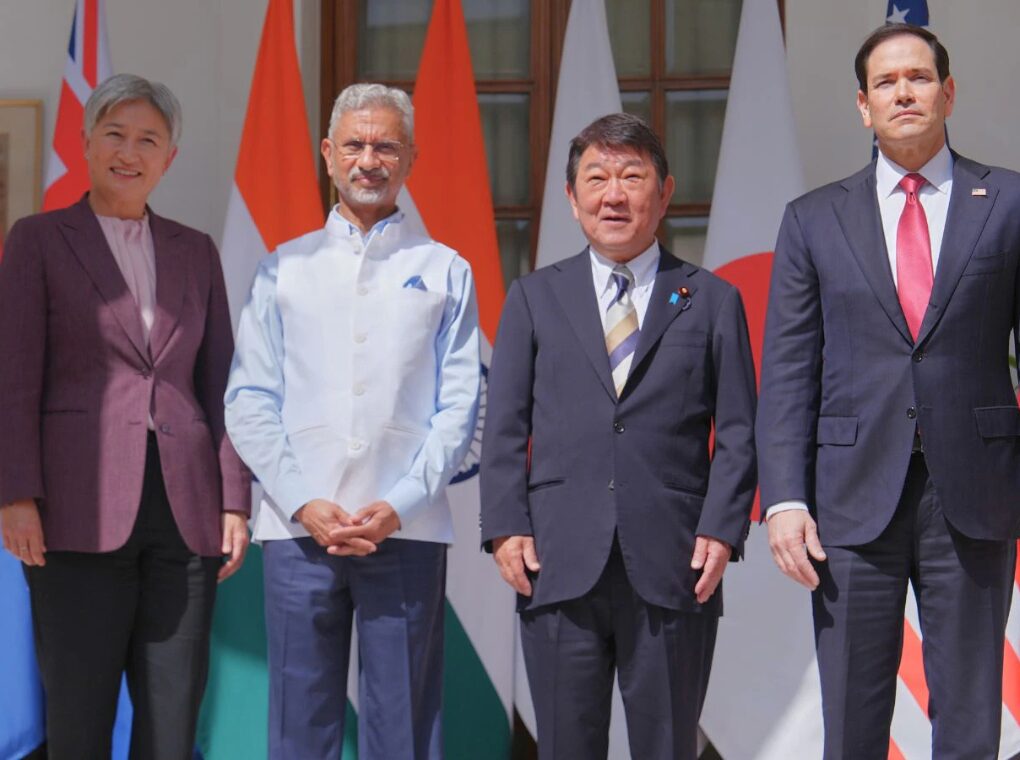
The future of the Quadrilateral Security Dialogue (Quad)—comprising India, Japan, Australia, and the United States—is once again under intense scrutiny following a high-level foreign ministers’ meeting in New Delhi India. While the grouping unveiled a series of new cooperative initiatives aimed at strengthening maritime security and supply chain resilience, growing questions over long-term strategic cohesion—particularly under shifting US policy under President Donald Trump—have reignited debate about whether the Quad is evolving, stagnating, or quietly fragmenting.
Quad projects unity amid strategic uncertainty
The recent meeting in New Delhi brought together foreign ministers from India, Japan, Australia, and United States under the Quad framework. The group announced new collaborative initiatives focusing on Indo-Pacific maritime surveillance, critical minerals supply chains, and energy security cooperation.
Among the most notable outcomes was the launch of the “Indo-Pacific Maritime Surveillance Collaboration,” aimed at improving real-time information sharing on maritime activity across contested waters. The partners also advanced a “Critical Minerals Initiative Framework,” intended to reduce dependence on concentrated supply chains and strengthen resilience in key industrial inputs.
Additionally, discussions included plans for coordinated infrastructure development in the Pacific Islands, including a jointly supported port project in Fiji—part of a broader strategy to enhance regional connectivity and presence.
Collectively, these initiatives are designed to demonstrate that the Quad remains operationally active and strategically relevant, despite speculation that internal divergences could weaken its long-term viability.
China pushes back against Quad messaging
The diplomatic tone of the meeting quickly drew a response from Beijing. Chinese officials reiterated warnings to Quad members against what they described as interference in regional maritime disputes in the East and South China Sea. Beijing has consistently rejected Quad statements on freedom of navigation and security in disputed waters, arguing that such positions escalate tensions and reflect external containment efforts.
In its joint statement, however, the Quad expressed “serious concerns” over coercive maritime actions, including interference with offshore resource development and unsafe military manoeuvres. While China was not explicitly named, the language clearly reflected longstanding concerns over Beijing’s growing naval assertiveness in the Indo-Pacific.
This rhetorical standoff underscores the Quad’s enduring strategic fault line: the balance between maintaining regional stability and countering perceived unilateral actions by China.
Strategic cohesion tested by shifting US policy
Much of the current uncertainty surrounding the Quad stems from evolving strategic signals from Washington under President Donald Trump. Analysts note that recent US policy shifts—particularly in trade, immigration, and Indo-Pacific defense priorities—have introduced ambiguity into long-standing alliance expectations.
Reports suggest that the US has softened aspects of its earlier posture toward China, with policy documents emphasizing economic engagement alongside deterrence. The 2025 US National Security Strategy and subsequent 2026 defense guidance reportedly frame China less as an existential adversary and more as a strategic competitor requiring calibrated engagement.
This recalibration has raised concerns among Indo-Pacific partners, who view the Quad as originally designed to counterbalance China’s expanding maritime and economic influence.
Further complicating perceptions is Trump’s more transactional approach to alliances, which prioritizes burden-sharing and bilateral negotiation over multilateral strategic alignment. His administration’s emphasis on economic leverage and negotiation flexibility has led some observers to question the durability of US commitments within long-term frameworks like the Quad.
India’s strategic balancing act
For India, the Quad remains a critical pillar of its Indo-Pacific strategy. New Delhi continues to support the grouping as a platform for maritime security cooperation, technology sharing, and supply chain diversification.
However, India also maintains a delicate balancing act—strengthening ties with Quad partners while preserving strategic autonomy and managing complex relations with China and Russia. This balancing approach shapes India’s engagement style within the Quad, favoring pragmatic cooperation over formal alliance structures.
Prime Minister Narendra Modi has repeatedly emphasized the Quad’s role in delivering regional public goods rather than functioning as a military bloc, aligning with India’s preference for flexible multilateralism.
Japan and Australia reinforce Indo-Pacific security focus
Both Japan and Australia continue to strongly support the Quad’s strategic foundation. Tokyo views the grouping as essential to safeguarding maritime trade routes and upholding the rules-based order in the Indo-Pacific, while Canberra sees it as a key mechanism for regional deterrence and economic resilience.
Japan has also deepened its defense cooperation with US and regional partners in recent years, while Australia has expanded joint maritime exercises and intelligence-sharing frameworks under the Quad umbrella.
Leadership gap and questions about Quad’s future direction
Despite continued institutional activity, analysts warn that the Quad’s long-term effectiveness depends heavily on sustained political leadership at the highest level. The absence of regular leaders’ summits has fueled speculation that the grouping is increasingly reliant on bureaucratic momentum rather than strategic direction.
Observers argue that without clear ideological anchoring—particularly a shared consensus on China’s role in the Indo-Pacific—the Quad risks evolving into a technocratic coordination platform rather than a coherent geopolitical alliance.
Some analysts suggest that renewed ambiguity in US strategic priorities under Trump could accelerate this shift, potentially downgrading the Quad from a high-level strategic forum to a more decentralized cooperation mechanism led primarily by foreign ministries.
Bottom line: QUAD Not collapsing, but recalibrating
Despite speculation about decline, the Quad is not currently disintegrating. Instead, it appears to be undergoing a period of recalibration, shaped by shifting global power dynamics and evolving US foreign policy priorities.
While new initiatives in maritime surveillance, energy security, and critical minerals demonstrate continued engagement, the absence of a unified strategic vision raises questions about long-term cohesion.
The Quad’s future will likely depend on whether its members can reconcile differing national priorities into a sustained strategic framework—or whether it gradually transforms into a looser, issue-based partnership without a single defining geopolitical anchor.