
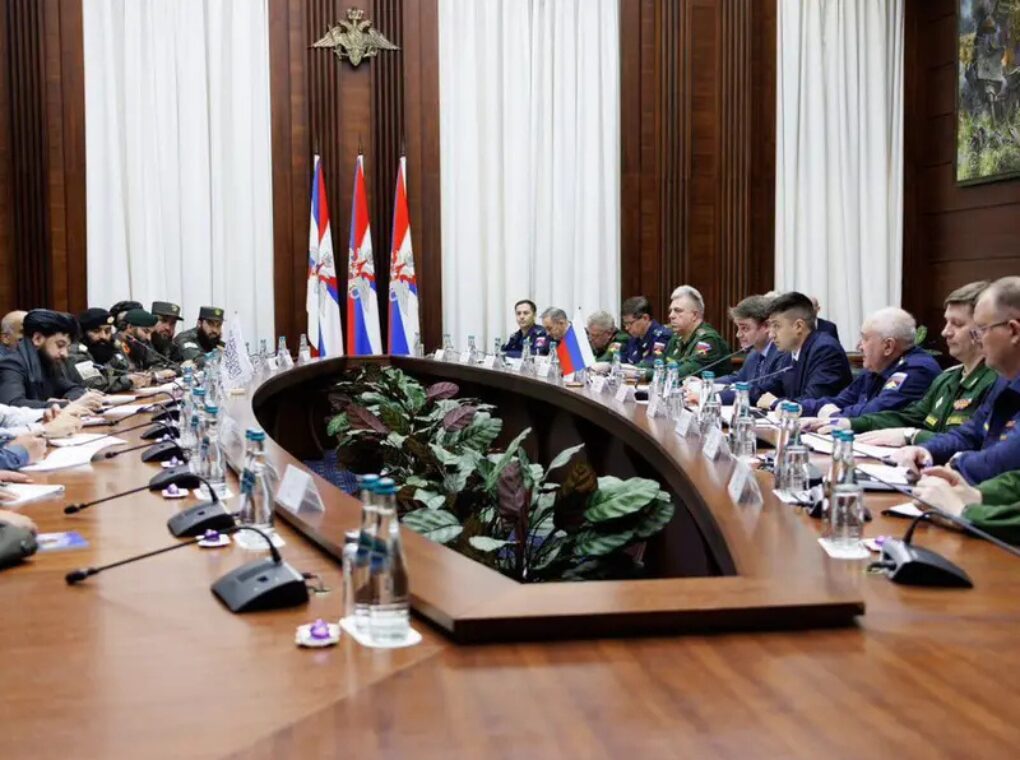
In a historic geopolitical development, Russia has become the first country to sign a military cooperation agreement with the Taliban-led government in Afghanistan, marking a major shift in regional diplomacy and security dynamics. The agreement was signed during the inaugural International Security Forum hosted by Russia’s Security Council in Moscow between May 26 and May 29, 2026.
The move comes after Moscow became the first nation to officially recognise the Taliban administration as the legitimate government of Afghanistan in 2025, signaling a dramatic transformation in relations between the two countries that once fought a devastating war during the Soviet era.
Russia-Taliban Military Pact: What information is public?
The newly signed Military-Technical Cooperation Agreement was formalized in Moscow during high-level talks involving senior Taliban officials, including Afghanistan’s Defence Minister Mullah Mohammad Yaqoob Mujahid, son of Taliban founder Mullah Mohammad Omar.
While the specific details of the agreement have not been made public, the pact is expected to increase military cooperation between Russia and Afghanistan. Analysts suggest the deal could involve military equipment repairs, training, logistical support, and limited arms assistance.
Speaking during the forum, Yaqoob described Russia as an “important regional and global power” and emphasized that strengthening bilateral ties was a strategic priority for Kabul.
“We have historic relations with Russia and seek to expand them further,” Yaqoob reportedly said, underscoring Afghanistan’s interest in deepening cooperation with Moscow.
Shoigu Slams Western Sanctions, Opposes NATO Presence
During the security forum, Sergei Shoigu, a close ally of Vladimir Putin and former Russian defence minister, criticized Western sanctions imposed on Afghanistan and called for the release of frozen Afghan assets.
Shoigu argued that Western countries should acknowledge responsibility for Afghanistan’s post-war reconstruction following two decades of military intervention.
“We consider it unacceptable for us and our Afghan partners that military infrastructure or military installations of the United States and NATO be deployed in Afghanistan or neighbouring countries under any pretext,” Shoigu said during the event.
His remarks reflect Russia’s broader effort to challenge Western influence in Central Asia while positioning itself as a strategic security partner for Afghanistan.
From Soviet War to Strategic Partnership
The military agreement represents a remarkable reversal in Russia-Afghanistan relations.
The Soviet Union invaded Afghanistan in 1979 to support the communist Afghan government amid growing resistance from Islamist and tribal groups. The decade-long conflict turned into one of Moscow’s most costly military failures, as U.S.-backed Mujahideen fighters resisted Soviet forces.
After suffering heavy casualties, Soviet troops withdrew in 1989. Afghanistan subsequently descended into civil war, eventually paving the way for the Taliban’s rise in the 1990s.
Ironically, Moscow and the Taliban—once enemies—have steadily improved relations since the U.S.-led invasion of Afghanistan in 2001. Reports over the years suggested Russia engaged in quiet diplomatic and logistical contacts with Taliban factions as American influence weakened in the region.
In 2025, Russia formally recognised the Taliban government, becoming the only country to grant official diplomatic recognition to Kabul’s Islamist rulers.
Will Afghanistan Send Fighters to Support Russia?
The agreement has raised speculation over whether Afghanistan could provide manpower to support Russia, particularly as Moscow continues military operations linked to the war in Ukraine.
Observers point to North Korea’s 2024 military cooperation with Russia, which reportedly included troop deployments, as a possible precedent.
However, experts believe such a scenario remains unlikely for now.
According to security analysts, the Taliban government is currently grappling with instability in northern Afghanistan, concerns over militant activity, and ongoing tensions with Pakistan. Under such conditions, Kabul is more likely seeking military assistance, spare parts, and outdated equipment than participation in overseas conflicts.
Aleksei Zakharov, a fellow at the New Delhi-based Observer Research Foundation, told media outlets that Russia would likely avoid sharing advanced military technologies due to proliferation concerns.
At the same time, Russia itself faces economic strain and growing military resource constraints, limiting the scale of assistance Moscow can realistically provide.
Symbolism or Strategic Shift?
Experts say the agreement is as much about political legitimacy as military cooperation.
Hameed Hakimi, a research associate at ODI Global, said the pact gives the Taliban an opportunity to project international legitimacy and strengthen domestic political messaging.
Meanwhile, Russian analyst Ruslan Suleymanov described the agreement as largely symbolic, calling it “a political signal” rather than evidence of imminent military cooperation on a large scale.
Still, the pact underscores an evolving geopolitical landscape where former adversaries are forging new alliances based on shared security interests and opposition to Western influence.
As Russia deepens engagement with the Taliban-led government, the agreement could reshape regional power dynamics in Central Asia and further complicate global diplomatic efforts surrounding Afghanistan’s future.