
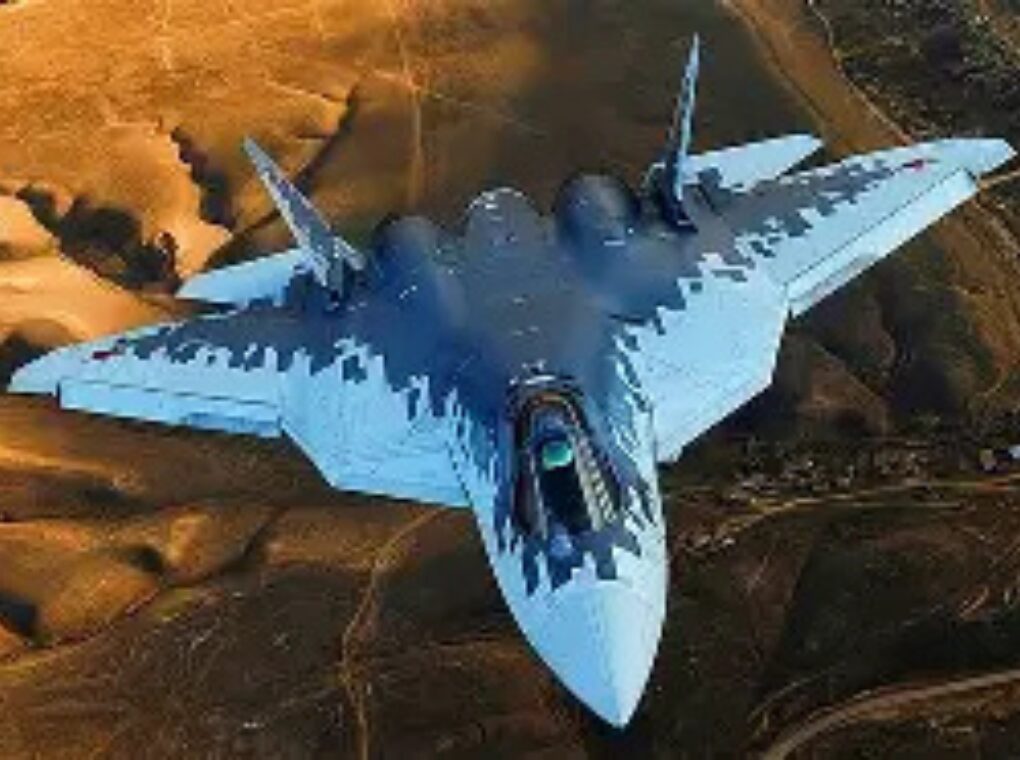
Russian President Vladimir Putin has renewed Moscow’s pitch for India to join the development and production of the Su-57 fifth-generation stealth fighter jet, offering what he described as unrestricted cooperation and complete technology sharing.
Speaking during an interaction with heads of international news agencies at the St. Petersburg International Economic Forum (SPIEF) on Thursday, Putin said Russia remains open to making India a partner in the advanced fighter programme, a proposal that comes as New Delhi seeks solutions to address the Indian Air Force’s growing fighter aircraft shortfall.
“We offered our friends from India to jointly develop this machine, a fifth-generation aircraft. I think it is the best aircraft to date. But our Indian friends said, ‘Well, let’s see,’” Putin said, according to reports.
The Russian president further emphasized Moscow’s willingness to cooperate without restrictions.
“In principle, this could have been our joint product. We developed it independently. But we are ready to work with India, supply it, and develop it further. There will be no restrictions whatsoever,” Putin added, signaling a major offer of technology transfer.
Why Russia’s Su-57 Proposal Matters for India
Putin’s latest proposal arrives at a crucial moment for India’s military modernization plans. The Indian Air Force (IAF) has long sought a fifth-generation stealth fighter capability, especially as regional rivals rapidly upgrade their air combat fleets.
India’s indigenous Advanced Medium Combat Aircraft (AMCA) programme remains under development and is unlikely to enter operational service before 2035, creating a capability gap in the coming decade.
Military analysts believe the Su-57 could potentially serve as an interim solution while India develops its homegrown stealth platform.
According to reports, New Delhi has not entirely ruled out the Russian offer. State-run Hindustan Aeronautics Limited (HAL) is reportedly in discussions with Russia’s Sukhoi Design Bureau over possible cooperation. India is also believed to be evaluating the purchase of at least two squadrons (around 36 aircraft) if the jet meets IAF operational requirements.
The Collapse of the India-Russia FGFA Programme
India and Russia previously collaborated under the Fifth Generation Fighter Aircraft (FGFA) programme launched in 2007, which aimed to jointly develop a stealth fighter based on the Su-57 platform.
However, after years of negotiations, India withdrew from the programme in 2018–2021, citing multiple concerns, including:
> Rising project costs
>Limited clarity on technology transfer
>Concerns over stealth capabilities
> Engine performance issues
> Insufficient customization for Indian operational needs
At the time, Indian defense planners were reportedly unconvinced that the aircraft met fifth-generation standards comparable to Western stealth fighters.
Rising Regional Threats Push India to Reassess
The urgency surrounding India’s stealth fighter requirements has increased amid rapid military developments in Asia.
China already operates the J-20 stealth fighter** and is reportedly advancing next-generation combat aircraft projects, including the J-36 and J-50 programmes.
Meanwhile, Pakistan has reportedly moved closer to acquiring China’s J-35 stealth fighter, with reports suggesting Islamabad could procure up to 40 aircraft in the coming years.
Against this backdrop, the Indian Air Force faces mounting pressure to modernize as its fighter squadron strength continues to remain below sanctioned levels.
Could India Buy the Su-57?
Defense experts believe India may consider a limited purchase of the Su-57 as a stop-gap measure until the AMCA becomes operational. However, any deal would likely depend on several factors, including:
>Proven stealth and combat performance
> Engine reliability
> Extent of technology transfer
> Local manufacturing under “Make in India”
>Cost-effectiveness compared to alternatives
For now, New Delhi has not officially responded to Putin’s proposal. However, Russia’s renewed offer of unrestricted collaboration signals Moscow’s intent to deepen defense ties with India at a time of shifting geopolitical and military realities.
With China and Pakistan accelerating their stealth fighter ambitions, India’s next decision on fifth-generation air power could shape the balance of power in the region for decades.