
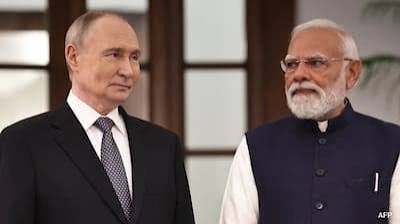
Poland’s Deputy Foreign Minister, Wladyslaw Teofil Bartoszewski, has made a remarkable claim, saying that PM Modi played the most important role in preventing a potential nuclear escalation during the Russia-Ukraine war.
According to Bartoszewski, Russia was preparing to use tactical nuclear weapons against Ukraine in late 2022, but President Vladimir Putin changed his mind after speaking with Prime Minister Narendra Modi.
Speaking during a press interaction in India, Bartoszewski said that India’s decades-old relationship with Moscow gives New Delhi a level of diplomatic influence that most Western countries no longer possess.
“President Putin actually pays attention to what Prime Minister Modi tells him,” Bartoszewski said.
Referring to one of the most tense phases of the war in late 2022, he claimed that Prime Minister Modi played a crucial role in persuading Russia not to use tactical nuclear weapons in Ukraine.
“I mentioned the role Prime Minister Modi played in stopping Putin from using tactical nuclear weapons in Ukraine at the end of 2022,” he said.
He added that PM Modi remains “one of the very few people who can actually exert some pressure and influence on President Putin.”
It is important to note, however, that neither India nor Russia has publicly confirmed any specific intervention regarding nuclear weapons.
What is publicly documented is Prime Minister Modi’s consistent call for dialogue and diplomacy throughout the conflict. During the Shanghai Cooperation Organisation Summit in Samarkand in September 2022, Modi famously told Putin that “today’s era is not of war,” a remark widely seen as India’s clearest public appeal for restraint.
India’s Unique Position
Unlike most Western countries, India has maintained relations with both Russia and Ukraine since the war began.
New Delhi has consistently advocated dialogue and diplomacy while refusing to join Western sanctions against Moscow. At the same time, India has continued humanitarian assistance to Ukraine and maintained diplomatic engagement with Kyiv.
According to Bartoszewski, this balanced foreign policy makes India one of the few countries whose messages Moscow is willing to hear.
He said, “Not only India and Prime Minister Modi, but also China’s Xi Jinping oppose escalation. It is especially important when such messages come from countries that Russia does not consider hostile. India’s role here is crucial.”
His remarks suggest that Europe is increasingly recognizing that countries maintaining working relations with Russia may play an important role in any future peace process.
Putin’s Earlier Praise for India
The Polish minister’s remarks come just weeks after President Vladimir Putin publicly praised India’s independent foreign policy during the St. Petersburg International Economic Forum.
Putin dismissed attempts by other countries to pressure India over its relationship with Russia.
“Everyone has understood that putting pressure on Prime Minister Narendra Modi and India is detrimental to international relations,” Putin said.
“We are pleased that India is developing relations with all countries it considers important for its national interests.”
As the Russia-Ukraine war enters another prolonged phase with no immediate settlement in sight, Poland’s assessment reinforces the view that India occupies a rare diplomatic position, maintaining credibility with both Russia and the West.
Whether that influence ultimately translates into a larger role in future peace negotiations remains uncertain. However, Bartoszewski’s remarks underline India’s growing importance as a geopolitical interlocutor in one of the world’s most consequential conflicts.
Poland Softens Its Position on India’s Russian Oil Purchases
The Polish minister also acknowledged that differences between Warsaw and New Delhi over India’s purchase of discounted Russian crude oil have largely been resolved.
After the Ukraine war began, India became one of the world’s largest buyers of Russian oil, taking advantage of discounted prices following Western sanctions. Poland had previously criticized those purchases, arguing that they indirectly supported Russia’s wartime economy.
Bartoszewski admitted that while Poland disagreed with India’s policy, it understood the economic reasoning behind it.
“We criticized India for buying Russian oil. We understood the economic reason because it was available at nearly 40 percent below market prices. But we believed it was helping finance Russia’s war economy,” he said.
However, he stressed that the issue no longer dominates bilateral relations.
“We understood India’s position. India understood our position. We happened to disagree, but we still have amicable relations.”
Expanding India–Poland Strategic Partnership
Bartoszewski’s visit comes ahead of Polish Prime Minister Donald Tusk’s expected visit to India later this year, as both countries seek to deepen cooperation in defence, security, space and advanced technologies.
The two countries have already begun manufacturing Polish-designed drones in India and are exploring wider defence collaboration. Poland is also looking to partner with Indian defence manufacturers as it modernizes its military with European Union support.
Beyond defence, discussions are underway on satellite manufacturing, sewage treatment, clean water infrastructure and advanced coal mining technologies suited for India’s large open-cast mines.
The Polish minister also backed the proposed India-European Union Free Trade Agreement (India-EU FTA), saying it has the potential to significantly expand bilateral trade, which currently exceeds €6 billion but remains well below its full potential.