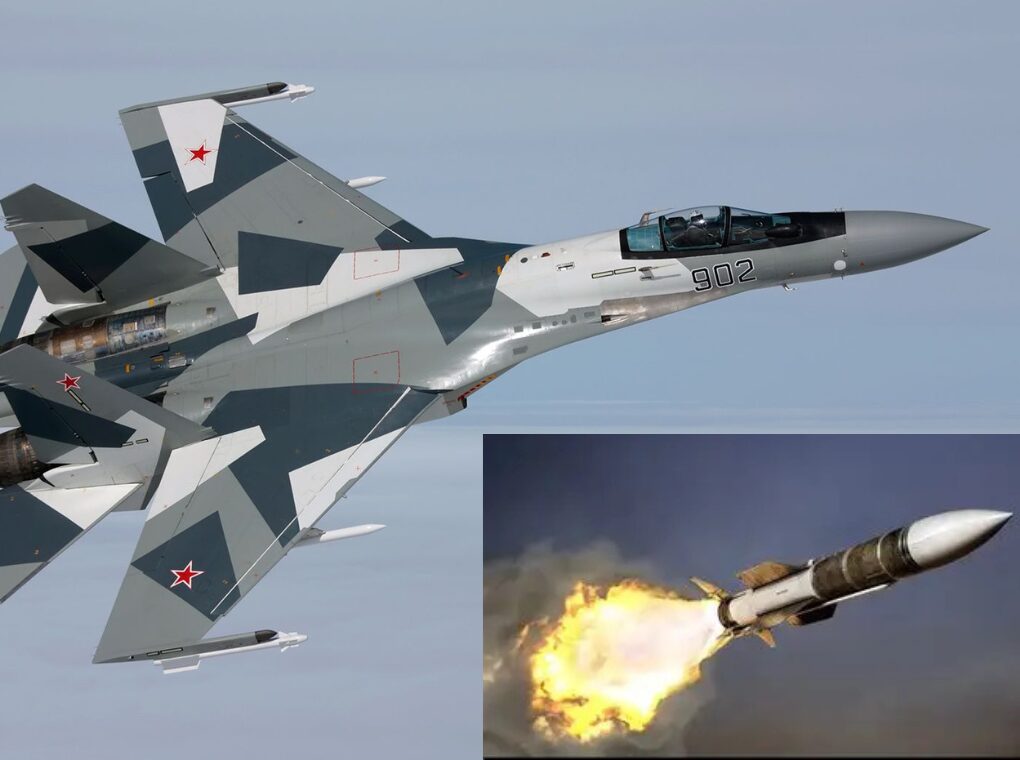
A major development from the ongoing Russia-Ukraine war is drawing renewed attention to Russia’s long-range air combat capabilities. Reports suggest that a Ukrainian MiG-29 fighter jet was recently shot down by a Russian Su-35 using the R-37M long-range air-to-air missile, with the engagement allegedly taking place at a staggering distance of around 190 kilometres.
If confirmed, the incident would further cement the Su-35 and R-37M combination as one of the most dangerous beyond-visual-range (BVR) threats in modern warfare.
A New Era of Long-Range Air Combat?
The most striking aspect of the reported kill is not just the missile itself, but the role of the Su-35’s radar and tracking system. Successfully guiding a missile at nearly 190 kilometres requires maintaining an accurate and stable lock on a fast-moving target throughout the engagement — a technically challenging task even for advanced fighter jets.
This is where Russia’s Su-35 stands out.
Equipped with the powerful Irbis-E PESA radar, the Su-35 is considered one of the most capable non-stealth air superiority fighters in service today. The radar is known for its long detection range and ability to track multiple targets simultaneously, giving it a significant advantage in BVR engagements.
Not the First Combat Success
This is not the first time the R-37M has been linked to high-profile air kills in Ukraine.
In March this year, reports claimed a Ukrainian Su-27 was shot down near Donbas in another long-range interception, allegedly carried out by a Su-35 firing an R-37M. The incident reportedly resulted in the death of an experienced Ukrainian pilot.
Even before that, Russian forces had claimed multiple combat kills involving the R-37M launched from both the Su-35 and the MiG-31 interceptor.
In 2024, one of the most notable claims involved a 213-kilometre kill against a Ukrainian MiG-29 — widely described as the longest-range air-to-air kill ever recorded.
Over the course of the conflict, aircraft including the Su-27, MiG-29, Su-24 and Su-25 have reportedly been downed by the missile.
From Skepticism to Battlefield Reality
When the R-37M first entered the spotlight, many military analysts questioned whether such a large missile could effectively engage agile fighter jets.
Originally designed as an ultra-long-range missile for targeting high-value support assets like AWACS and aerial refueling tankers, the R-37M was often seen as too heavy and insufficiently agile for fighter-versus-fighter combat.
But battlefield reports from Ukraine are beginning to challenge that view.
The MiG-29 and Su-27 are highly manoeuvrable combat aircraft, yet repeated reports suggest the R-37M has managed to score successful kills against them. That indicates the missile is proving itself as a serious threat even in dynamic fighter combat.
Speed: The Missile’s Biggest Advantage
What makes the R-37M particularly deadly is its sheer speed.
While most modern air-to-air missiles operate at speeds of around Mach 4, the R-37M is believed to reach speeds approaching Mach 6.
That speed dramatically reduces a pilot’s reaction time.
In BVR combat, survival often depends on detecting the incoming missile early, predicting its flight path and executing evasive manoeuvres. But with the R-37M covering ground at such extreme velocity, that reaction window becomes dangerously small.
By the time the target pilot realizes the threat and begins defensive action, the missile may already be too close to evade.
This has become one of the missile’s biggest tactical strengths.
Ukraine’s Radar Problem
For Ukraine, the challenge is compounded by its aging fighter fleet.
A significant portion of Ukraine’s combat aircraft still rely on Soviet-era radar and electronic warfare systems. In many cases, the detection range of those radars is shorter than the R-37M’s engagement range.
This creates a severe situational awareness gap.
By the time Ukrainian pilots detect a threat, Russian fighters may have already launched.
That imbalance gives Russia a crucial first-shot advantage.
How Far Can the R-37M Really Reach?
The exact maximum range of the R-37M remains classified, but open-source estimates place it between 250 and 300 kilometres. Some claims suggest it could reach up to 400 kilometres under ideal launch conditions involving high altitude and high speed.
What is publicly documented, however, are repeated claims of combat kills at extraordinary distances — including the reported 213-kilometre strike and now the latest 190-kilometre engagement.
Together, these incidents suggest the missile may reliably engage targets at distances approaching 200 kilometres.
The Real Force Multiplier: Networked Warfare
Range alone does not guarantee success.
The key factor in ultra-long-range air combat is maintaining continuous target tracking. The Su-35’s powerful radar, when integrated with airborne early warning aircraft, other fighters and secure datalink systems, significantly improves the R-37M’s effectiveness.
This networked battlefield awareness allows Russia to extend its kill chain far beyond the missile’s onboard seeker limitations.
That makes the Su-35 and R-37M pairing especially lethal.
A Growing Threat in Modern Air Warfare
The R-37M’s performance in Ukraine is reshaping perceptions of long-range air combat.
What was once considered a niche weapon for taking down large support aircraft is now increasingly proving capable against frontline fighter jets.
For Russia, this offers a major strategic advantage in BVR warfare.
For Ukraine, and potentially NATO air planners, it raises urgent questions about countermeasures, survivability and the future of air combat in contested skies.
If these combat reports continue, the Su-35 and R-37M combination may well become one of the defining BVR threats of the modern battlefield.