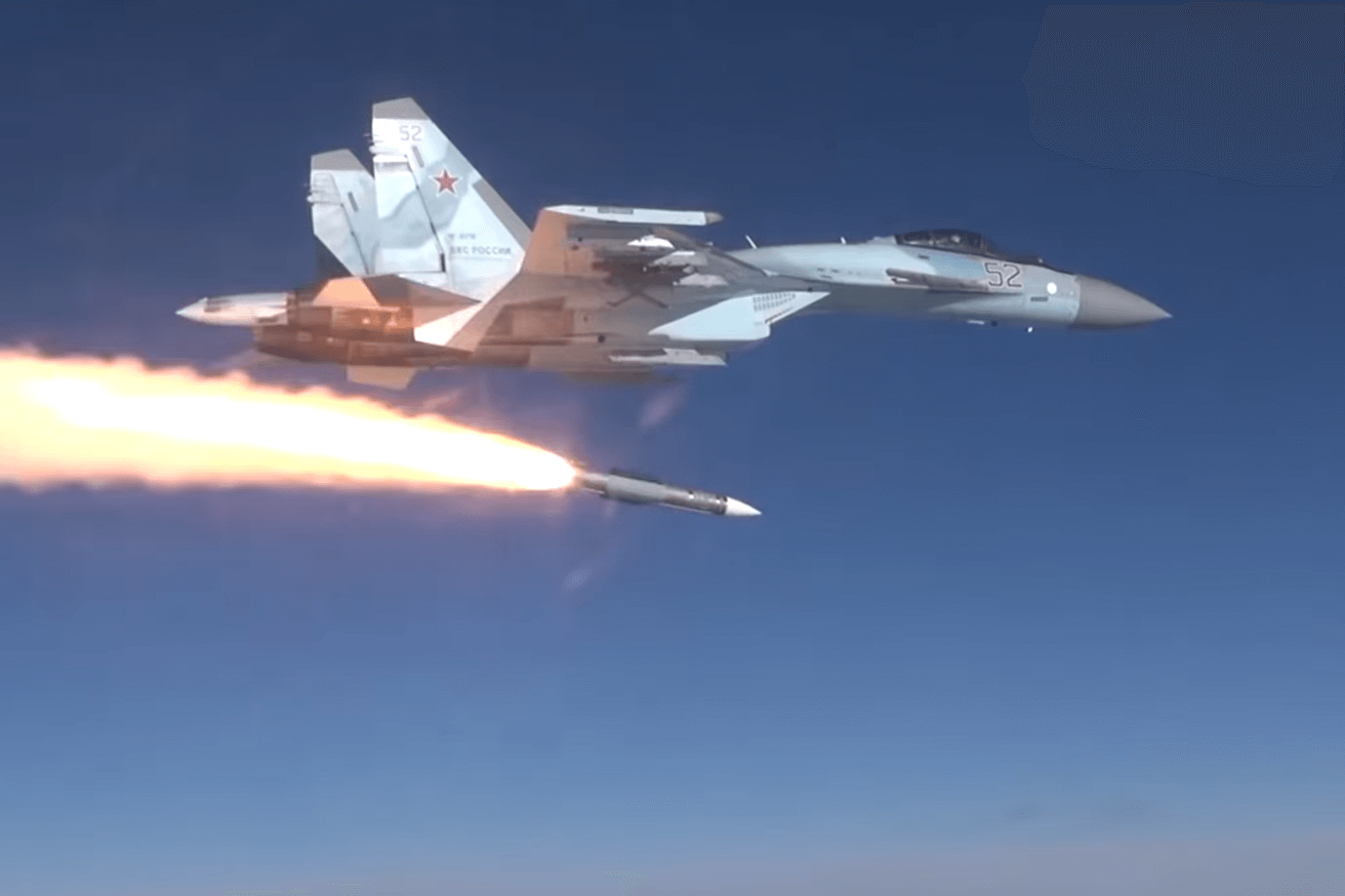
A major and highly interesting report has emerged from the Russian side in the Russia-Ukraine war. The claim is that a Russian Sukhoi Su-35 shot down a Ukrainian F-16 Fighting Falcon in an air-to-air engagement.
According to reports, this was a long-range BVR (Beyond Visual Range) kill, likely carried out using either the R-37M or an advanced version of the R-77.
Reports further suggest that the Ukrainian F-16 performed several aggressive maneuvers to evade the incoming missile, but failed to survive the engagement. Russia has previously claimed multiple long-range BVR kills, including earlier claims involving the R-37 missile. However, this is believed to be the first reported confirmed air-to-air kill of an F-16 – and that too by a Su-35 platform.
Why This Kill Matters Beyond Ukraine
So far, it has not been fully confirmed which missile was used to shoot down the Ukrainian F-16. It remains unclear whether the kill was achieved using the advanced R-77 variant or the R-37M. But reports consistently state that the engagement was carried out by the Sukhoi Su-35.
The Su-35 was designed by Russia as a multirole fighter platform. Its Irbis-E (PESA) radar is considered extremely powerful. The radar can reportedly track targets beyond 250 kilometers and guide missiles toward them. This allows the aircraft to effectively support both missiles, each of which is believed to have a range well beyond 150 kilometers.
The incident is being viewed as strategically important because Russia’s BVR capabilities have long been questioned. Many analysts believed Russia lagged behind the West in this field, especially when compared to missiles like the American AIM-120 AMRAAM or Europe’s Meteor, which uses a ducted ramjet engine.
However, Russian performance in the Ukraine war appears to suggest that Moscow has significantly narrowed this gap. Reports surrounding the new R-77M variants claim ranges of around 150 to 190 km. Meanwhile, the R-37M is believed to offer a direct engagement range of around 180 km and up to 400 km in a lofted trajectory profile.
R-37M or R-77M? Why the Missile Matters
Compared to typical BVR missiles, the R-37M is much larger and significantly heavier. Because of this, many Western analysts argued that the missile would be effective mainly against large and slow-moving targets such as AWACS aircraft, but not against fast and maneuverable fighter jets. According to this argument, the missile’s size and weight would prevent it from sustaining enough energy in the terminal phase and would also limit its maneuverability against supersonic fighters. This is why the missile earned the nickname “AWACS killer.”
If this F-16 kill was indeed achieved using the R-37M, it would be a major development. It would directly challenge the long-held Western assessment and demonstrate that the missile is not limited to large targets, but can also effectively engage advanced fighters like the F-16.
On the other hand, if the kill was achieved using the R-77M, it could be even more strategically important for Russia. The R-77M is considered better suited for fighter-versus-fighter combat. Unlike the larger R-37M, it is a more conventional BVR missile, lighter in size and weight. It also uses a dual-pulse motor, which not only increases range but also helps the missile sustain energy until the final stage of engagement. This makes it more dangerous against fighter aircraft capable of aggressive evasive maneuvers.
This is why there is growing speculation that the kill may have been carried out using the R-77M launched from the Sukhoi Su-35.
Russia’s BVR Doctrine Is Clearly Evolving
At the start of the war, Russia mainly relied on the Mikoyan MiG-31 paired with the R-37M. But this reported engagement suggests that Russia is now increasingly deploying R-77M missiles from the Su-35 platform as well, which is significant from an operational perspective.
Some reports also claim that Russia is now using AWACS guidance and collaborative engagement capability to make its long-range missiles even more effective. This means targets can be tracked by a separate platform while the missile receives mid-course guidance updates from elsewhere. As a result, targets can be engaged even at ranges of 200 to 250 kilometers. It also means the launching aircraft does not necessarily have to continue guiding the missile throughout the engagement and can disengage after launch.
At the same time, it is important to note that the F-16s supplied to Ukraine are not the most advanced variants. Their electronic warfare and BVR defensive capabilities are considered weaker compared to modern 4.5-generation fighter aircraft. But that does not make this an easy kill. Long-range BVR kills are always technically difficult and highly demanding.
That is exactly why this incident is being seen as evidence of Russia’s evolving air-to-air combat capability.
Overall, this is being viewed as a major achievement for Russia. Especially because Ukraine continues to receive layered air defense systems and advanced support from Europe and the United States. Despite that, if Russia is consistently managing to score BVR air-to-air kills, it suggests that its aerial warfare capabilities have evolved significantly during the course of the war.