
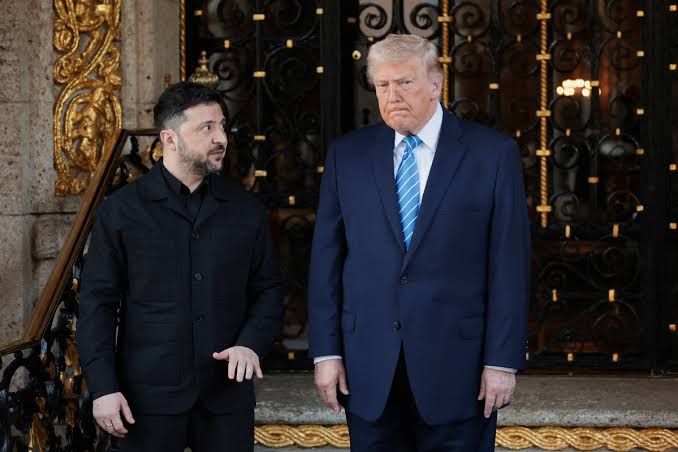
US President Donald Trump turned down a personal request from Ukrainian President Volodymyr Zelensky for hundreds of additional Patriot interceptor missiles during an Oval Office meeting on 28 July, the Financial Times reported on 5 August, citing people familiar with the talks. Trump told Zelensky that American stockpiles were thin and that the interceptors were needed to protect US facilities in the Middle East and the Gulf during the war with Iran.
The Night the Maths Came Due
Overnight into 5 August, Russia launched 24 ballistic missiles, four anti-ship missiles and 115 attack drones, mostly at Kyiv and the surrounding region, Ukraine’s air force said. Crews shot down 98 drones. They intercepted none of the missiles. At least 17 people were killed and dozens wounded, CNN reported, with strikes recorded across 26 locations — warehouses, a railway station, a brewery and logistics depots among them.
“Ballistic missile interceptors could have saved the lives of those killed today,” Zelensky said in a statement quoted by the New York Times.
It was the third ballistic attack on the capital region in a week. On 1 August, Ukraine shot down just one of 27 ballistic missiles fired.
What Kyiv Asked For
At the White House meeting, Zelensky told Trump that Ukraine needed at least 300 Patriot interceptors before winter to stop Russia crippling the energy grid. Patriot is the only system in Ukraine’s inventory that reliably brings down ballistic missiles.
The supply line has thinned badly. Allied deliveries of air-defence missiles fell by two-thirds in the first half of 2026 compared with the same period last year, Zelensky said on 5 August after meeting his military commanders. “Our partners do have the missiles,” he told them.
Production numbers explain the gap. Kyiv puts Lockheed Martin’s output at roughly 60–65 interceptors a month against Russian production of about 120 ballistic missiles a month, Euronews reported. An analysis by the Center for Strategic and International Studies, cited by The Atlantic, estimates the Iran war has consumed about two-thirds of America’s advanced Patriot stock, leaving roughly 759 remaining.
The Licence That Keeps Moving
The second half of Kyiv’s plan was a production licence — permission to build PAC-3 interceptors itself. On 8 July, at the NATO summit in Ankara, Trump said Washington would grant it. By 31 July, at a Cabinet meeting at Camp David, he had stepped back.
“We have not agreed to that. We’re talking about it,” Trump said, according to Reuters, adding that sharing such technology was a hard thing to give away because recipients could one day turn on Washington.
Matthew Whitaker, the US ambassador to NATO, closed the door further on 3 August. “A long-term production agreement will not be concluded before this winter,” he said on Fox News, noting that PAC-3 manufacture is tightly restricted under US export rules.
So Kyiv has neither the missiles nor the means to make them.
Is This a Supply Problem or a Policy Turn?
Both, on the available evidence and the distinction matters less than Kyiv would like.
The stockpile argument is real. Reuters reported on 4 August that US Army stocks of ATACMS and Precision Strike missiles were heavily depleted by the Iran campaign; the White House rejected that account, saying America has far more munitions than anyone else in the world. Defence Secretary Pete Hegseth has similarly dismissed reports of Patriot shortfalls.
But scarcity is also a choice about who gets scarce things first. Trump’s answer — Gulf bases before Ukrainian cities is a ranking, not an accident.
One caution against reading 5 August purely as a supply failure: a senior Ukrainian official told the Kyiv Independent that interceptor shortages were not the decisive factor that night. Russia ran heavy drone reconnaissance the previous day, then fired a large salvo from several directions at once. Intercepting all of it would have been close to impossible at any stockpile level.
What Happens Next
Steve Witkoff and Jared Kushner, Trump’s envoys, are expected in Kyiv in the second half of August — their first visit — around the 35th anniversary of Ukrainian independence, with peace talks on the agenda.
Zelensky has meanwhile shifted the ask. Partners unwilling to send interceptors, he said, can instead impose new sanctions on Russia’s missile industry.
Ukraine’s own answer is further off. Fire Point’s FP7.X interceptor, the Freya project, has 13 European industrial partners and expects its first successful intercept by mid-2027, chief executive Iryna Terekh told Reuters. Winter arrives sooner.
Donald Trump, Volodymyr Zelensky, Trump Zelensky, Patriot missiles, Patriot missile system, Patriot interceptors, PAC-3, PAC-3 interceptors, Ukraine Patriot missiles, Ukraine air defence, Ukraine missile defence, Russia Ukraine war, Russian missile attack, Russian ballistic missiles, Kyiv missile attack, Kyiv attack, Ukraine war, US Ukraine relations, Trump Ukraine policy, US military aid Ukraine, Patriot missile shortage, US missile stockpile, Lockheed Martin, NATO, Ukraine NATO, Iran war, US weapons stockpile, ballistic missile defence, Ukraine energy grid, Steve Witkoff, Jared Kushner, Russia Ukraine peace talks