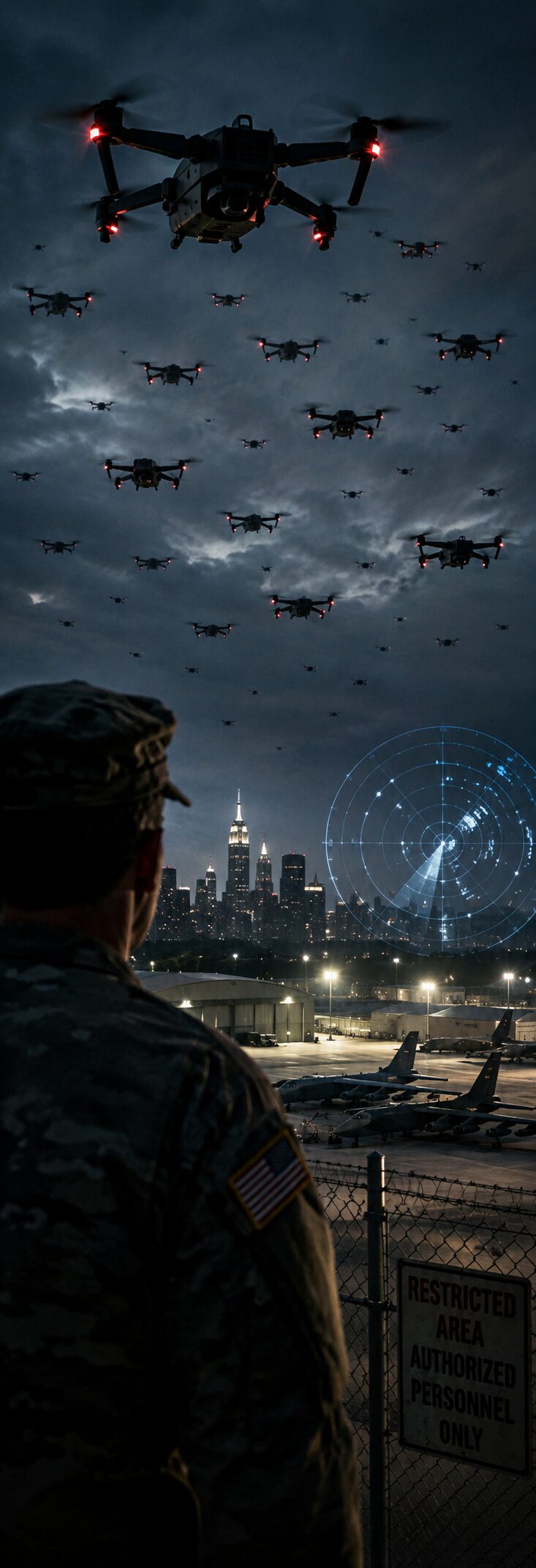
NORTHCOM’s deputy commander says America lacks both the sensors to see an attack and the weapons to stop it. Marco Rubio, meanwhile, says objects over US bases are not American.
A senior American general has said the United States cannot defend itself against a swarm of drones launched from inside its own borders.
Lieutenant General Joseph Jarrard, deputy commander of US Northern Command (NORTHCOM), gave that assessment on 13 August at the Space and Missile Defense Symposium in Huntsville, Alabama. Asked directly whether he could stop such an attack, he answered with a single word: no.
Jarrard also serves as vice commander of the US element of NORAD. He then explained the problem plainly. His command lacks the sensors to detect a swarm, he said, and often lacks the weapons to shoot one down. “We are ill-equipped right now to handle something like that,” he told the audience, which attended.
The Attack Scenario that Worries Planners
Jarrard named no specific threat. However, one model stands out.
In June 2025, Ukraine launched Operation Spiderweb. Operatives hid drones inside lorries parked near Russian airbases, then released them remotely. The strikes wrecked a large number of Russian bombers.
A second warning arrived in March. An Iranian-backed militia flew a first-person-view drone into a parked US Army Black Hawk at Camp Victory in Iraq.
Both attacks were cheap. Both came from close range. Neither required a missile.
Congressional investigators reported that more than 350 drone incursions were detected at 100 military installations in 2024 alone, according to the House Oversight Committee.
Detection has improved. Defeat has not kept pace. General Gregory Guillot, the NORTHCOM commander, told senators in March that “about a quarter of the ones that we detect we’re able to defeat”. A year earlier, he said, almost none were.
The gap showed at Barksdale Air Force Base in Louisiana, home to nuclear-capable B-52 bombers. Between 9 and 15 March, security forces logged waves of 12–15 drones over sensitive areas. An internal briefing seen by ABC News said the aircraft appeared custom-built and required “advanced knowledge” of signal operations.
The Programmes Exist. They are Simply Behind
Washington has not ignored the problem.
Secretary of War Pete Hegseth created Joint Interagency Task Force 401 in August 2025 to pull scattered counter-drone work into one body. NORTHCOM and NORAD also run the Falcon Peak experiments; the next round, Falcon Peak 26.2, begins this month at Yuma Proving Ground in Arizona.
Separately, the Defense Innovation Unit ran a low-cost sensing challenge that drew 115 entries. The Pentagon has also shifted policy, issuing new guidance in February on nets, cables and physical shelters.
Why the Lag?
Three reasons stand out.
First, detection. Radars built to spot bombers struggle with small, slow objects flying low over civilian ground. Jarrard called detection his biggest concern.
Second, the law. Only about half of American military installations count as “covered facilities” under Section 130i, the statute that lets the Pentagon act against drones. Parts of that authority lapse on 31 December 2026 unless Congress extends them. Lawmakers at an April 2025 hearing complained of “ambiguous legal authorities both on and off base”.
Third, capacity. NORTHCOM’s counter-drone fly-away kits must be requested, then delivered. Against a Spiderweb-style raid, they would arrive after the damage.
Congress has moved, though slowly. The SAFER SKIES Act extended counter-drone powers to state and local police. A joint Justice and Homeland Security interim rule took effect on 1 July 2026. Training and certification must come first, so few forces are yet cleared to act.
Nobody will say who is flying them and attribution remains the sorest point. Secretary of State Marco Rubio raised it on The Katie Miller Podcast, published on 11 August. “There are things flying over our military installations, and they’re not ours,” he said. He added: “I don’t know who it is. I don’t know what it is”.
Rubio framed the issue as security, not aliens. Any unidentified object over restricted airspace, he argued, deserves investigation.
Overseas, one assessment has gone further. The International Institute for Strategic Studies concluded in July that the Kremlin very likely ran a drone campaign over Europe between August 2024 and February 2026. American officials have made no equivalent public finding at home.