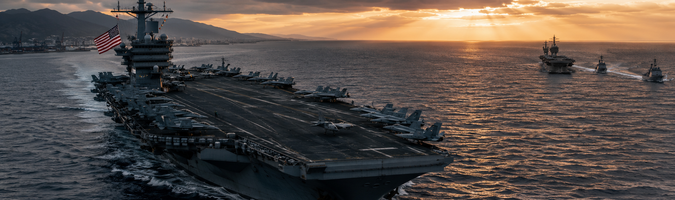
For the first time in months, the western Pacific has US Aircraft Carrier on station. The USS George Washington sailed west through the Strait of Malacca on August 13, bound for the Arabian Sea, where it will relieve the USS Abraham Lincoln after a record-breaking deployment.
The reason is simple: President Donald Trump’s war against Iran has absorbed most of America’s carrier force, and the Pacific has paid the price.
Why Washington Sent the Ship West
The Lincoln’s crew is exhausted. The carrier left San Diego on November 21, 2025, and has now been deployed more than 265 days — 241 of them consecutively at sea, surpassing the previous modern record of 206 days set by the USS Dwight D. Eisenhower in 2020. It hasn’t made a port call since December 11, when it stopped in Guam.
Conditions aboard have become a political issue. Families have raised concerns about mental health support and water shortages, and Democratic lawmakers are demanding answers. A Navy official told USNI News that disrupted supply routes forced commanders to prioritize deliveries — “first food, then hygiene items, then mail” — though the Navy maintains the crew has clean water, working air conditioning, and proper meals.
The George Washington, forward-deployed to Yokosuka, Japan, was the only carrier close enough to take over quickly — and until last week, the only US carrier in Asia at all.
A Fleet Stretched Thin
On paper, the US Navy operates 11 aircraft carriers, a number set by law rather than operational need under Title 10 of the US Code. To hit that mark, the Navy has kept the 51-year-old USS Nimitz in service until March 2027, even though its replacement, the USS John F. Kennedy, is roughly two years behind schedule and only began acceptance trials on August 12.
The usable number is much lower. Defense analyst Bryan Clark of the Hudson Institute says the Navy typically deploys just two or three carriers at once — four if the USS Theodore Roosevelt sails from San Diego. Several others are sidelined: the Truman and Stennis are in mid-life refueling overhauls, the Reagan is in dry dock until late 2026, and the Gerald R. Ford, fresh off its longest deployment since Vietnam, needs yard time of its own.
Maintenance capacity is the bottleneck. Only two shipyards handle this work, and a Government Accountability Office review found 75 percent of carrier and submarine maintenance periods ran late between 2015 and 2019 — carriers averaging 113 days behind schedule. University of Kentucky security scholar Robert Farley adds a simpler point: crews have limits, and performance suffers the longer deployments stretch.
The Political Fallout
No one expects China to invade Taiwan because one carrier left the region — but the symbolism cuts deep. Clark says Beijing’s messaging is aimed at convincing the Philippines, Japan, and Indonesia that the US “is not the big dog in the western Pacific anymore.” Recent Chinese activity lends weight to that narrative: joint drills with Indonesia this week, exercises near Scarborough Shoal earlier this month, and a live-fire drill by a Chinese destroyer near Japan’s Okinotori last month.
Allies have taken notice. Greg Poling of the Center for Strategic and International Studies argues the administration promised to prioritize the Pacific and then did the opposite. Evan Sankey of the Cato Institute says the psychological reassurance carriers provide allies is now missing, feeding perceptions of American distraction. In response, Washington dispatched Adm. Frank Bradley, head of Special Operations Command, to Manila to pledge expanded joint exercises.
Even US strategy documents reflect the shift: the 2026 National Defense Strategy ranks the homeland and Western Hemisphere above China as top priorities.
Are Carriers Still Worth It?
The episode has revived a deeper debate. Michael Swaine of the Quincy Institute argues that drones and missiles have made carriers easier to target, especially for China, and that submarines and smaller vessels can strike many of the same targets. Adm. Daryl Caudle, the chief of naval operations, told the AP in February that he wants commanders to lean on smaller ships first.
China, meanwhile, is betting the opposite way — it commissioned the Fujian, its third carrier and first with catapults, on November 5, 2025, and the Pentagon projects the Chinese navy will field nine carriers by 2035.
The immediate gap may close soon: if the Roosevelt deploys, the George Washington could head back east within months. But the underlying math won’t improve quickly. Eleven hulls, two shipyards, and one long war add up to a fleet stretched thin — and the missing carrier in Asia is a symptom, not the disease