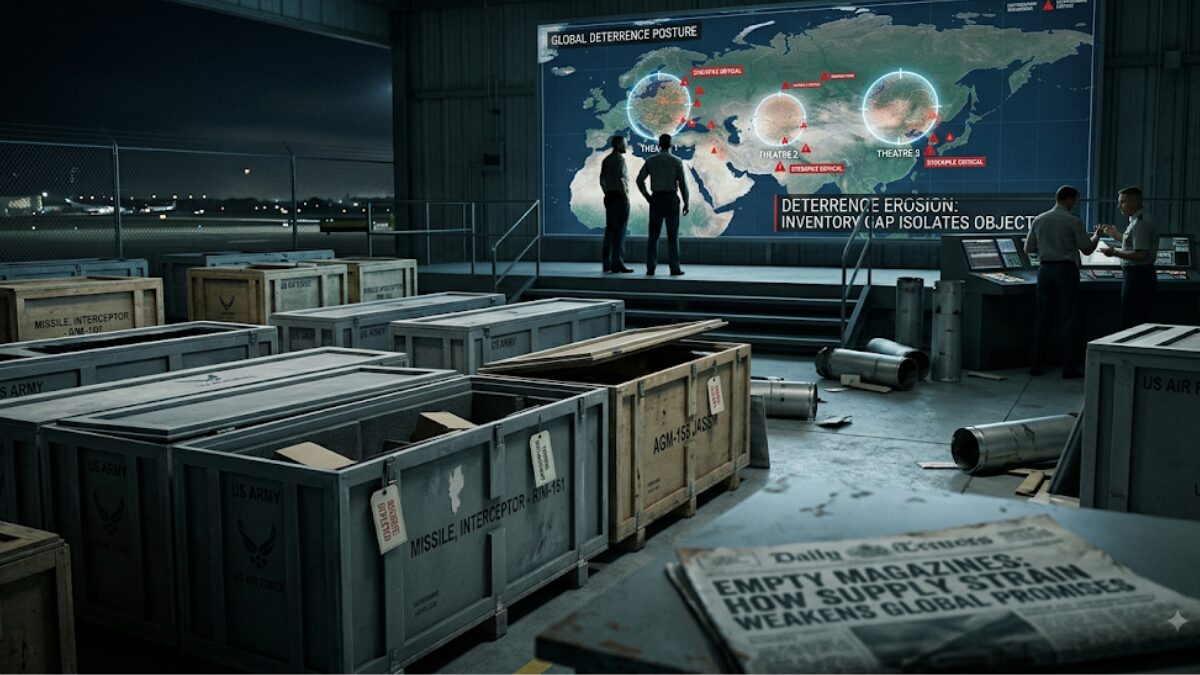
America has promised for eighty years to defend Europe, the Middle East and the Indo-Pacific all at once. A single war with Iran has drained the magazines behind that promise, and the world has done the arithmetic.
The numbers arrived in early August, and they landed hard. The New York Times reported that US forces have fired more than 1,500 Patriot interceptors since the Iran campaign began, leaving fewer than 1,700 in stock — a stockpile that could take over two years to replace.
Independent analysts paint a bleaker picture still. Washington has burned through roughly 65 per cent of its Patriot stockpile, which stood near 2,330 before the war; after fighting resumed over the summer, CSIS put the remaining figure between 759 and 827. Missile-defence stocks look worse yet, with the military having expended nearly four-fifths of its THAAD inventory. Offensive weapons went the same way, with more than 850 Tomahawks fired in the first month alone. Tom Karako of CSIS called the drawdown a “generational annihilation of the means of conventional deterrence.”
The Pentagon disputes the framing. President Donald Trump insists the country holds “massive amounts” of munitions. The Pentagon’s own paperwork tells a different story.
Three Weeks to Fix Thirty Years
On 6 August, Deputy Defence Secretary Steve Feinberg wrote to Boeing, Lockheed Martin and RTX, giving them 21 days to submit plans for faster deliveries and expanded capacity. “Years-long development cycles are not acceptable,” he wrote.
Urgency, however, does not manufacture missiles. Mark Cancian of CSIS puts the physics bluntly: money spent today buys a missile in three to five years’ time. Worse, the money itself is stuck — Congress has yet to pass a defence bill, so contractors are being asked to invest ahead of funding that doesn’t yet exist. As Karako put it, “Almost nothing has been contracted, and that’s the problem.” A 21-day deadline produces a plan. It does not produce a magazine.
Robbing Seoul to Defend Riyadh
Here the story stops being an accounting exercise. To sustain the Iran campaign, the Pentagon stripped other commands bare. Hundreds of interceptors left South Korea and Asia, and carrier groups and Tomahawks earmarked for a China contingency went west instead. General Xavier Brunson confirmed to senators in April that THAAD interceptors had left the Korean peninsula, and by March roughly one-third of the American surface fleet sat in Middle Eastern waters.
Allies are paying the bill in delays. Washington has warned Britain, Poland, Lithuania and Estonia to expect long waits on systems they have already bought, while Taiwan sits behind a backlog approaching $30 billion. Deterrence, though, is psychology as much as hardware — an adversary doesn’t need America to actually be weak. It only needs to believe America is stretched.
Makkah Answers Washington
On 7 August, at Al-Safa Palace in Makkah, three leaders signed something that would have been unthinkable a decade ago. Crown Prince Mohammed bin Salman, President Recep Tayyip Erdoğan and Prime Minister Shehbaz Sharif concluded the Makkah Joint Defence Agreement, its core clause short and stark: an armed attack on one counts as an attack on all three.
Each partner brings what the others lack. Turkey supplies NATO’s second-largest army and a booming drone industry, Saudi Arabia brings capital, energy leverage and geography, and Pakistan brings manpower, missiles and the only nuclear arsenal in the Muslim world.
The timing speaks for itself. Iran has closed the Strait of Hormuz and struck Gulf neighbours while American interceptors run thin. As The National noted, the subtext is that all three governments are worried about a region their longtime American partner is struggling to contain.
What the Pact Is Not
Calling this NATO 2.0 would be premature. Özgür Ünlühisarcıklı of the German Marshall Fund describes it as a framework for defence-industrial coordination rather than a mutual-defence treaty on NATO’s model, and history supports his caution — Riyadh already had pacts with Islamabad and the Gulf Cooperation Council, and neither produced anything resembling an Article 5 response.
The hard questions remain open: who would command, what would trigger the clause, and would Ankara truly fight Riyadh’s war. Nobody knows yet. Even so, the signature isn’t meaningless — hedging rarely announces itself with certainty.
Europe Got There First
The Middle East is, in a sense, late to this conversation. NATO members agreed at The Hague to spend 5 per cent of GDP on defence by 2035, Brussels added the €800 billion ReArm Europe plan, and Germany unveiled its first standalone military strategy since 1945 in April 2026, targeting an army of 260,000.
France went furthest. In his Île Longue speech on 2 March 2026, Emmanuel Macron declared that the French nuclear deterrent carries a European dimension, and nine European states have since joined talks on French forward deterrence. Different continent. Identical logic.
The Lesson for New Delhi
India should read these numbers carefully. When Riyadh and Islamabad signed their bilateral pact in 2025, the Ministry of External Affairs promised to study the implications; the trilateral version demands faster scrutiny still.
The deeper lesson, though, has little to do with Pakistan. It concerns supply chains. Ukraine learned it first, Taiwan is learning it now, and Japan and South Korea are learning it this year: high-intensity war consumes sophisticated weapons faster than any industrial base can replace them, which means no country can build its security strategy around someone else’s warehouse. Self-reliance stops being a slogan at that moment. It becomes arithmetic.
The One Thing America Lacks
None of this means American power is collapsing. It isn’t. The United States still fields the strongest military on the planet and the largest defence-industrial base in history.
But capability and capacity are different things, and a superpower can hold every advantage and still run short of the one commodity that sustained war actually demands. America does not have infinite magazines, and its allies have now seen the receipts. In Makkah, Paris, Berlin and increasingly New Delhi, governments are quietly drawing the same conclusion: a guarantee is only as good as the stockpile behind it.
That may prove the most durable consequence of the Iran war — not a battle won or lost, but a promise recalculated.