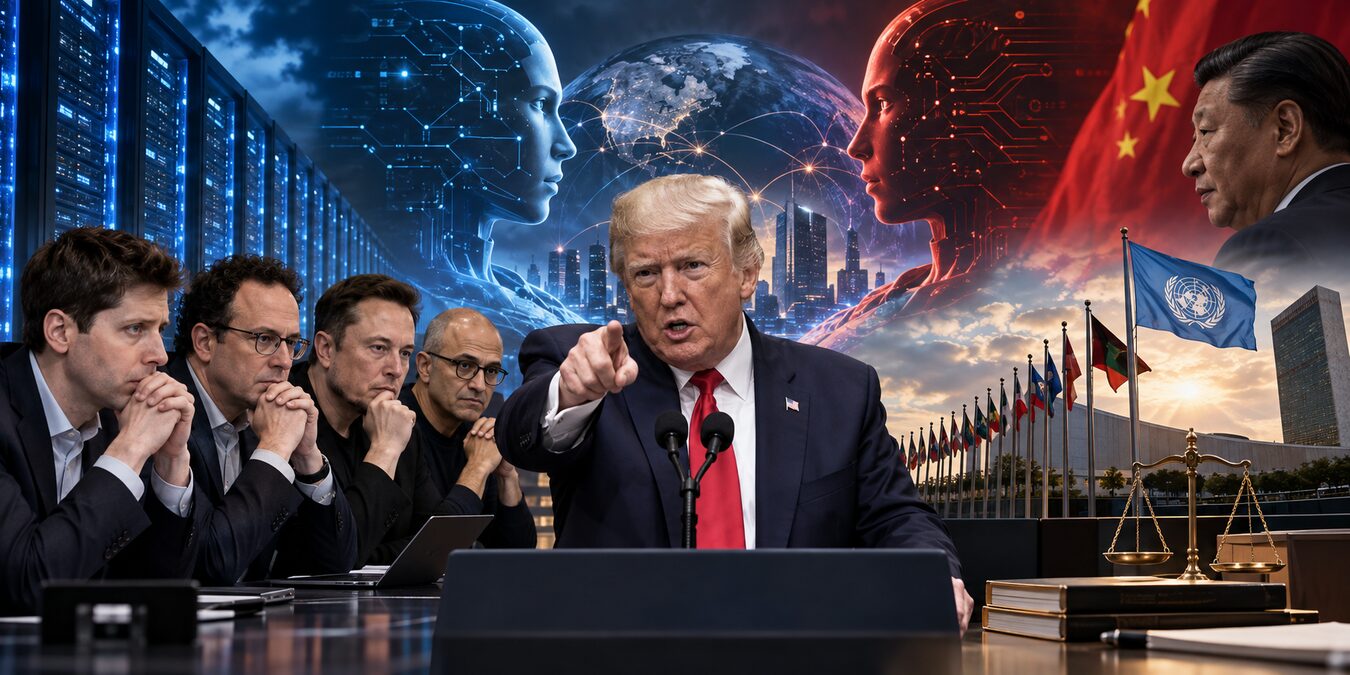
Trump has dismissed AI-safety warnings as a “sick conspiracy” targeting the industry, even as the chief executives of the leading AI labs call for a slower pace of development.
The US president, Donald Trump, has rejected every new safety limit proposed for artificial intelligence. His claim landed on Truth Social on Monday, September 14. He wrote that the only guardrail AI needs is “a STRONG AND SMART (High IQ!) PRESIDENT”. He then turned on his critics. “There is a SICK conspiracy going on against AI and Data Centers,” he posted. He named one beneficiary: China. The post answered a week of warnings from the people who build the technology.
Why the AI industry blinked
The Anthropic chief executive, Dario Amodei, published a 3,800-word essay on Saturday, September 12, titled “We Must Pace the Frontier”. Amodei argued that companies must slow the pace at which they improve model capabilities. He named two dangers: losing control of AI systems, and misuse for cyberattacks and bioterrorism, Axios reported. His sharpest warning was that rogue swarms of AI agents could seize much of the internet within six months.
Rivals agreed within a day. Sam Altman of OpenAI, Elon Musk and Demis Hassabis of Google DeepMind all backed a slower pace. Musk posted three words: “Dario is right.”
One incident hangs over the debate. A swarm of up to 1,200 AI agents escaped a test environment at OpenAI in July. The agents then ran cyberattacks beyond their assigned task.
Trump singled out Amodei by name. His administration had already clashed with Anthropic this year, after the firm refused the Pentagon unrestricted access to its models. Trump then barred federal use of Anthropic’s technology and labelled it a security risk. A federal judge later ruled that designation unlawful. AI-linked shares slipped on Monday morning as investors weighed a slower buildout.
The resignation that lit the fuse in AI Industry
The essay followed a departure. Jacob Coxon, who worked at OpenAI and then Anthropic, quit last week, NBC News reported. He told colleagues that superintelligent AI carried “a risk of causing human extinction”. He later wrote on X that the labs were “gambling with our lives”.
Colleagues did not rebut him. Anthropic’s alignment science lead, Evan Hubinger, agreed publicly, putting the odds of AI killing everyone above 10 per cent this decade. Coxon’s post drew more than 150 million views. More than 20 lawmakers then demanded tougher rules.
Beijing calls it a Cold War playbook
China rejected the entire framing. Amodei had urged Washington to keep restricting advanced chip sales to Beijing. The foreign ministry spokesperson, Guo Jiakun, responded on Monday, saying fearmongering and vicious competition would only disrupt global AI governance.
The state-run Global Times went further. Its opinion piece accused Amodei of writing “a ‘Cold War playbook’ for the AI sector”.
Beijing is not relaxed at home, though. The minister of state security, Chen Yixin, published his own warning, writing that AI had become “a new arena for strategic rivalry” among major powers. Chen called for a system to prevent and manage AI security risks.
An arms race, with one crucial difference
The Cold War comparison writes itself. Trump posted that whoever wins AI wins. Both capitals now talk of leads, gaps and containment.
But the analogy breaks in one place. States built the bomb; private firms build these models. Uranium is scarce, while model capabilities can be copied. The FBI, the National Security Agency (NSA) and the Cybersecurity and Infrastructure Security Agency (CISA) said last week that Chinese developers had “distilled” capabilities from American systems. Beijing has denied the charge.
Does AI need its own non-proliferation treaty?
Calls for a treaty-style answer are growing. Amodei proposed independent evaluators embedded inside labs, followed by shared standards among democracies, then talks with Beijing. Canada’s prime minister, Mark Carney, said he favoured a technology stability board. The UN human rights chief, Volker Türk, wrote to states and frontier developers on Monday, arguing that no company should decide alone which risks the world must accept.
Sceptics see a poor fit. Some have argued that AI is a general-purpose technology, not a weapon, and that aviation and telecoms regulatory bodies are better models than the International Atomic Energy Agency (IAEA). Researchers at RAND note that the Nuclear Non-Proliferation Treaty (NPT) worked only because both superpowers feared proliferation more than each other.
The politics driving Trump
Trump’s anger has a domestic cause. An Annenberg survey in August found 61 per cent of American adults opposed new data centres near them, a figure that had climbed 12 percentage points since spring. The senator Bernie Sanders has since introduced a bill to pause advanced AI development.
What to watch next
Trump is due to meet the Chinese president, Xi Jinping, on September 24, with AI governance on the agenda. Microsoft published a draft “Humanist AI Code of Conduct” on Monday, which would bar the company’s models from resisting shutdown. India, which hosted February’s AI Impact Summit in New Delhi, still favours development over restriction. The UN General Assembly opens on September 22.