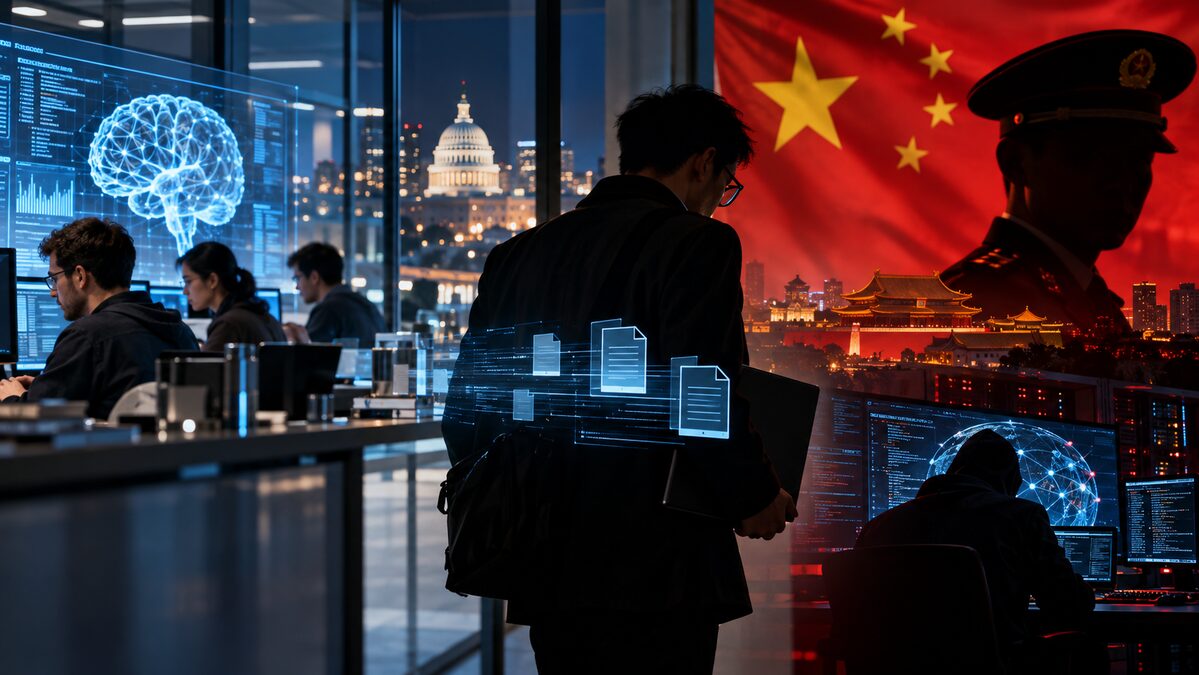
CosonA former Anthropic researcher has pushed China’s corporate espionage back into the headlines. Jacob Coxon says Beijing already has spies inside America’s leading artificial intelligence labs.
What did Coxon Claim?
Coxon worked at both OpenAI and Anthropic. He said that “China already has spies at OpenAI and Anthropic“. put his certainty at 90 per cent. He argued that Beijing could steal any American lead and catch up quickly. The British researcher left Anthropic in September. He warned then that AI firms were racing towards superintelligence without adequate safeguards.
How does China’s Corporate Espionage Work?
American officials describe four main routes.
First through insiders where employees copy files before they join or launch Chinese ventures. Second through hackers where state-linked groups break into company networks. Third through talent programmes, where Beijing funds scientists who bring expertise home. And fourth through, Partnerships as joint ventures can expose a firm’s sensitive designs.
In 2020, the FBI said it opened a new China-related counterintelligence case roughly every ten hours. Almost half of its nearly 5,000 counterintelligence cases involved China. The FBI cited scientist Hongjin Tan as an example. Tan stole trade secrets worth over $1bn from an Oklahoma petroleum company. He had applied to China’s Thousand Talents Programme.
Which Cases Define the Record?
Concerns go back decades. In 1999, a congressional committee accused China of stealing design data on seven American nuclear warheads. In 2014, Washington charged five Chinese military officers with hacking Westinghouse, US Steel and other firms. One officer took reactor pipe designs while Westinghouse negotiated with a Chinese state firm. These were America’s first criminal charges against state actors for such hacking.
In 2022, a US court jailed Xu Yanjun for 20 years. Xu, a Chinese intelligence officer, had tried to steal jet engine secrets from GE Aviation. He used Chinese universities as cover and invited engineers to China. Authorities arrested him in Belgium in 2018. America then secured its first extradition of a Chinese intelligence officer.
Chips drew scrutiny too. In 2020, Taiwan’s UMC pleaded guilty to trade secret theft involving Micron and paid a $60m fine. Prosecutors said the scheme served Fujian Jinhua, a Chinese state-owned chipmaker. A US judge acquitted Fujian Jinhua in 2024.
Has Espionage Already Reached AI?
Yes, though the court record cuts both ways. In January, a jury convicted former Google engineer Linwei Ding of stealing AI trade secrets. He uploaded more than 2,000 pages of confidential files to a personal cloud account. Ding had secretly founded an AI start-up in China. Other threats come from outside. On 1 October, the security firm Proofpoint said suspected Chinese hackers had impersonated an Anthropic employee. They also posed as former American officials. The hackers targeted American experts on AI policy. Britain’s MI5 says British academics contributed AI research to a Chinese institute close to Chinese intelligence.
American labs also accuse Chinese rivals of “distillation”. The technique trains one model on another model’s answers. In February, Anthropic accused DeepSeek, Moonshot AI and MiniMax of copying Claude. It said the labs used roughly 24,000 fraudulent accounts. Anthropic counted more than 16 million exchanges with its model. AI secrets travel easily. Anthropic chief Dario Amodei warned in 2025 of “$100 million secrets that are a few lines of code“. He urged Washington to help labs strengthen their security.
How large are the losses?
Nobody knows precisely. A bipartisan commission estimated in 2017 that intellectual property theft costs America $225bn to $600bn a year. That figure covers all offenders. The commission named China as the principal one. Some analysts question the quality of that estimate.
Why is the debate so sensitive?
Suspicion carries costs. The Justice Department ended its China Initiative in 2022. Civil rights groups said the programme amounted to racial profiling of Asian Americans. American AI labs also rely heavily on talent from China. Blanket suspicion could drive those researchers away.
Coxon wants stricter hiring rules at AI firms. Labs face a hard balance. They must protect their secrets without treating a whole workforce as suspects. For now, Coxon’s 90 per cent remains a guess. The court record shows the underlying risk is real.