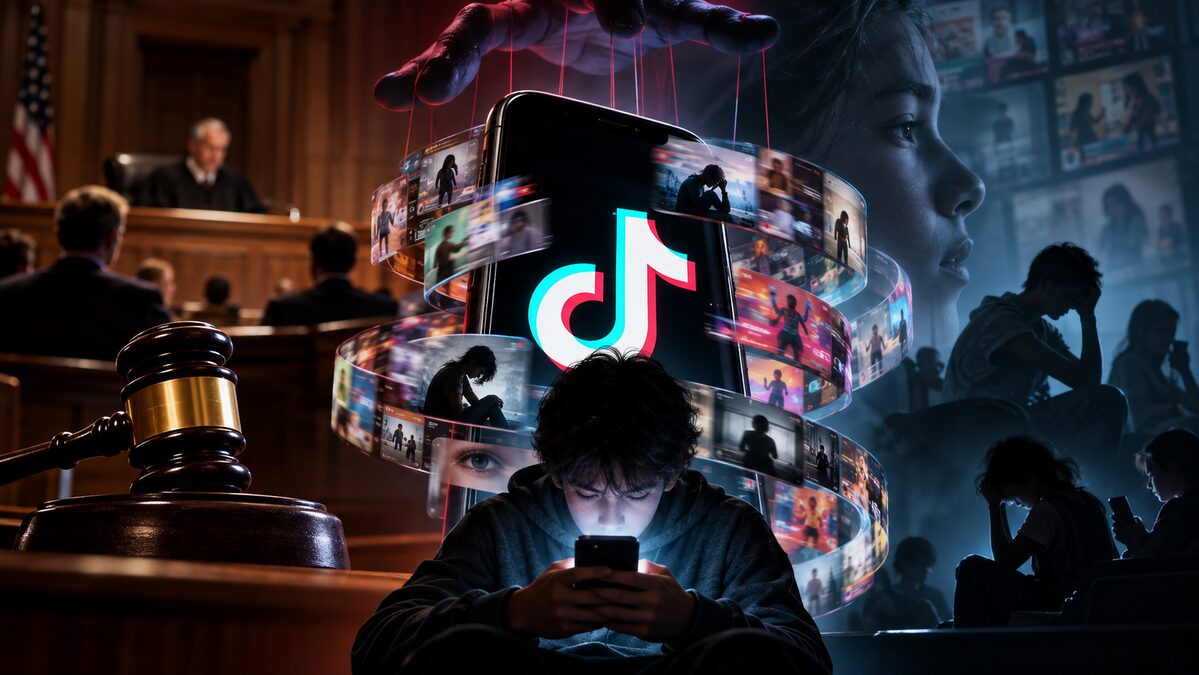
An Alabama jury will soon decide whether TikTok hooked children and hid the dangers from their parents. The trial opens Monday in Montgomery state court — the first case against TikTok to reach a jury in America’s sprawling litigation over social media and teen wellbeing. Alabama accuses TikTok and its Chinese parent, ByteDance, of building an addictive app and misleading consumers about its safety. The outcome could shape at least 27 similar lawsuits from other states and Washington, DC.
TikTok’s Endless Scroll on Trial
Republican Attorney General Steve Marshall brought the case last year. The state argues TikTok’s endless video stream makes it the most addictive social media platform, and that its algorithm steers young users toward increasingly intense content about violence and self-harm. The lawsuit links this to a teen mental health crisis, claiming emergency-room visits for self-harm in Alabama began to “skyrocket.”
Alabama also alleges TikTok falsely promised to limit sexual and violent content to secure teen-friendly app-store ratings, and misled users about Chinese government access to American data. The state says children can dodge age questions simply by watching videos without an account — and that TikTok still collects data on their viewing habits regardless.
TikTok’s Defense
TikTok says it built the platform with teen safety as a priority. Its lawyers argue Section 230 shields platforms from liability for what users post.
The company has previously settled cases before juries could hear them — in January, it settled a landmark Los Angeles case the very day trial began against Meta and YouTube. The Alabama trial could give the public a rare look inside the company. Neither TikTok nor the attorney general’s office responded to requests for comment.
What the Research Shows
Independent researchers have spent years testing TikTok’s “For You” feed. In 2023, Amnesty International set up accounts posing as 13-year-olds in Kenya, the Philippines and the US; within 20 minutes, mental health struggles dominated more than half the recommended videos, and several each hour romanticized, normalized or encouraged suicide.
Amnesty repeated the test in France in 2025: within three to four hours, teen accounts saw videos romanticizing suicide, including method information. Lisa Dittmer, Amnesty’s researcher on children’s digital rights, warned of “toxic rabbit holes.”
A 2025 review of studies linked heavy TikTok use to shorter attention spans, weaker school results, and changes in brain regions tied to behavioral control. A survey of 1,735 Chinese middle-schoolers found short-video addiction lowered wellbeing, mostly by worsening anxiety and depression. Another study of 1,629 Chinese high-schoolers linked heavy use to poor sleep and social anxiety.
China’s Tighter Version
ByteDance runs a separate app, Douyin, for Chinese users. The two apps look nearly identical but follow China’s stricter content rules. Since 2021, Douyin has forced users under 14 into a “teenager mode” capping viewing at 40 minutes a day and restricting access to the 6am–10pm window, with real-name verification enforcing the limits. In this mode, young users see only approved content — science experiments, museum exhibits, history lessons.
MIT Technology Review asked why TikTok took so long to bring similar screen-time limits abroad; the magazine reported ByteDance has since begun introducing some of these measures outside China.
Caught in a Superpower Tug-of-War
The trial also lands amid a long fight between Washington and Beijing over TikTok. US lawmakers feared the Chinese government could access American user data, prompting a national security law ordering ByteDance to sell TikTok’s US business or face a ban. The Supreme Court upheld the law, and Trump later signed an order approving a sale.
TikTok announced the new TikTok USDS Joint Venture on January 22, 2026. Oracle, Silver Lake and Abu Dhabi’s MGX each hold 15%; ByteDance keeps 19.9%. The venture says it will retrain the recommendation algorithm on US user data, stored on Oracle’s US cloud. Alabama filed its case before the sale, and ByteDance remains a named defendant.
The trial is expected to last two to three weeks. A win for Alabama could strengthen dozens of pending cases nationwide; a win for TikTok would bolster its argument that federal law protects platforms. Either way, parents, regulators and ByteDance will be watching Montgomery closely.