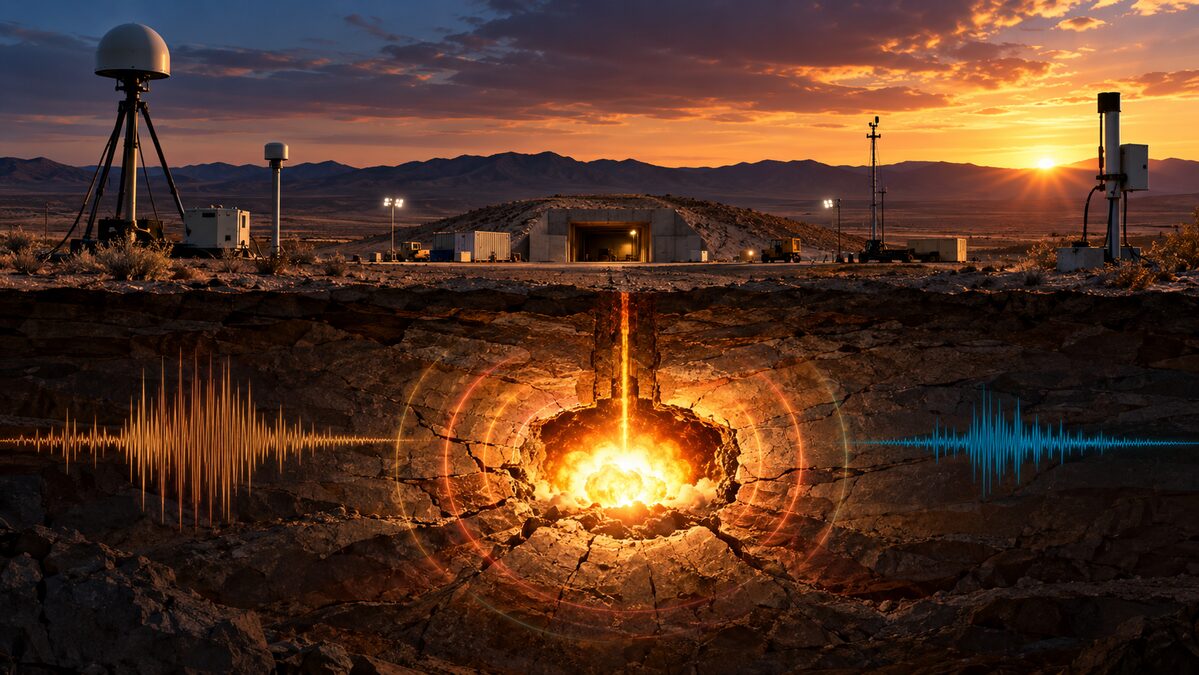
The United States fired a large chemical charge deep under the Nevada desert on 30 September. The blast carried no nuclear material. Yet it mimicked the one thing American scientists fear they cannot hear: a small, muffled nuclear test. The experiment aims to improve US detection of low-yield explosions. Washington accuses China of hiding exactly such a test in June 2020. Beijing rejects the claim.
What Happened in the Tunnel
NNSA teams fired the charge inside P Tunnel, in Area 12 of the Nevada National Security Site. They used chemical high explosives and radiotracers, the Energy Department said. No fissile material took part, so no chain reaction occurred.
The agency chased one specific target: a “decoupled” explosion. A state can muffle a test by firing the device inside a large underground cavity. The rock then soaks up much of the shock, and the seismic signal shrinks sharply. The Energy Department said the shot mimicked the kind of test it believes China carried out in June 2020 at Lop Nur. The data will validate scientific models and refine detection algorithms.
How the Detection Technology Works
Every underground blast shakes rock and pushes air. Sensors catch those signals thousands of kilometres away. Each instrument answers a different question.
The NNSA ringed its 2023 shot in the same tunnel with accelerometers, seismometers, infrasound sensors, electromagnetic sensors, radiotracer samplers and weather instruments, the Energy Department said. Seismometers read size and depth. Infrasound sensors catch sound below human hearing. Radiotracers follow gases as they seep up through fractured rock.
That last point decides nuclear from non-nuclear. A real detonation vents distinctive radioactive gases. Chemical explosives do not. The hard part is discrimination. The planet delivers thousands of earthquakes and mining blasts every day. Explosions push rock outwards, so they produce stronger compressional waves than earthquakes do. Algorithms hunt that difference. Nevada experiments feed those algorithms data from a blast whose size, depth and geology scientists already know.
Why America Built this Capability
Washington cannot walk into a rival’s test site. It must police the 1996 Comprehensive Nuclear-Test-Ban Treaty from a distance. The treaty organisation runs the International Monitoring System, a worldwide network of seismic, infrasound, hydroacoustic and radionuclide stations. That network tracks large blasts well. It reliably confirms explosions only above roughly 500 to 1,000 tonnes of TNT equivalent. Anything smaller can hide in the noise.
So the NNSA builds its own ground truth. Its Source Physics Experiment series fired chemical charges at the Nevada site between 2010 and 2019. Those shots help analysts separate low-yield nuclear tests from mining work and small earthquakes. Even a tiny yield teaches a weapons designer plenty, which is why the gap worries Washington.
Why it Matters Now
The treaty scaffolding is falling away. New START, the last pact capping US and Russian deployed warheads, expired on 5 February 2026. Its lapse left the two largest arsenals unconstrained for the first time since 1972.
Pressure on the testing moratorium followed. President Donald Trump told the Pentagon in October 2025 to resume nuclear testing on an equal basis with other states. Energy Secretary Chris Wright later said the president was not calling for explosive tests. Nevada’s senators demanded clarity anyway.
Better detection serves both sides of that argument. It sharpens any American case against a rival. It also underpins any future treaty, because somebody must verify the promises.
The China Dispute
One date drives this row: 22 June 2020. Thomas DiNanno, under-secretary of state for arms control, told a Geneva disarmament conference in February 2026 that China conducted a yield-producing test that day. He gave no further detail.
The accusation landed one day after New START expired. A seismic station in Kazakhstan, about 720km from Lop Nur, recorded the signal. American officials believe decoupling hid the yield. The suspicion is older. A 2020 State Department report flagged excavation, containment chambers and year-round activity at Lop Nur. It offered no evidence of an actual blast.
China denies everything. Beijing called the claim entirely unfounded and an attempt to fabricate excuses for resuming American testing. The treaty organisation’s chief, Robert Floyd, said monitors caught two very small seismic events twelve seconds apart. Independent analysts still call the evidence inconclusive.
What to Watch Next
The data now moves to the national laboratories and their modelling teams. The NNSA notifies regional seismic networks and the treaty organisation before such shots, and it publishes findings afterwards, former administrator Jill Hruby said in 2023.
Three questions follow. Will Washington release harder evidence on Lop Nur? Will Moscow or Beijing answer with experiments of their own? And will the United States step from chemical shots to a real detonation?
America last tested a nuclear weapon in 1992. That line still holds, 34 years on.