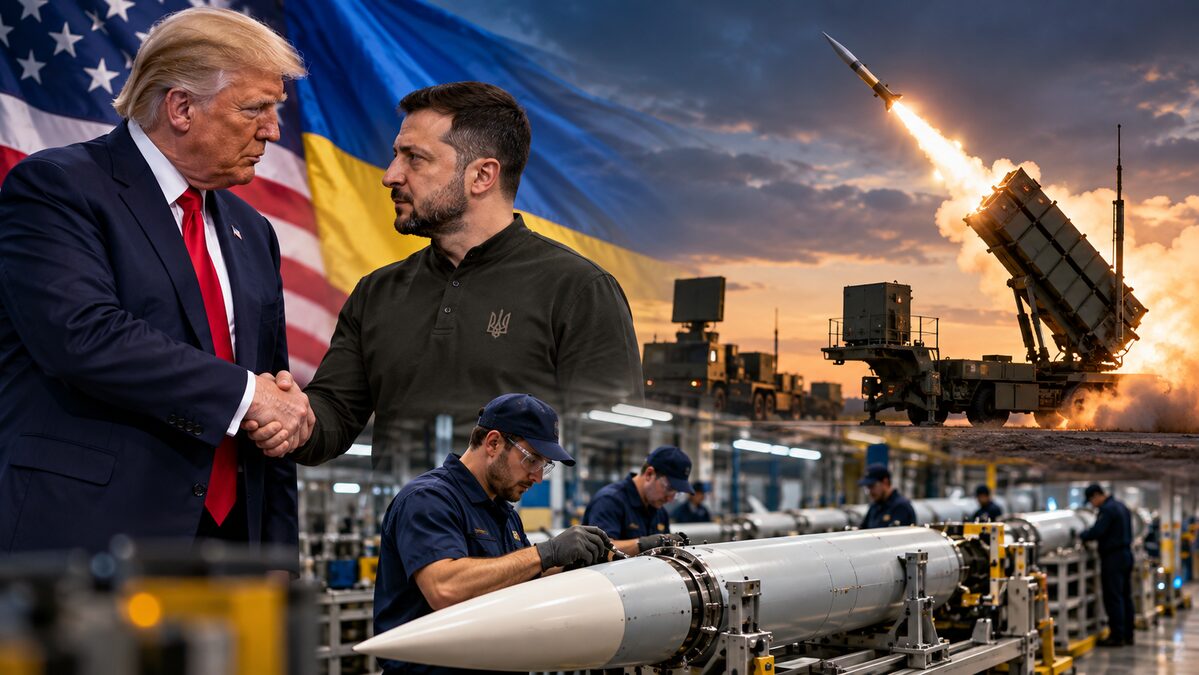
Ukrainian President Volodymyr Zelensky says US President Donald Trump has made a “final decision” to let Kyiv build Patriot missiles.
Zelensky shared the news with reporters on 25 September, after meeting Trump at the UN General Assembly in New York. “Ukraine will receive licences for the production of Patriot missiles,” Zelensky said in a voice note.
The promise ends months of mixed signals from Washington. However, the White House had not independently confirmed the decision
Why Ukraine Needs its Own Interceptors
Patriot interceptors remain one of the few weapons that can shoot down ballistic missiles. Yet a global scramble for air defence has squeezed Ukraine’s supply. Kyiv has reported a severe interceptor shortage since the US and Israel went to war with Iran in February, which diverted supplies.
Russia has exploited the gap. Moscow has struck Ukraine, and Kyiv in particular, almost constantly for around a month. On 25 September, daytime drone strikes on Kyiv killed seven civilians, and injured 59 more, according to the capital’s mayor.
Zelensky said last month that Kyiv needs five per cent of America’s Patriot interceptors to survive winter, and 10 per cent to stop all Russian ballistic missiles.
How Long will Production in Ukraine Take?
A licence will not deliver missiles quickly. Zelensky himself estimates Ukraine may need one to one-and-a-half years to ramp up production once it receives the licence. Kyiv is negotiating with US firm Raytheon over a licence to make PAC-2 GEM-T interceptors. Lockheed Martin, by contrast, makes the newer PAC-3 family.
Military analysts offers a gloomier forecast. They say full domestic production of the GEM-T could put the first missiles in Ukrainian hands only in late 2028 or 2029. Final assembly using parts made elsewhere could shorten that timeline.
Independent experts agree on the slow pace. “I would be very surprised if this is faster than 12 months,” Fabian Hoffmann of the Norwegian Institute for Defence Studies said.
Analyst Chernev estimated that even with complete component kits from abroad, Ukraine would need at least 18–24 months to launch a pilot line.
A licence would probably not cover entire Patriot batteries, including radars and launchers. It could instead cover interceptors, kit assembly or selected parts.
Precedents exist. Japan’s Mitsubishi Heavy Industries has assembled PAC-3 missiles under licence for decades. Raytheon and MBDA Deutschland are building a GEM-T plant in Schrobenhausen, Germany.
Does It Cross Russia’s Red Lines?
Moscow has not declared the licence a formal red line. Instead, the Kremlin signalled quiet watchfulness.
Kremlin spokesman Dmitry Peskov said Russia closely tracks which countries grant licences and supply weapons, and factors all of it in. He also brushed aside Zelensky’s claim, saying the Ukrainian leader had said a great deal lately.
Trump has framed the move as defensive. “It’s a defensive weapon, which I like better than an offensive weapon,” he said in July. Russian Foreign Minister Sergey Lavrov nonetheless accused Washington of abandoning its role as a neutral broker.
The bigger risk lies on the ground. Any Patriot factory would likely become a Russian target. Russian strikes in July 2026 hit Kyiv electronics and logistics hubs linked to missile programmes. Analysts warn Ukraine would then have to divert scarce Patriots to guard the new plants.
In short, the licence does not breach any red line Moscow has spelt out. But it hands Russia fresh targets.
A History of U-Turns
The latest pledge follows a series of reversals. Trump first floated the licence at the NATO summit in Turkey in July, then backed away.
On 23 July, Zelensky announced a joint production deal with a Raytheon delegation in Kyiv. On 31 July, Trump said the US had not agreed to the licence, calling the technology “a hard thing to give away”. The US State Department later said Washington had not reached a final decision. Zelensky now says Trump has settled that question.
What Comes Next
Kyiv is not relying on Patriots alone. Zelensky said Ukraine is also developing its own anti-ballistic system, Freya. The scale of the threat remains stark. Russia produces at least 700–800 Iskander and Kinzhal ballistic missiles each year.
Diplomacy continues alongside the fighting. The Kremlin said a trilateral US–Russia–Ukraine meeting could happen soon. Zelensky said it might take place in the United Arab Emirates at a technical level.
For now, imported interceptors must carry Ukraine through another winter of strikes. Home-built Patriots remain, at best, a promise for 2027 or beyond.