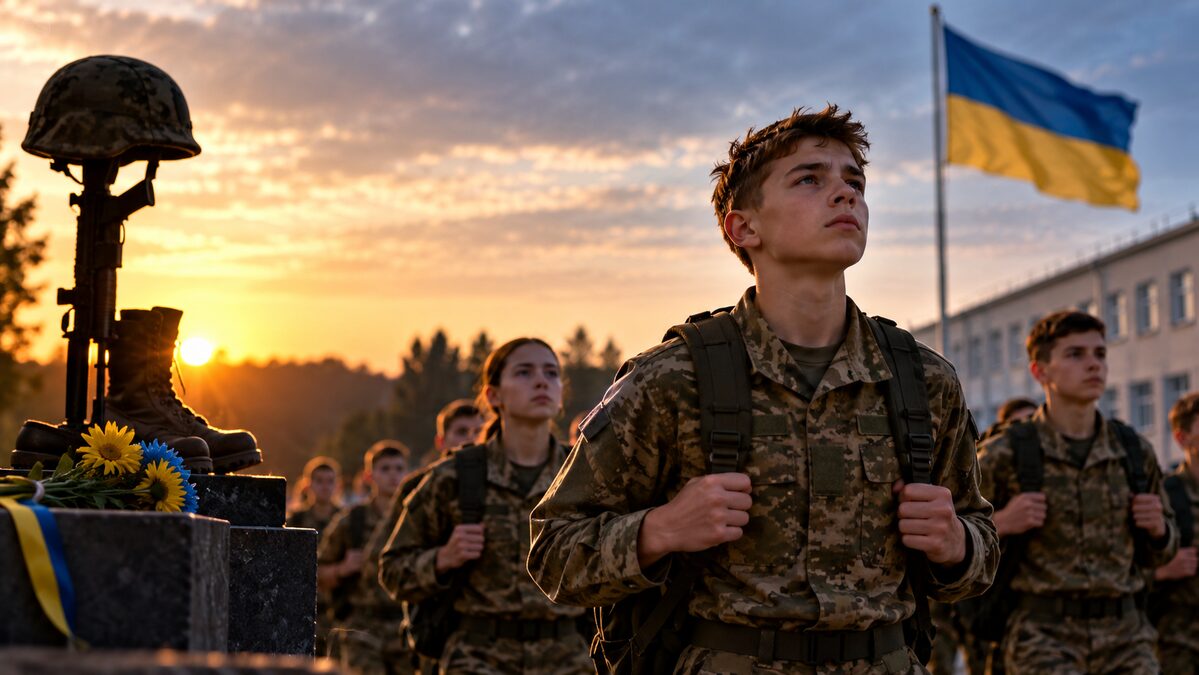
Ukraine is preparing its war orphans for a life in uniform. The pupils are teenagers who have lost parents in the fight against Russia, and The Washington Post revealed the programme on September 27 after gaining rare access to one of five state boarding schools where staff combine grief counselling with the discipline of a boot camp.
The schools illustrate how deeply more than four years of full-scale war have drained Ukraine’s manpower. For Kyiv, they answer a difficult question: who will fight once the fathers are gone.
What Ukraine wants from the schools
Kyiv has three goals. It wants to care for grieving children, keep them in education, and build a pool of future recruits. Ukrainian officials say the army needs about 30,000 recruits a month to hold its strength, and the schools run a two-year course for children of fallen fighters that steers cadets towards the security services, which are struggling to fill their ranks.
Teachers also prepare pupils for university entrance exams in the second year, and every cadet must complete a degree, even those who choose military service. Staff say they put no pressure on the teenagers to enlist, though the arrangement raises the question of how freely a grieving teenager can really choose.
Kyiv has so far resisted American pressure to draft men younger than 25. President Volodymyr Zelensky has argued that lowering the draft age could damage the country’s long-term future. Instead, his government launched one-year contracts for volunteers aged 18 to 24 in February 2025. Recruits receive a one-off payment of one million hryvnias, then worth about $24,000, along with interest-free mortgages, free university study and the right to travel abroad. Contract holders must serve at least six months in combat.
The scale Ukraine’s losses
Ukraine officially counts about 55,000 dead and about 114,000 missing, a toll Zelensky cited in February 2026. Independent estimates run far higher. The Center for Strategic and International Studies put Ukrainian military deaths at 100,000 to 140,000 by December 2025, and total casualties, including wounded and missing, at 500,000 to 600,000. In April, Dutch military intelligence estimated roughly 500,000 permanent Ukrainian losses.
The heaviest burden has fallen on young men, and a marked gap has opened in Ukraine’s population pyramid around age 25. Ukraine has already lost one generation of young men, and experts say two more years of war could claim a second. In the small town of Hoshcha, the hospital recorded only 139 births by late 2025, against more than 400 a year a decade earlier.
Aid groups say the official figures understate how many children have lost a parent. The charity SOS Children’s Villages estimates that the war has orphaned about 2,000 Ukrainian children.
A question the programme raises
Duty has often passed from father to son in military families, but that has traditionally been a choice made by a grown man, not one placed before a child who has not yet finished school. A state that houses, feeds and trains a child holds considerable influence over his future, and the programme has drawn comparisons to how uneasily a similar arrangement would sit elsewhere, such as boot camps for the children of America’s fallen service members.
Diplomacy in the background
The report comes as the Trump administration presses for an end to the war. Special envoy Steve Witkoff and Trump’s son-in-law Jared Kushner visited Russia and Ukraine separately in early September, though the House of Commons Library noted that commentators saw little progress from those talks. Trump nonetheless sounded upbeat after meeting Zelensky at the United Nations on September 22, saying that for both Kyiv and Moscow “it’s to their advantage to make a deal.”
What the programme leaves unresolved
Cadets at the school chant “Glory to Ukraine,” the words their fathers died for. The schools have drawn credit for giving grieving children structure, schooling and a sense of purpose, and criticism for channelling children who have already lost one parent toward the war that killed him. The debate over the programme reflects the wider strain facing Ukraine after nearly four years of war: how to sustain the fight without depleting the generation meant to inherit peace.