
The US Army has ordered its specialist drone battalion in Europe to give up its drones and revert to conventional infantry — less than a year after the unit was created, and just months after Ukrainian drone crews destroyed an entire American armoured brigade in a war game on German soil.
Gen. Christopher LaNeve, the Army’s acting chief of staff, issued the order, according to two US officials who confirmed the decision on August 20. The battalion will complete two exercises in Germany, hand over what it has learned, and then stand down.
The timing has drawn scrutiny. The unit existed specifically to absorb the kind of lessons that Ukrainian crews had just delivered.
Why the Unit Is Being Wound Down
The battalion — formally the 3rd Battalion, 504th Parachute Infantry Regiment — drew roughly 600 paratroopers from the 173rd Airborne Brigade, based in Vicenza, Italy, and Grafenwoehr, Germany. US Army Europe and Africa had established it as a prototype tactical unmanned systems battalion, designed to deploy wherever drone capability was needed.
Following exercises at Hohenfels this month and next, the unit will “refocus on its core warfighting tasks as an airborne infantry battalion,” an Army official said.
The politics behind the decision are hard to ignore. The battalion was a signature project of Gen. Randy George, the former Army chief of staff, whom Defence Secretary Pete Hegseth removed in April without explanation. Gen. Chris Donahue, then commander of US Army Europe and Africa and another champion of the unit, was removed by Hegseth in July.
LaNeve, who replaced George, previously served as Hegseth’s senior military assistant at the Pentagon. Since taking command, he has pushed a back-to-basics agenda. His guidance memo, *Army Azimuth*, released on August 19, argues the next war won’t resemble the last and promises faster adoption of autonomy and artificial intelligence — yet never mentions drones once. It closes by insisting “there are timeless truths in war.”
Michael O’Hanlon, a defence analyst at the Brookings Institution, called the reversal “deeply regretful and dangerous.” Several other analysts echoed similar concerns.
How Ukraine’s Drone Crews Beat an American Brigade
The exercise in question, Combined Resolve 26-07, ran at the Joint Multinational Readiness Center in Hohenfels from April 9 to May 10. Roughly 3,500 American troops took part, most from the 3rd Armored Brigade Combat Team, 1st Cavalry Division, based out of Fort Hood, Texas.
Their objective was straightforward: attack the training centre’s resident enemy force. But that force had reinforcements. Ukrainian operators from the 412th Unmanned Systems Forces regiment, known as Nemesis, joined the defenders — a contingent the Kyiv Post reported at fewer than 20 pilots and technicians. The Americans lost anyway.
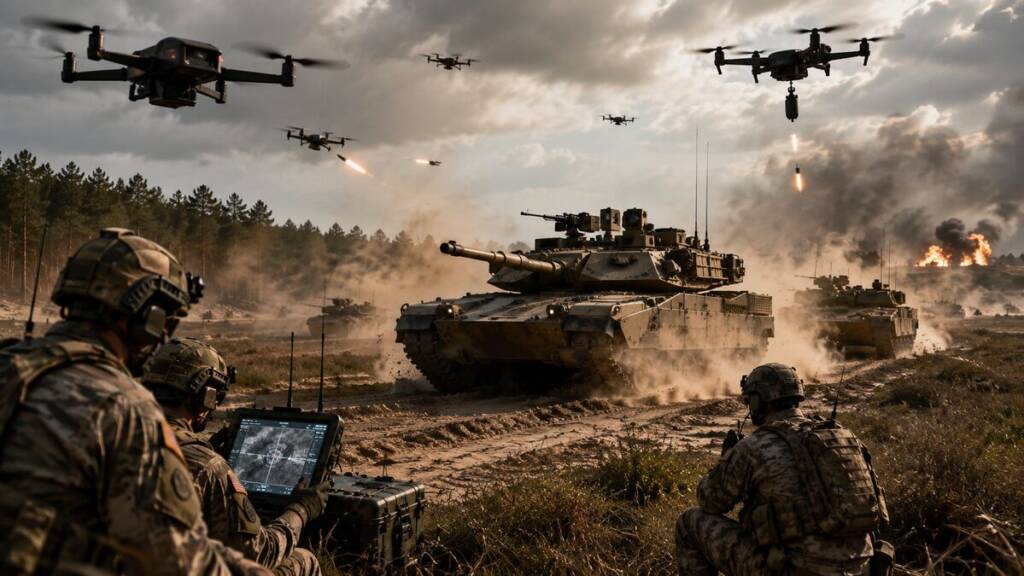
Heavy armour kicked up dust as it advanced across dry ground, and Ukrainian reconnaissance drones spotted the plumes immediately. Munition-dropping drones followed, and first-person-view kamikaze drones finished the job. No live warheads were used — umpires scored a hit whenever a drone flew close enough to its target.
The collapse was rapid. Judges reportedly had to bring “destroyed” American units back into the fight as fresh reinforcements just to keep the exercise running, and US drone operators struggled to troubleshoot and prepare their own aircraft under near-combat conditions.
Performance did improve. Over a two-week rerun, American forces dispersed more effectively, concealed themselves better, and used jamming equipment more skillfully, an Army official told the Journal. Midway through, the Ukrainian operators switched sides to coach the Americans on offensive drone tactics.
This wasn’t an isolated result. Ukrainian crews had already defeated British and Estonian troops at Hedgehog in Estonia in May 2025, and outfought Swedish defenders at Aurora on Gotland in spring 2026. Members of the now-disbanded drone battalion had also rotated quietly through Kyiv to learn directly from Ukrainian units.
What Replaces the Drone Unit
Nothing — at least not in the form of a dedicated unit.
Instead, the Army says drone capability will be distributed across regular formations. The battalion will rejoin a Mobile Brigade Combat Team (Airborne). These leaner brigades emerged from George’s transformation programme. They carry organic drone and counter-drone equipment. Each infantry battalion will gain a multi-purpose company built around an “effects platoon” holding counter-drone systems and loitering munitions.
Army officials note that these newer mobile brigades have performed better against Ukrainian operators than the older armoured brigade did at Hohenfels.
Critics remain unpersuaded. The Army has yet to explain how it intends to accelerate drone learning without the specialised unit built for that exact purpose. A spokesperson said only that the service remains committed to “accelerating American drone dominance.”
The War Keeps Making the Argument
Drones are not a uniquely European problem. During this year’s conflict with Iran, Iranian Shahed drones struck ships and bases. They killed US soldiers and brought down an Army helicopter. American forces then used costly interceptors against comparatively cheap drones.
That is precisely the problem the drone battalion was created to solve. It will now file its final report — and disappear.