
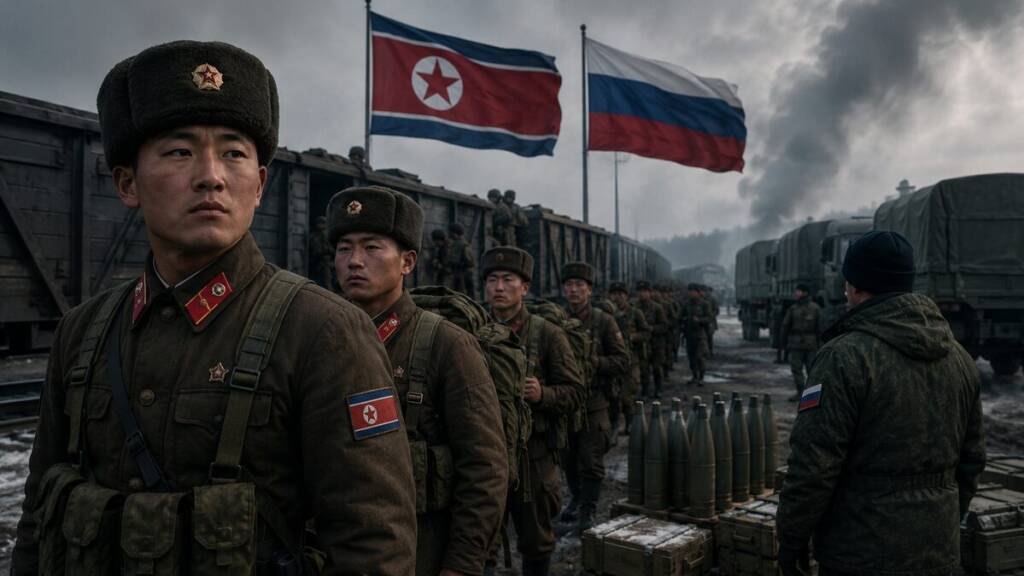
South Korea’s military intelligence says North Korea is continuing preparations for another troop deployment to Russia, but that no movement indicating an imminent dispatch has been detected.
The Defense Intelligence Agency gave that assessment in a report submitted to opposition lawmaker Yu Yong-weon on Sunday, August 23. “North Korea continues preparations for a troop deployment, but no signs have been detected so far that an additional deployment is imminent,” the agency said.
The timing is notable: this is the first time Seoul’s military has publicly addressed the possibility of a second North Korean deployment since the first began in October 2024.
The DIA estimates the North has sent more than 16,000 soldiers since then, many killed or wounded, and has supplied Russia with more than 15 million 152mm artillery-shell equivalents along with short-range ballistic missiles.
Ukrainian President Volodymyr Zelenskyy set off the latest round of speculation in late July, saying Russia wanted 30,000 additional North Korean troops and that Voronezh region facilities were being readied to receive them. Separately, Japan’s Kyodo News reported — citing Ukrainian defense intelligence — that Russia and North Korea were weighing a plan to expand the total deployment to around 50,000 by the end of November, a bigger and later figure than Zelenskyy’s. Kim Yo-jong, sister of leader Kim Jong-un, dismissed the reports last week as “completely groundless.”
A June 2024 mutual defense treaty between Kim and President Vladimir Putin underpins the arrangement. Neither Moscow nor Pyongyang publishes its own figures, and both initially denied any troop or arms transfers at all, so none of these numbers can be independently verified.
Why the Troop Deployment Keeps Growing
Pyongyang is being paid. A March 2026 report from Seoul’s Institute for National Security Strategy estimated North Korea earned between $7.7 billion and $14.4 billion from arms exports and troop deployments between August 2023 and December 2025 — the bulk of it from munitions sales, with direct troop-related income (wages and death compensation) put at roughly $620 million. The report also pointed to technology transfers in drones, loitering munitions, air defense, and naval systems.
Kim gains politically too. Pyongyang has opened a memorial museum for its overseas military operations, and Russia has awarded Order of Courage medals to North Korean soldiers. Russian Defense Minister Andrei Belousov visited Pyongyang in April 2026 and announced a bilateral military cooperation plan covering 2027–31, suggesting both governments now see the relationship as long-term.
Does Russia Need the Manpower?
That depends on who has asked. Ukraine’s Foreign Intelligence Service (SZRU) reported that Russia’s Defense Ministry had recruited about 195,000 contract soldiers by early July 2026 — under half of its stated annual goal of 409,000 — with the daily recruitment rate falling from around 1,200 in 2024 to roughly 1,090 by mid-2026. Multiple Ukrainian and Western analysts, including ISW’s Kateryna Stepanenko, say Russian casualties began outpacing recruitment in late 2025.
Moscow, however, has avoided a formal draft since 2022, relying instead on rising signing bonuses, and Putin has ordered no new mobilization.
Politics of Substituting Foreign Troops
Putin has steered clear of a second mobilization since the one in September 2022 triggered street protests and drove tens of thousands of Russian men abroad. Foreign soldiers carry none of that domestic political cost — North Korean casualties don’t produce Russian funerals or public questions. That’s a plausible incentive, though it isn’t proof of an explicit Russian strategy to substitute North Korean troops for Russian ones.
A Wagner Replacement?
Only partly. Wagner recruited convicts and lost an estimated 20,000 fighters around Bakhmut before collapsing as an independent force after Yevgeny Prigozhin died in 2023. North Korean units have since taken on comparable front-line roles, including assaults, mine clearance and first-wave attacks. Ukrainian and South Korean officials estimate that around 6,000–7,000 North Korean soldiers have become casualties, although these figures vary by source and remain independently unverified.
The key difference: Wagner was a private company; the Korean People’s Army answers to a state. Pyongyang reportedly sent a senior general to command its forces in Russia, underscoring that this is state-to-state military cooperation, not a mercenary arrangement.
What to Watch
Any new deployment will show up in shipping activity from North Korean ports, rail traffic across Russia, and logistics near Voronezh — not in official statements. The DIA also flagged that North Korean missiles used in the war may have improved in accuracy, aided by battlefield data and possible Russian technical support — a development Yu warned could eventually pose a threat back on the Korean peninsula.