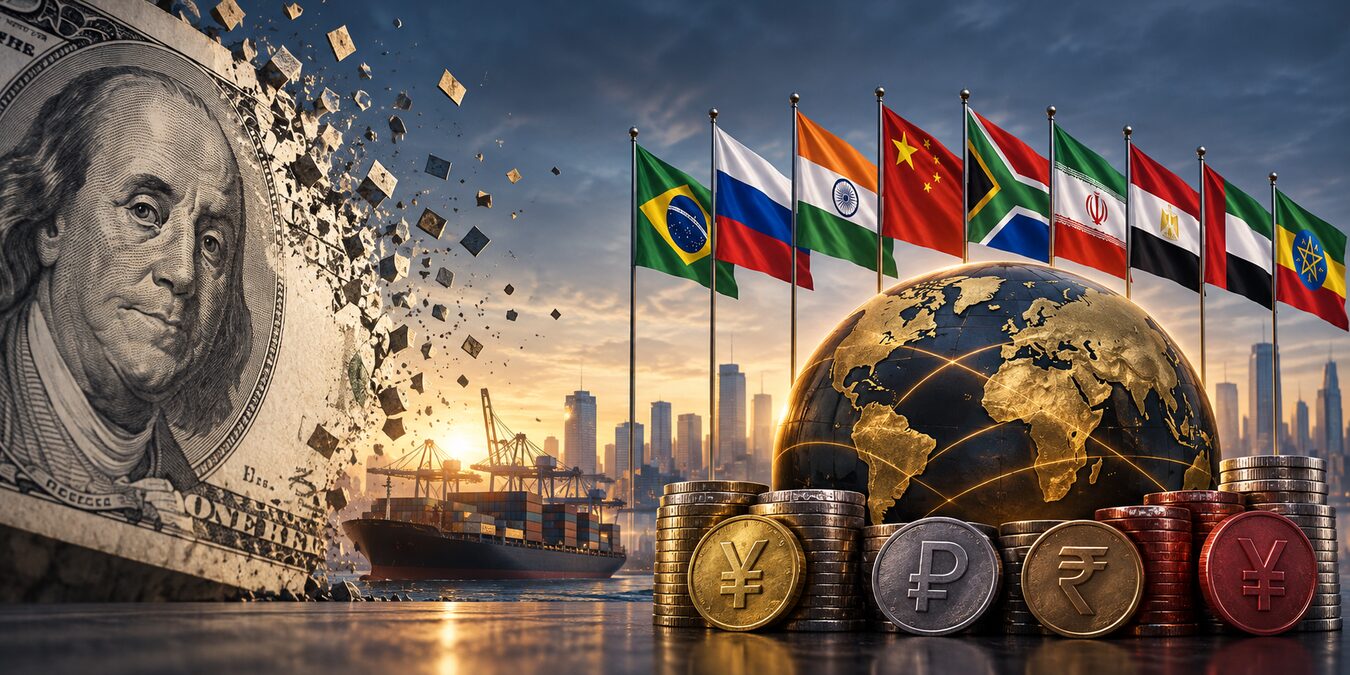
Is the dollar losing its grip on the world economy? The question now dominates global economic debate. BRICS de-dollarisation drives much of that conversation. The bloc has expanded fast. Its members trade more in their own currencies. Headlines announce the end of dollar dominance almost every week. The data tells a different story.
The International Monetary Fund (IMF) tracks what central banks hold. The dollar made up 56.4 percent of global reserves at the end of 2025. That share rose to 57.1 percent in early 2026. BRICS drew its loudest headlines during those same months. Yet the dollar gained ground instead of losing it.
So what is really happening? Does BRICS threaten the dollar? Or does the great escape exist mainly in headlines?
What is BRICS actually doing?
Brazil, Russia, India, China and South Africa founded the group as a loose coalition. Iran, Egypt, Ethiopia, the United Arab Emirates and Indonesia joined later. The expansion gave BRICS serious economic and demographic weight. The bloc now speaks for close to half the world’s population. India holds the chair this year. New Delhi hosted the summit and against all odds in releasing a joint declaration.
De-dollarisation attracts the most attention of any BRICS agenda item. The term means something fairly simple. Members want to cut their dollar dependence in mutual trade. They also want to settle more transactions in national currencies.
Some of this has already happened. Russia and China now settle most bilateral trade in roubles and yuan. Analysts often cite a figure near 90 percent. The exact share matters less than the direction. The dollar plays a far smaller role in that corridor today. India and Russia follow a similar path. Both countries now trade heavily outside the dollar.
BRICS also wants its own payment plumbing. A proposed BRICS payment system would connect national networks directly. Such a link would cut dependence on Western banking infrastructure for cross-border transfers. China’s Cross-Border Interbank Payment System (CIPS) offers one model. India’s Unified Payments Interface (UPI) offers another.
These steps look like the foundation of a major shift. The wider picture complicates that reading.
How far has BRICS de-dollarisation actually gone?
The Bank for International Settlements (BIS) surveys currency markets every three years. Its latest survey placed the dollar on one side of roughly 89 percent of all trades. That number has not fallen. It edged slightly higher than the previous survey.
Central bank reserves tell the same story. The dollar holds more than 57 percent of them. The most recent data shows that share rising.
Now compare the Chinese yuan. BRICS has pushed local-currency trade for years. The yuan still holds under 2 percent of global reserves. That single number explains the real state of BRICS de-dollarisation.
Dollar use inside the bloc may well keep falling. Russia and China may settle nearly everything in roubles and yuan. Other members may build their own local-currency arrangements. None of that ends the dollar’s global role. The dollar still anchors international trade, currency markets and central bank reserves.
Where do India and Russia stand?
India leads within BRICS. New Delhi still treats de-dollarisation with caution. The external affairs minister has ruled out any move against the dollar. India has no policy to replace it as the global reserve currency. Indian officials also acknowledge the dollar’s role in global financial stability.
India therefore backs alternative payment systems and local-currency trade. It does not want to dismantle the existing financial order. That distinction matters more than most commentary allows.
Russia’s position also carries more nuance than social media suggests. President Vladimir Putin says Russia fights no war against the dollar. Western sanctions cut Moscow off from conventional financial channels. That pressure pushed Russia toward alternatives. Distance from the dollar serves Russian necessity, not Russian ideology.
Would a common BRICS currency change the system?
Officials have discussed a shared BRICS currency for years. Some imagined a gold-backed instrument. Others proposed a common unit of account or a settlement mechanism. Talk still runs far ahead of execution.
Proposals such as the “Unit” have circulated widely. Reports mention small pilot exercises. No evidence shows any BRICS currency replacing the dollar at scale. Calling this moment a dollar-killing revolution would be premature.
BRICS is building something narrower but more practical. It wants real options outside the Western financial system.
A reserve currency demands far more than size. A large economy and a large population do not suffice. It needs deep and open financial markets, confidence in the currency itself. It also require political stability, credible institutions and the trust of global investors. Here BRICS faces its hardest test.
The world’s financial system still runs on the dollar. Payments, banking, currency markets, investment and reserves all lean on it. Local-currency trade alone cannot unseat such a deep incumbent. BRICS is not trying to kill the dollar. It is building ways to need it less.
Is the world leaving the American financial system?
Is the world abandoning the dollar overnight? The short answer is no.
However, the change is still real. Several countries settle more trade in national currencies. Russia and China have cut the dollar out of much bilateral commerce. BRICS keeps developing payment systems and financial institutions. Economies under sanctions keep searching for new financial routes.
The dollar meanwhile holds firm. It dominates currency markets. Its share of central bank reserves has risen in the latest data.
Financial diversification describes this shift better than de-dollarisation does. BRICS members want one thing above all. They want to avoid total dependence on a single currency or system.
That ambition still matters. BRICS cannot displace the dollar today. But local-currency trade may keep growing. Payment systems may mature. BRICS institutions may expand. Trust among members may deepen. The picture could then change slowly, without any single dramatic moment.