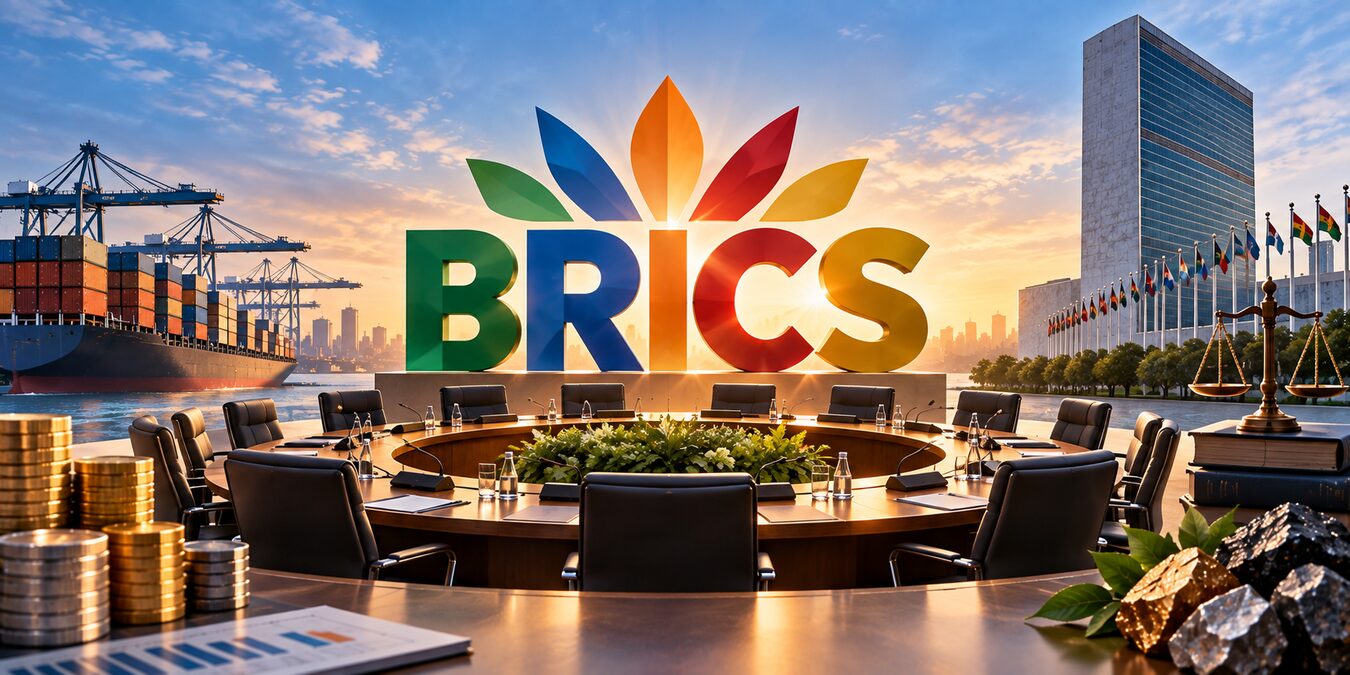
Leaders of the expanded BRICS bloc adopted the New Delhi Declaration at Bharat Mandapam on 12 September, a 140-paragraph text that defends South Africa’s membership of the G20 and raises objections to tariffs, unilateral sanctions and unpaid UN dues without naming any country.
Paragraph 116 marks a departure for the grouping. The leaders described South Africa as a founding country and a full member of the G20 and called any arbitrary revision of that membership inadmissible. Earlier BRICS declarations have not addressed a member’s standing in an institution outside the bloc.
The paragraph follows a dispute between Pretoria and Washington. US President Donald Trump said in November 2025 that South Africa would not be invited to the G20 summit the United States hosts this year. President Cyril Ramaphosa rejected that position, saying his country belongs to the group in its own right.
Trade, UN Funding and the Secretary-General Race
Paragraph 21 records concern that unilateral tariff and non-tariff measures distort trade and fall outside WTO rules. Trump’s tariff campaign against trading partners, several of them BRICS members, may have prompted the language. Trump has separately called the bloc “anti-American” and threatened additional tariffs on countries that align with it.
Paragraph 8 deplores attempts to undermine multilateral institutions, including through “deliberately withholding assessed contributions”. Paragraph 9 notes, during the contest to succeed António Guterres, that no woman has ever been elected UN Secretary-General, that one holder of the post has come from Latin America and the Caribbean, and that Africa and Asia have supplied two each.
Across 45 pages, the declaration names neither the United States nor Trump.
West Asia and Gaza
Members reached agreement after three foreign ministers’ meetings, in September 2024, April 2025 and New Delhi in May this year, ended without a joint statement. Iran and the United Arab Emirates sit on opposing sides of the regional conflict.
Paragraph 28 calls for restraint and for the protection of civilians while recalling members’ respective national positions. Paragraph 29 condemns attacks on nuclear facilities under IAEA safeguards without identifying who carried them out. On Gaza, the leaders took note of Security Council Resolution 2803, cautioned against arrangements that might prejudice Palestinian rights or prolong occupation, and opposed forced displacement from the Strip. Several paragraphs name Israel.
Payments and the Dollar
Paragraph 90 asks the BRICS Payment Task Force to continue studying cross-border payment and messaging channels, and states that there is “no one-size-fits-all approach”. The text does not propose a common currency. Trump has threatened 100 per cent tariffs on members that pursue an alternative to the dollar.
However, the drafting seems very conscious as de-dollarisation and central bank digital currencies do not appear, the $100 billion Contingent Reserve Arrangement receives a ninth test run after a decade without a drawdown, and that the New Development Bank is encouraged to expand local-currency lending without a target or a date.
Critical Minerals and the Security Council
Paragraph 20 acknowledges China for extending zero-tariff treatment to 53 African countries. Paragraph 67 affirms sovereign rights over critical minerals and the right to enforce public-policy measures. Both provisions serve Beijing’s position more than New Delhi’s, given Indian exposure to Chinese export controls.
China and Russia again supported the aspirations of Brazil and India to play a larger role in the UN, including the Security Council. This wording has changed little since the Ufa summit of 2015, and distinguishes an aspiration from an endorsement. South Africa, absent from that paragraph in the 2025 Rio text, remains absent.
Other Outcomes
Prime Minister Narendra Modi called the grouping’s twentieth year a “coming of age”, which described the summit as evidence of India’s ability to build consensus among members with competing interests.
Sarang Shidore, director of the Global South programme at the Quincy Institute, said that BRICS functions as a “pragmatic club for limited purposes”, focused on development, trade and institutional reform rather than opposition to the United States.
India ran more than 400 meetings across 30 cities during its chairship. The declaration condemned the Pahalgam attack of 22 April 2025, in which 26 people died, opposed carbon border taxes and backed WTO accession for Ethiopia and Iran. The bloc has 11 members following Indonesia’s entry in January 2025, although Saudi Arabia has not formally confirmed its membership.
India has handed the chairship to China, which hosts the 19th summit in 2027.